

When assembling your camping kit, tent stakes are rarely the most glamorous purchase. You are much more likely to obsess over the denier of your rainfly or the fill power of your sleeping bag. However, when a midnight squall rolls through your campsite, your entire shelter relies on a few inches of metal buried in the dirt.
At besttentstakes.com, we frequently receive the same question from both beginners and seasoned backpackers: Are titanium tent stakes actually worth the premium price tag?
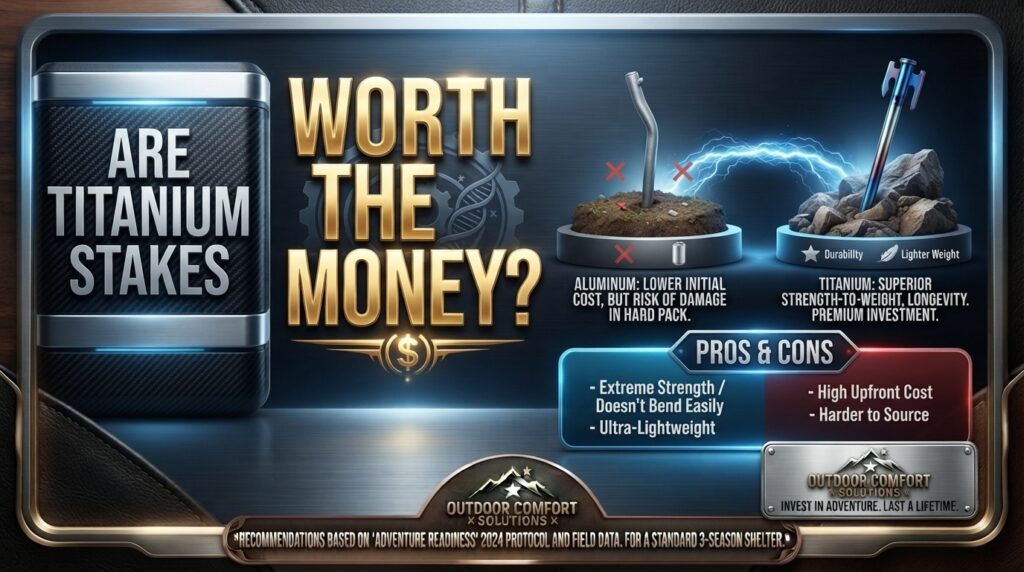
The short answer is yes, for the right camper in the right conditions. Titanium stakes offer an incredible strength-to-weight ratio, high durability against rocky impacts, and absolute corrosion resistance. However, they are not a magic bullet for every single soil type.
In this comprehensive guide, we will break down the metallurgy, analyze how titanium performs across diverse US regions—from the granite of California to the damp forests of Washington—and help you determine if they belong in your gear cache.
The Science of Tent Stakes: Titanium vs. Aluminum vs. Carbon Fiber
Before deciding if the high cost of titanium is justified, it is critical to understand how it stacks up against competing materials.
The Material Showdown
| Material | Pros | Cons | Best Use Case |
| Titanium | Extremely strong, lightweight, handles rock impacts well, highly corrosion-resistant. | Expensive, “ultralight” wire versions can bend in dense soil. | Rocky terrain, ultralight thru-hiking, extreme weather. |
| Aluminum (e.g., 7075-T6) | Inexpensive, lightweight, excellent surface area for the weight. | Heads can deform or snap when hammered with rocks; lower durability. | Budget backpacking, general forest soil, weekend camping. |
| Carbon Fiber | The absolute lightest option available. | Highly expensive, prone to shattering if hammered. | Soft soil, extreme ounce-counting where hammering isn’t needed. |
| Steel | Very cheap, exceptional holding power. | Incredibly heavy, prone to rusting. | Permanent campsites, large family car-camping tents. |
The Physics of Bending and Buckling
To understand why titanium is prized, we have to look at the engineering of a tent stake being driven into hard ground. When you strike a stake with a rock, you are applying an axial load. The stake’s resistance to bending (buckling) can be modeled using Euler’s critical load formula:
$$P_{cr} = \frac{\pi^2 EI}{(KL)^2}$$
Where:
- $P_{cr}$ is the critical buckling load.
- $E$ is the elastic modulus (material stiffness).
- $I$ is the area moment of inertia (cross-sectional shape/thickness).
- $L$ is the length of the stake.
- $K$ is the column effective length factor.
Mathematically, a high-quality 7075-T6 aluminum stake actually has a higher elastic modulus relative to its diameter than titanium, meaning it can technically resist buckling better under a perfectly straight, laboratory-grade impact.
So why do aluminum stakes break while titanium stakes survive?
The answer is ductility and stress concentration. When you are in the backcountry using a jagged rock as a hammer, you are rarely striking the stake perfectly straight. The jagged impacts cause microscopic deformations (stress concentrations) on the head of the aluminum stake. Aluminum is brittle under this specific type of stress, causing the head to snap off. Titanium, however, is incredibly resilient to this sheer, jagged impact. You can pound a titanium nail peg into a hidden subterranean boulder, and instead of snapping, it will simply stop dead.
Regional Performance: Where Does Titanium Shine?
A tent stake is only as good as the soil it is driven into. Holding power increases non-linearly with embedment depth and directly with the stake’s surface area. Here is how titanium stakes handle the diverse terrains across five major camping hubs.
1. California (The Sierra Nevada & Granite Terrain)
- The Challenge: Backpacking in California often means pitching your tent above the treeline on thin dirt covering solid granite bedrock, or in incredibly hard-packed rocky soil.
- The Verdict: Titanium is essential here. Aluminum Y-stakes will bend and snap when forced into this terrain. A Titanium Nail Peg is practically indestructible and can be driven between rocks without deforming.
2. Texas (Hard-Packed Clay and Arid Plains)
- The Challenge: Texas summers bake the clay and dirt into a concrete-like crust.
- The Verdict: Worth the money. You need a stake that can be aggressively hammered into unyielding ground. Titanium nail pegs or thicker titanium V-stakes will penetrate the hardpan where plastic or cheap aluminum will buckle.
3. New York (The Adirondacks & Dense Forests)
- The Challenge: Forest floors are a mix of soft loam, dense tree roots, and hidden stones.
- The Verdict: Highly recommended, specifically the Titanium Shepherd’s Hook. A thin titanium hook has a slim profile that easily slots between dense tree roots where wider Y-shaped stakes refuse to go.
4. Washington (The Cascades & Damp Loam)
- The Challenge: The Pacific Northwest is famous for wet, loose, and soft soil. In these conditions, thin titanium nail pegs or wire hooks will simply slice through the mud and pull out under wind tension.
- The Verdict: Only worth it if you buy the right shape. You need surface area to create friction in wet soil. A wide Titanium Y-Stake or a Titanium V-Stake is required here to provide enough drag to anchor your rainfly.
5. San Francisco (Coastal Sand and High Wind)
- The Challenge: Pitching on loose beach sand or coastal dunes with high ocean gusts.
- The Verdict: Standard titanium stakes will fail here. However, specialized wide-bodied Titanium Ascent stakes (designed for sand and snow) perform beautifully, as they provide massive surface area while remaining ultralight.
Actionable Tips for Using Titanium Stakes
To protect your investment and ensure your shelter stays grounded, follow these expert staking tips:
- The 90-Degree Rule: Always drive your stake into the ground so that the angle between the guy-line and the stake is exactly 90 degrees. This leverages maximum friction against the soil.
- Paint Your Stakes: Titanium’s natural matte grey color makes it practically invisible in the dirt. To avoid losing a $5 stake, spray the heads with fluorescent orange paint, or tie a loop of high-visibility reflective paracord to the notch.
- Hammer Straight Down: If you are using a rock to pound a titanium stake into frozen or rock-solid earth, ensure your strikes are directly vertical. Striking the side of the stake can cause a permanent bend, even in titanium.
- The “Pilot Hole” Technique: If you are using ultralight, thin titanium shepherd’s hooks, do not pound them with a rock. If the ground is too hard to push them in by hand or foot, use a single heavy-duty titanium nail peg to pound a “pilot hole,” remove it, and slide your lightweight hook into the resulting hole.
10 Frequently Asked Questions (FAQ)
1. Are titanium stakes actually indestructible?
No material is entirely indestructible, but titanium comes incredibly close. Thick titanium nail pegs can be hammered into frozen ground or rocky soil without snapping. However, if you purchase “ultralight” titanium wire hooks and strike them off-axis with a heavy rock, they will bend.
2. How much lighter is titanium compared to aluminum?
It depends on the stake’s thickness, but generally, titanium allows for a thinner stake with equal or greater strength. For example, a high-quality titanium shepherd’s hook can weigh as little as 6 to 8 grams, saving precious ounces for thru-hikers.
3. Do titanium tent stakes rust?
No. Titanium is highly resistant to rust and corrosion, making it an excellent long-term investment, especially if you camp in damp environments or coastal, saltwater areas.
4. What is the best shape for a titanium stake?
The shape dictates the function. Nail pegs are best for hard, rocky ground; Shepherd’s hooks are ideal for slotting between forest roots; and V-stakes or Y-stakes provide the necessary surface area for loose, sandy, or wet soil.
5. Why do my titanium stakes keep pulling out of the ground?
You are likely using a thin profile (like a nail or wire hook) in soil that is too soft. Holding power relies on friction, which requires surface area. If the ground is loose, you need to switch to a wider V-shape or Y-shape stake.
6. Can I use titanium stakes in the snow?
Yes! Titanium is actually preferred by many winter campers because the metal bonds less tightly to frozen snow and ice than aluminum does, making them much easier to extract on freezing mornings.
7. How do I remove a stubbornly stuck titanium stake?
Never pull directly on your tent’s guy-line, as you risk tearing the fabric. Instead, take a spare stake, hook it through the pull-cord or under the notch of the stuck stake, and pull directly upward.
8. Are carbon fiber stakes better than titanium?
Carbon fiber stakes are lighter, but they have a fatal flaw: they shatter easily upon impact. If you need to use a rock to hammer your stakes into the ground, titanium is vastly superior.
9. Why are titanium stakes so expensive?
The raw material cost of titanium is higher than aluminum or steel, and the metal is notoriously difficult to machine and shape, which drives up the manufacturing costs.
10. I am a beginner on a budget; should I buy titanium?
If you are completely new to camping, a quality set of 7075-T6 aluminum Y-stakes will serve you perfectly well at a fraction of the cost. Upgrade to titanium only when you start camping in extreme, rocky terrains, or when you begin serious ultralight backpacking where every ounce counts.
Conclusion: The Final Verdict
So, are titanium stakes worth the money?
If you are a casual weekend camper pitching a family tent in a manicured state park, standard aluminum or steel stakes will do the job perfectly well.
However, if you are an ultralight backpacker counting grams on a thru-hike, or an adventurer frequently battling the granite of California, the hard clay of Texas, or frozen winter soil, titanium stakes are absolutely worth the investment. They eliminate the frustration of bending cheap pegs, they do not rust, and they provide unmatched durability against blunt force impacts. By matching the right stake profile—be it a nail, hook, or V-shape—to your specific terrain, a premium set of titanium stakes could easily be the last set you ever need to buy.