

For any beginner camper, the sound of a flapping tent wall in the middle of a windy night is a rite of passage—one you would likely prefer to avoid. Whether you are planning a trip to the rugged coastlines of Washington, the high-altitude terrain of the Sierra Nevada in California, the dense forests of New York, or the arid plains of Texas, your tent is your sanctuary. And that sanctuary is only as secure as the stakes holding it down.
But how many stakes are actually enough? And why do you need spares? This guide covers everything you need to know about tent stakes, from quantity to material, ensuring you never have to scramble in the dark.
The Rule of Thumb: How Many Stakes Do You Need?
Most modern tents arrive with a standard set of stakes, typically ranging from 8 to 11 units. This number is usually sufficient for a “fair weather” setup where you stake out the four corners and the primary vestibule points.
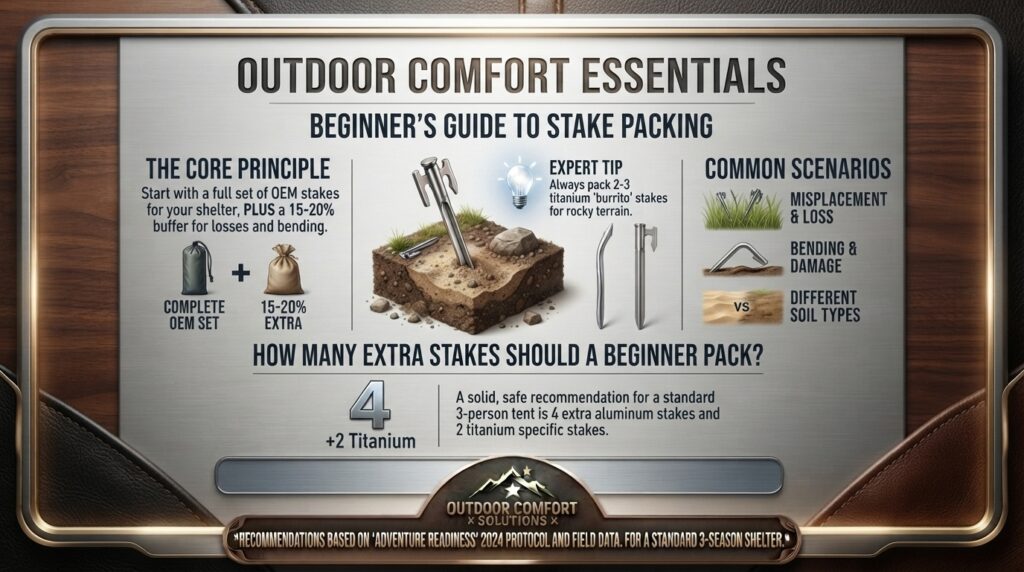
However, the “Beginner’s Baseline” is simple: Always carry 2 to 4 extra stakes beyond the manufacturer’s recommendation.
Why You Need Extras
- Loss and Damage: It is incredibly common to lose a stake in tall grass or for one to bend when hitting a hidden rock in hard-packed soil.
- Unforeseen Conditions: You may arrive at your site only to find the ground is soft, sandy, or unexpectedly rocky, requiring different anchoring strategies or “double staking”.
- High Winds: In exposed areas—like a windy ridge in California or an open field in Texas—you may need to use every single guy-line point on your rainfly to keep your tent stable.
Understanding Your Terrain: A State-by-State Perspective
Different regions present unique challenges. Here is how your geography dictates your staking needs:
| Region | Typical Soil/Terrain | Recommended Stake Type |
| Texas | Hard-packed, clay, or sandy | V-stakes or long heavy-duty stakes |
| New York | Forest floor, roots, moderate soil | Y-stakes or standard aluminum pins |
| California | Rocky, granite, or loose dirt | Needle/Nail stakes for rocks; Y-stakes for dirt |
| Washington | Soft, damp, or loose forest soil | Longer “tube” stakes for surface area |
| San Francisco (Coastal) | Sand, high wind | Specialized snow/sand stakes |
Choosing the Right Material for Your Stakes
Not all stakes are created equal. As a beginner, understanding your materials will save you from frustration.
- Aluminum: The “Goldilocks” option. They are lightweight, relatively inexpensive, and versatile enough for most soil types.
- Titanium: The ultralight choice. These are incredibly strong but come at a higher price point.
- Steel: Often included with entry-level tents. They are heavy and durable but prone to rusting.
- Plastic: Best for soft or sandy ground. They are affordable but can snap in frozen or rocky earth.
Pro Tips for Securing Your Tent
Even the most expensive stakes will fail if installed incorrectly. Follow these expert tips:
1. The 90-Degree Rule
Drive your stake into the ground at an angle pointing away from the tent. The optimal angle between the guy-line and the stake is 90 degrees. This provides maximum leverage against the wind.
2. The “Double Stake” Technique
If you are expecting severe weather and your primary stake isn’t holding, use the double staking method. Drive a second stake into the ground behind your primary one and tie the guy-line to both, creating a redundant anchor.
3. Use Rocks for Reinforcement
If the ground is too hard to drive a stake fully, or too loose to hold one, place a large, heavy rock over the head of the stake. This adds significant downward force and prevents “pull-out”.
4. Visibility Matters
Always choose stakes with bright-colored heads or reflective pull-loops. This prevents you from tripping over them in the dark and makes them much harder to lose when packing up your campsite.
10 Frequently Asked Questions (FAQ)
1. Can I use sticks instead of stakes?
In an emergency, you can carve stakes from wood, but they rarely provide the same security as manufactured metal or plastic stakes.
2. Should I replace my tent’s stock stakes?
Not immediately. Test them on a few trips. If you find they bend easily, upgrade to Y-stakes or V-stakes.
3. What if I’m camping on sand?
Standard stakes will pull right out. Invest in wide, curved “sand stakes” that provide maximum surface area.
4. How do I remove stubborn stakes?
Use another stake to hook the loop or notch to pull upwards. Avoid yanking on the guy-line itself, as this can damage the tent fabric.
5. What is the difference between Y-stakes and V-stakes?
Y-stakes generally offer more surface area and are slightly more resistant to bending than V-stakes, making them the “all-rounder” champion.
6. Do I really need to use all the guy-lines?
On a calm night, no. In any chance of wind or rain? Absolutely. Using all points keeps the rainfly tight, preventing fabric from flapping and moisture from leaking.
7. Why do my stakes keep bending?
You might be hitting hidden rocks. If you encounter resistance, don’t force it—move the stake a few inches to the left or right.
8. Are titanium stakes worth the money?
If you are counting every ounce for long-distance backpacking, yes. For weekend car camping, aluminum is perfectly fine.
9. Can I use a hammer to drive stakes?
A rubber mallet is great for firm soil, but a large rock is often all you need. Be careful with metal hammers, as they can shatter plastic stakes or severely damage the heads of thin metal ones.
10. How do I clean my stakes?
Wipe off excess dirt and mud before packing them. If they are metal, ensure they are dry to prevent corrosion.
Conclusion
Packing an extra handful of stakes is one of the most underrated habits of a prepared camper. By bringing a few spares and understanding the specific needs of the terrain you are visiting—whether it’s the rocky soil of California or the damp earth of Washington—you ensure your tent stays grounded, no matter what Mother Nature throws your way.
Now that you know your gear, it’s time to get outside. Check out our latest collection of high-performance stakes at besttentstakes.com and head out on your next adventure with total confidence.