

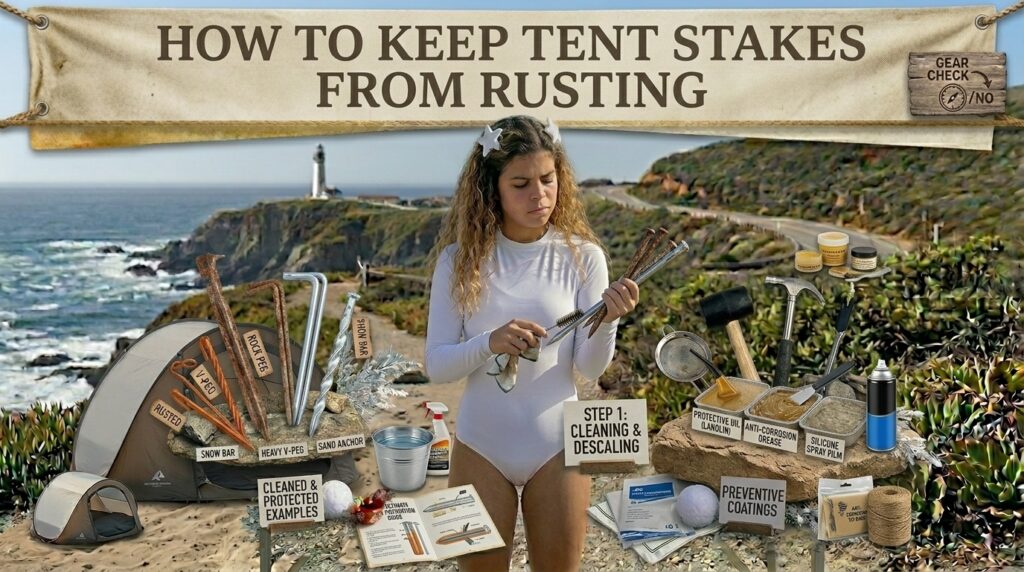
How to keep tent stakes from rusting: The Metallurgy and Corrosion Prevention Guide. Chemical Oxidation Vectors, Material Science Inhibitors, and Field Maintenance for Outdoor Anchors
For most campers, tent maintenance stops at drying out the rainfly and shaking dirt off the tent floor. However, the gear that bears the highest physical strain—the tent stake—is routinely packed away wet, caked in mud, and exposed to highly reactive soil chemistries.
Over a short period, this neglect leads to chemical oxidation. For steel and iron-based alloys, this results in standard red rust ($Fe_2O_3 \cdot nH_2O$), which physically eats away the metal. For aluminum and titanium anchors, it creates more subtle forms of galvanic and pitting corrosion that weaken structural integrity without showing bright discoloration.
       The Oxidation Loop (Storage Failure):
       [Trapped Moisture + Soil Acid/Salt] ──► Breaks Protective Oxide Layer ──► Continuous Pitting ──► Metal Structural Failure

       The Preservation Loop (Active Defense):
       [Mechanical Cleanse] ──► Chemical De-Moisturization ──► Hydrophobic Barrier Coating ──► Indefinite Storage Life
A corroded tent stake doesn’t just look bad; its structural integrity is compromised. Rust creates microscopic pits along the shaft, dramatically reducing its shear strength and weight capacity. The next time your guy lines pull hard during a high-wind storm, a weakened stake can easily snap or bend out of shape.
This definitive guide breaks down the science behind tent stake corrosion, details the precise chemical behaviors of different metals, offers a dynamic preservation simulator, and outlines a step-by-step process to keep your stakes in pristine condition for years to come.
SECTION 1: REGIONAL ENVIRONMENT & REACTION VECTORS
The speed and severity of tent stake corrosion are directly tied to the soil compositions, relative humidity, and air salinity of your specific regional camping market:
| Target Regional Market | Local Air & Soil Profile | Primary Oxidation Threat Vector | Targeted Preservation Regimen |
| Florida / Gulf Coast (Miami, Everglades, Keys) | High atmospheric humidity, intense sea spray, and alkaline limestone sand. | Atmospheric Chloride Acceleration: Salt ions act as a powerful catalyst, rapidly destroying protective zinc coatings on steel. | Marine-grade hydrophobic barriers (such as silicone or dry-film lubricants) applied after every trip. |
| Washington / Pacific PNW (Olympic Peninsula, Cascades) | High rain totals, acidic volcanic topsoils, and damp forest loam. | Acidic Leaching: Saturated, low-pH forest soils strip away protective anodized finishes, causing pitting corrosion on aluminum. | Deep chemical neutral washes followed by long-term dry storage cycles. |
| California / Pacific Coast (San Francisco, Big Sur, San Diego) | Heavy morning coastal fog, high-salinity air, and sandy soils. | Galvanic Salt-Bridge Bonding: Moisture from coastal fog combines with salt to accelerate corrosion where different metals touch. | Complete material isolation; avoid using steel mallets directly on aluminum stakes without a protective buffer. |
| Texas / Gulf Suburbs (Houston, Corpus Christi) | High heat, high coastal humidity, and heavy clay soils. | Crevice Oxygen Depletion: Heavy clay holds damp mud against the stake surface, creating low-oxygen pockets that trigger localized corrosion. | Stiff mechanical brushing to remove all packed clay before storing gear. |
| New York / Northeast (Adirondacks, Catskills) | Wet, changing seasons, high road-salt runoff near roadside sites, and rocky soil. | Mechanical Micro-Fracturing: Rocky soil scratches away protective paints and powders, leaving bare metal exposed to damp air. | Periodic clear-coat sealing over scratched areas to restore the metal’s protective barrier. |
SECTION 2: THE METALLURGICAL CHEMISTRY OF CORROSION – How to keep tent stakes from rusting
To properly care for your gear, it helps to understand the distinct chemical processes that occur when different metals are exposed to oxygen and water.
1. Ferrous Alloys (Forged Steel and Carbon Steel)
Carbon steel stakes offer exceptional structural strength, but they lack natural resistance to oxidation. When bare iron ($Fe$) comes into contact with water ($H_2O$) and oxygen ($O_2$), an electrochemical reaction begins:
$$4Fe + 3O_2 + 2nH_2O \rightarrow 2Fe_2O_3 \cdot nH_2O$$
The resulting hydrated iron(III) oxide is highly porous. Unlike the oxidation layers on other metals, rust doesn’t form a tight seal on steel. Instead, it continuously flakes away, exposing fresh layers of bare metal to the air until the stake is completely eaten through.
2. Aluminum Alloys (7000 and 6000-Series Aircraft Aluminum)
Aluminum stakes do not rust in the traditional sense. When aluminum is exposed to air, it instantly forms a microscopically thin layer of aluminum oxide ($Al_2O_3$) that naturally seals the metal against further corrosion.
However, when aluminum stakes are packed away wet in low-oxygen environments (such as wrapped tightly inside a muddy plastic bag), they experience pitting corrosion. Acidic soils or salt ions break down localized areas of the protective oxide layer, creating tiny, pinhole-sized pits that can hide underneath white aluminum oxide powder.
3. Titanium Alloys (Grade 5 Ti-6Al-4V)
Titanium sits at the top of the galvanic scale. It forms a highly resilient, self-healing titanium dioxide ($TiO_2$) protective film that is virtually immune to raw atmospheric rust, saltwater corrosion, and most organic acids. While titanium stakes require very little maintenance, they can still suffer from surface tarnishing if exposed to high chemical concentrations over long periods.
SECTION 3: THE CORROSION INTEGRITY & MATERIAL SIMULATOR
To help outdoor enthusiasts understand how their cleaning habits, choice of stake materials, and local storage environments affect the lifespan of their gear, use this technical simulator:
SECTION 4: THE STEP-BY-STEP PITCH-TO-STORAGE MAINTENANCE REGIMEN
To prevent pitting and rust from destroying your gear investment, use this simple three-phase maintenance routine after every trip:
1.Mechanical Soil Scraping and Air Drying:Timeframe: Before Leaving the Campsite.
Never pull stakes out of the ground and throw them directly into your gear pack. Use a dedicated cleaning tool or a piece of wood to scrape away heavy mud and clay clumps. Give the stakes a quick wipe down with an old towel and let them air dry on a camp table while you finish packing up the rest of your shelter.
2.Deep Chemical Cleanse and Neutralization:Timeframe: Within 48 Hours of Returning Home.
Fill a small bucket with warm water and a few drops of mild, pH-neutral dish soap. Use a stiff-bristled nylon brush to scrub away any remaining dirt or salt residues from the corners and crevices of your stakes. For gear used in highly acidic soils or coastal salt sand, rinse them in a light baking soda solution (one tablespoon per quart of water) to neutralize lingering acids or salt ions, then dry completely with a clean cloth.
3.Hydrophobic Protection and Environmental Isolation:Timeframe: Prior to Seasonal Storage.
Once the stakes are completely dry, apply a thin layer of a high-quality dry-film lubricant, silicone spray, or mineral oil to the metal surfaces. Avoid heavy oils that stay sticky, as they will attract dirt and grit during your next trip. Store the treated stakes inside a breathable canvas or mesh bag rather than an airtight plastic container, which can trap ambient moisture and cause condensation.
SECTION 5: ADVANCED CORROSION TREATMENT AND REMEDIATION
If your stakes have already begun to rust or oxidize, you can easily restore them using standard chemical and mechanical methods:
- The White Vinegar Bath (For Steel Stakes): Submerge rusted steel stakes in a container of pure white vinegar (acetic acid) for 12 to 24 hours. The acid reacts with the iron oxide, dissolving the rust shell. Remove the stakes and scrub away any loose particles with a brass wire brush or steel wool.
- The Baking Soda Scrub (For Delicate Geometries): Mix baking soda with water to form a thick paste. Apply the paste to oxidized areas and let it sit for an hour, then scrub with an abrasive pad. This gentle method is ideal for cleaning around the hooks, notches, and eyelets of aluminum stakes without scratching the surrounding metal.
- The Neutralization Rinse: After any acid treatment, you must neutralize the metal to stop the chemical reaction. Rinse the stakes thoroughly in clean water mixed with a small amount of household baking soda, dry completely with a heat source (like a hair dryer), and apply a fresh protective coating immediately.
SECTION 6: THE GROUND TRUTH — GOOGLE FEATURED SNIPPETS FAQ
1. Do aluminum tent stakes rust over time?
Aluminum stakes cannot develop traditional red rust because they contain no iron. However, they can experience pitting corrosion and form a white, powdery aluminum oxide coating if they are packed away wet and dirty in airtight storage containers.
2. Can you use WD-40 to protect tent stakes from rusting?
Yes, WD-40 is an effective short-term moisture displacer and rust preventative. However, because it leaves behind a thin, wet oil film, it can attract sand, dirt, and grit at the campsite. For a cleaner finish, many campers prefer a dry-film Teflon or silicone spray.
3. Are titanium tent stakes completely rust-proof?
Yes, grade-5 titanium is naturally rust-proof under normal outdoor conditions. It instantly forms a self-healing titanium dioxide layer that easily handles saltwater, high humidity, and acidic forest soils without degrading.
4. Why did my galvanized steel stakes start rusting after a few uses?
Galvanized steel stakes are coated in a thin layer of protective zinc. Over time, hammering them into hard, rocky soil scratches away this zinc layer, leaving the bare steel underneath completely exposed to moisture and air.
5. How can I safely remove red rust from steel tent stakes?
Soak your rusted steel stakes in pure white vinegar for 12 to 24 hours to loosen the rust scale. Use a stiff wire brush to scrub away the loose debris, rinse the stakes in clean water mixed with baking soda to neutralize the acid, and dry them thoroughly.
6. Does salt water make tent stakes corrode faster?
Yes, salt water and coastal air contain high concentrations of chloride ions. These ions turn moisture into a highly effective electrolyte that rapidly accelerates the corrosion process for both steel and aluminum gear.
7. Should I oil my tent stakes before storing them for the winter?
Yes, applying a light coating of mineral oil, silicone spray, or a dry lubricant before long-term storage forms a protective barrier that seals out ambient moisture and prevents oxidation.
8. Is it safe to store tent stakes inside my main tent bag?
No, it is best to avoid storing stakes in your main tent bag. Dirty or rusted stakes can easily transfer stains to your tent fabric, and sharp metal edges can puncture or tear thin rainfly materials during transport. Always store your stakes in a separate, dedicated storage pouch.
9. What is the difference between red rust and white rust?
Red rust is the breakdown of iron and steel exposed to oxygen and water. White rust is a powdery zinc oxide residue that forms on galvanized steel or aluminum when moisture gets trapped on the surface without adequate air circulation.
10. Can I paint my tent stakes to protect them from corrosion?
Yes, painting your stakes with a high-durability enamel or rubberized coating can help prevent rust. It also makes them much easier to spot in grass or dirt. Keep in mind that rough, rocky soils will eventually chip the paint away, requiring occasional touch-ups.
The Strategic Value of Corrosion Maintenance
At its core, preventing tent stake corrosion is not just about keeping your gear looking clean—it is a critical practice for maintaining structural safety in the field. When a stake oxidizes, whether it develops the visible red flakes of iron oxide on carbon steel or the hidden micro-pits of aluminum degradation, it loses its structural strength. A compromised anchor is far more likely to bend, snap, or pull loose when subjected to the intense mechanical stress of high-wind gusts or sudden changes in soil tension.
By implementing a few simple, proactive habits, you can protect your gear investment and ensure your shelter remains reliably anchored:
- Incorporate field care into your teardown routine: Take a few moments to brush away heavy mud and let your stakes air-dry before packing them away. This simple step goes a long way toward preventing long-term corrosion.
- Perform a thorough cleanup after your trip: Giving your stakes a quick wash and applying a thin layer of dry-film lubricant before putting them into seasonal storage keeps moisture from attacking the raw metal surfaces.
By treating your stakes with the same care and attention as your tent canopy or sleeping bag, you can extend the lifespan of your equipment and head out into the backcountry with total confidence in your shelter’s stability.