

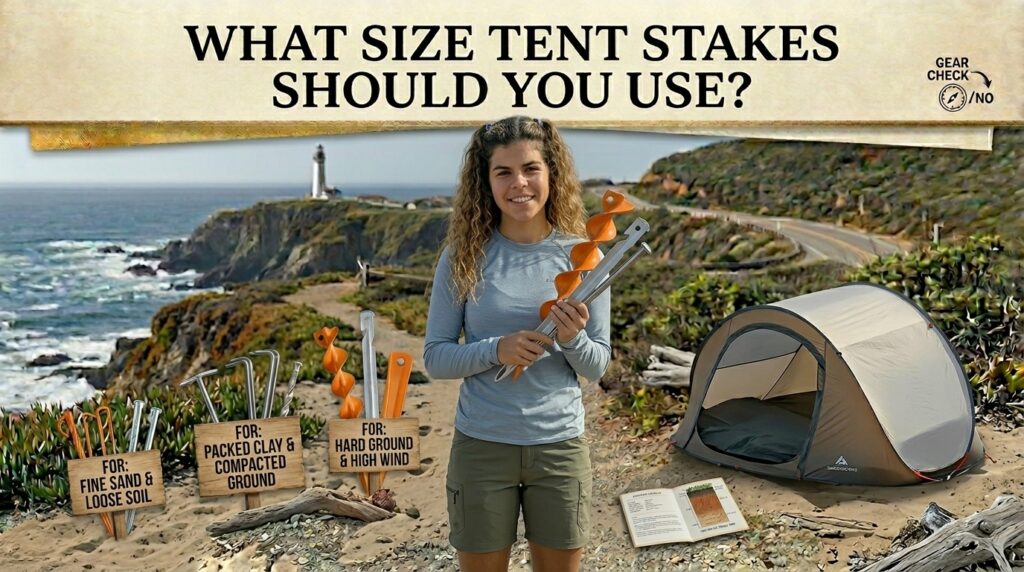
What Size Tent Stakes Should You Use? The Engineering and Soil Physics Guide to Secure Pitching. Holding Power Calculations, Soil Mechanical Profiles, and Mechanical Stress Vectors for Modern Shelters
When planning an outdoor expedition, backpackers and campers spend hours analyzing the water-column ratings of their rainflies, the fill power of their sleeping bags, and the structural geometry of their tent poles. Yet, the entire structural integrity of an outdoor shelter relies on a component that is often treated as an afterthought: the tent stake.
                [THE CAMPING SHELTER KINETIC SYSTEM]

    Aerodynamic Wind Vectors (Force) ──► Aerodynamic Sail (Tent Canopy)
                                                   │
                                                   ▼
       Hardened Mechanical Ground Anchorage ◄── Tension Lines (Guy Lines)
An electric or traditional tent is an aerodynamic sail. When high winds hit your tent canopy, that kinetic energy transforms into mechanical lift and shear forces that travel down your guy lines. If your stakes fail to hold, your shelter will collapse, exposing your gear and yourself to the elements.
Selecting the right size tent stake is not a matter of guesswork. It is a precise calculation based on the surface area of your stake, the depth it penetrates the ground, the angle of the tension line, and the mechanical properties of the soil.
This guide breaks down everything you need to know about tent stake sizing. We look at the physics of holding power, analyze different soil profiles across the United States, provide an interactive sizing calculator, and help you choose the best stakes for your next adventure.
SECTION 1: REGIONAL CORRELATION — GEOGRAPHY & SOIL SYSTEMS
The performance of a tent stake changes dramatically depending on the geological and soil profiles of your specific regional camping market:
| Target Regional Market | Dominant Camping Sub-Terrains | Soil Mechanical Matrix | Recommended Stake Dimensions |
| New York / Mid-Atlantic (Adirondacks, Catskills) | Glacial till, dense forest loam, hidden roots, and river cobble. | Highly Stony Hardpack: High resistance to deep penetration; high risk of stake bending. | 6 to 8 inches (Thick, forged-titanium or steel needles). |
| California / Pacific Coast (Yosemite, Joshua Tree, Big Sur) | Coarse granite sand, dry desert hardpack, and coastal dunes. | Dual Extremes: High-friction loose sand or concrete-like sun-baked clay. | 9 to 12 inches (Y-beam geometry for hardpack; wide snow/sand anchors for dunes). |
| Texas / South Central (Big Bend, Hill Country) | Sun-baked caliche, rocky limestone shelves, and expansive clay. | High-Density Caliche / Rock: Extremely difficult to penetrate; requires high shear resistance. | 6 to 7 inches (Heavy-duty forged steel or ultra-rigid titanium rock pins). |
| Florida / Gulf Coast (Everglades, Miami, Keys) | Oolitic limestone sand, saturated coastal silt, and loose beach sand. | Low-Cohesion Fluid Terrain: Low internal friction; high risk of vertical stake pull-out. | 12 to 18 inches (Wide-profile aluminum snow/sand anchors). |
| Washington / Pacific Northwest (Cascades, Olympic Peninsula) | Saturated volcanic loam, deep moss, and loose river gravel. | Saturated Low-Friction Loam: Wet conditions lower soil cohesion, requiring deeper anchoring. | 8 to 10 inches (Wide Y-beam or twisted-anchor profiles to maximize surface area). |
SECTION 2: THE PHYSICS OF HOLDING POWER
To understand why different stake sizes exist, we have to look at the math behind how a stake grips the earth. A stake’s holding power relies on three main variables: soil cohesion ($c$), the stake’s surface area ($A$), and the depth of penetration ($d$).
$$Holding\ Power \propto c \times A \times d^2$$
Notice that depth ($d$) is squared in this relationship. This means that doubling the length of your tent stake doesn’t just double its holding power—it quadruples it, assuming the soil density stays the same as you go deeper.
       [STAKE PENETRATION VELOCITY & EXTRACTION RESISTANCE]

      Standard 6" Stake                         Extended 12" Stake
     ┌─────────────────┐                       ┌─────────────────┐
     │  Surface Area   │                       │                 │
     │  [   Low   ]    │                       │  Surface Area   │
     │                 │                       │  [  Medium  ]   │
     └─────────────────┘                       │                 │
      Holding Force: 1x                        │                 │
                                               └─────────────────┘
                                                Holding Force: 4x (Quadrupled!)
This depth advantage happens because deeper soil layers are naturally compacted by the weight of the earth above them. This compaction increases the soil’s internal friction, creating a much stronger grip against the face of your stake.
SECTION 3: THE INTERACTIVE TENT STAKE ANCHORAGE CALCULATOR
To help backpackers, car campers, and overlanders determine the exact stake sizes needed for their specific equipment and environmental conditions, use this engineering simulator:
SECTION 4: THE FOUR ESSENTIAL TENT STAKE SIZE CATEGORIES
1. Ultra-Short Rock Pins (5 to 6.5 Inches)
- The Engineering Design: These stakes feature a thin needle or nail profile, usually made from high-strength forged steel or grade-5 titanium. They are designed with a small surface area to make them easier to drive into highly compacted terrain.
- When to Use: Use these when camping on sun-baked clay, caliche, gravel riverbeds, or rocky high-alpine ledges. In these conditions, standard stakes won’t penetrate the ground, and attempting to drive them in will simply bend or break the metal.
- The Limitation: These stakes offer very low holding power in loose or wet soils. If a sudden rainstorm softens the ground, these short pins can pull out easily under wind tension.
2. Standard Commuter / Backpacking Stakes (7 to 8.5 Inches)
- The Engineering Design: The most versatile stake size on the market. These stakes are typically built with a Y-beam, V-angle, or tubular profile to maximize surface area without adding unnecessary weight.
                   [CROSS-SECTIONAL GEOMETRIES]

      Standard Round Pin             Y-Beam Profile             V-Angle Profile
           ┌───┐                        ┌───┐                      ┌───┐
           │ ○ │                        │ █ │                      │ █ │
           └───┘                     ███┼███                      █▀ ▀█
      Low Surface Area              █   │   █                    █     █
     Low Rotation Resistance     Tri-Directional Grip       High Shear Resistance
- When to Use: This is the go-to size for standard backpacking, car camping, and weekend trips in normal forest loam, meadows, and typical state park campsites. They offer an ideal balance of weight, packability, and shear resistance.
- The Limitation: If you encounter loose sand, deep snow, or strong desert winds hitting a large family cabin tent, an 8-inch stake won’t offer enough surface area to stay secure.
3. Extended / Heavy-Duty Utility Stakes (9 to 11.5 Inches)
- The Engineering Design: These are thick, heavy-duty stakes made from reinforced aluminum alloys or forged steel. They are built to withstand the high impacts of heavy mallets and hammers.
- When to Use: Essential for larger family tents (4 to 8-person cabins), canvas wall tents, and large tarps or shade structures. They are also perfect for camping in regions with loose, wet topsoil—like the Pacific Northwest—where you need to reach deeper, more stable earth layers.
- The Limitation: These stakes are too heavy and bulky for long-distance backpacking trips, where every ounce matters in your pack.
4. Sand, Snow, and Fluid Terrain Anchors (12 to 18 Inches)
- The Engineering Design: These anchors feature a wide, curved, scoop-like shape with multiple holes drilled along the center spine. They are made from flexible, lightweight aluminum.
- When to Use: Designed specifically for beach camping in Florida or California, desert overlanding in Utah, and winter mountaineering in deep snow.
- How they Work: In loose terrain, you don’t just drive these stakes straight down. Instead, you bury them horizontally in the sand or snow like a “dead-man” anchor. You tie your guy line through the center holes, bury the stake 12 to 18 inches deep, and compact the sand or snow on top. This forces the entire wide surface of the stake to pull against a massive pile of compacted earth, providing incredible holding power in loose conditions.

SECTION 5: STEP-BY-STEP FIELD COUPLING & PITCHING REGIMEN
To get the maximum holding power out of your chosen tent stakes, follow this professional pitching process during your next setup:
1.Evaluate the Soil Profile:Pre-Pitch Assessment.
Walk your campsite footprint and test the ground density using a single stake. Press it into the soil with your hand to check for hidden rocks, loose topsoil layers, or soft sand. This test tells you whether to use short titanium rock pins or wide, extended Y-beam stakes.
2.Drive the Stake at a 45-Degree Angle:Mechanical Calibration.
Never drive your tent stakes straight down at a 90-degree angle, and never angle them toward the tent. Instead, angle the stake 45 degrees away from the tent canopy. This position ensures that the incoming tension from the guy line pulls perpendicular to the shaft of the stake, forcing it deeper into the ground rather than pulling it straight out.
3.Drive the Stake Flush with the Ground:Leverage Reduction.
Use a camp mallet or boot heel to drive the stake until the head sits perfectly flush with the ground surface. Leaving several inches of the stake exposed creates an unwanted lever arm. When high winds hit the tent, that extra leverage multiplies the forces pulling at the top of the stake, making it much easier to bend the metal or loosen the soil.
FEATURED SNIPPETS FAQ
1. What is the standard size tent stake for general camping?
The industry standard for general car camping and backpacking is a 7 to 8-inch Y-beam aluminum stake. This size provides an excellent balance of lightweight packability and strong holding power in standard forest soils and park campgrounds.
2. Can you use short 6-inch tent stakes for beach camping?
No. Short 6-inch stakes have almost zero holding power in loose beach sand. Under wind tension, the loose sand particles easily shift, causing the stake to slip out instantly. Beach camping requires specialized 12 to 14-inch wide sand anchors.
3. Why do my tent stakes keep bending when I drive them into the ground?
Stakes bend when they hit underground obstructions like rocks or roots, or when you attempt to drive soft aluminum stakes into sun-baked hardpack clay. If you frequently camp in hard or rocky soils, upgrade to forged steel or grade-5 titanium nail stakes.
4. How do you pitch a tent securely if the ground is too rocky to use stakes?
If the ground is solid rock or too stony to drive stakes, use the “Big Rock, Little Rock” method. Tie your tent’s guy line around a small rock, then place a massive boulder on top of the line to hold it in place by weight alone.
5. What are the best tent stakes for high-wind storms?
For high winds, use 9 to 12-inch heavy-duty Y-beam aluminum or forged steel stakes driven flush into the ground at a 45-degree angle. The Y-beam design provides three distinct faces that resist shifting under heavy wind loads.
6. Are titanium tent stakes stronger than heavy-duty steel stakes?
Grade-5 titanium offers an incredible strength-to-weight ratio, making it far lighter than steel while matching its strength. However, thick forged-steel stakes are still preferred for extreme hardpack because they resist bending under heavy hammer strikes better than thin titanium pins.
7. What is the purpose of the holes drilled into sand and snow stakes?
The holes allow loose sand or wet snow to pack through the stake body and freeze or compact in place. This integration locks the stake into the surrounding earth, significantly increasing its pull-out resistance.
8. Should I use a mallet or step on my tent stakes to drive them down?
Whenever possible, use a specialized rubber camp mallet or a block of wood to tap stakes into the ground. Stepping on stakes with your boot concentrates your weight onto a small area, which often bends the stake or damages your footwear.
9. How do I prevent my tent stakes from rusting between camping trips?
Clean your stakes after every trip by wiping away dirt and mud with a damp cloth. Let them dry completely before packing them away. While aluminum and titanium won’t rust, steel stakes should be kept dry to prevent corrosion.
10. Do larger family cabin tents require different size stakes than small backpacking tents?
Yes. Large family cabin tents have massive vertical walls that catch wind like a sail, creating intense lifting forces. These shelters require 9 to 12-inch heavy-duty stakes to handle the extra mechanical stress, whereas a tiny backpacking tent can safely use lightweight 7-inch pins.
The Final Pitch: Sizing for Absolute Security
At its core, choosing the right size tent stake comes down to a simple balance between soil density and shelter surface area. There is no single “perfect” stake that can handle every environment across the United States. A minimalist 6-inch titanium pin that slides perfectly into the hard limestone shelves of Texas will fail instantly in the soft, wet loam of the Pacific Northwest or on a windy beach in Miami. Conversely, a heavy 14-inch sand anchor will only leave you frustrated and carrying unnecessary weight if you try to drive it into a rocky glacial trail in upstate New York.
To guarantee your shelter stays secure in any weather, build your gear kit around two simple rules:
- Match your stakes to your terrain: Always check your destination’s soil profile before you head out. When in doubt, pack a versatile set of 7-to-8-inch Y-beam stakes as your foundation, and carry a few specialized rock pins or sand anchors as backups.
- Focus on proper setup technique: Even the highest-grade, perfectly sized stake will pull out if it is driven at the wrong angle or left sticking halfway out of the ground. Take the extra time to drive your stakes flush with the earth at a clear 45-degree angle away from your tent.
By matching the right stake size to your environment and using the proper setup techniques, you can rest easy on your next outdoor adventure—knowing your shelter is securely anchored to handle whatever the elements throw your way.