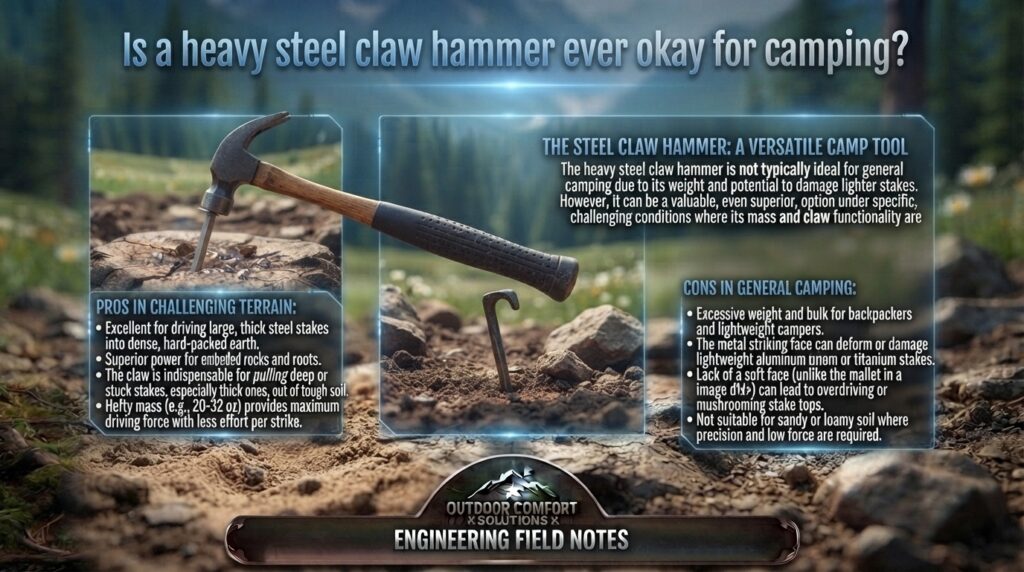
Is a heavy steel claw hammer ever okay for camping?

Every seasoned camper has, at least once, found themselves at a campsite with ground so hard it feels like solid concrete. You pull out your lightweight tent stakes, try to push them in with your heel, and nothing happens. You look in your trunk, see your standard 16-ounce household claw hammer, and think, “Surely this will get the job done.”
While a heavy steel claw hammer is a marvel of engineering for building houses, it is often a weapon of mass destruction for modern camping gear. At besttentstakes.com, we see the casualties of these hammers every day: mangled aluminum pegs, shattered plastic caps, and torn rainflies.
So, is a heavy steel claw hammer ever truly okay for camping? The answer is “yes, with major caveats.” Here is the comprehensive guide to when you can use one, when to leave it at home, and how to use it without destroying your equipment.
The Physics Problem: Why Steel Hammers Struggle with Tent Stakes
To understand why claw hammers are dangerous for camping, we have to look at the Material-Force Dynamic.
- Mass vs. Resistance: A household hammer is designed to drive a hardened steel nail into wood. Tent stakes, by contrast, are designed to be light and portable. When you strike a 10-gram aluminum stake with a 450-gram steel hammer, you are delivering massive kinetic energy to a surface that cannot absorb it.
- Mushrooming and Deformation: Aluminum is ductile. Under the heavy, focused impact of a steel hammer, the head of the stake will spread outward (mushroom). Once a stake is mushroomed, it is nearly impossible to pull out of the ground, and it will never sit flush in its original container again.
- The “Leverage Trap”: The claw on the back of your hammer is designed to rip nails out of wood using immense leverage. If you use it to pry a stake out of the ground, you are focusing hundreds of pounds of force onto a tiny, fragile neck of metal. This is the fastest way to snap a stake in half.
When Is It Okay to Use a Steel Claw Hammer?
There are specific scenarios where a heavy hammer is not just acceptable—it is required.
1. The “Texas Hardpan” and Frozen Ground
In arid states like Texas, where the ground can become baked, impenetrable clay, a rubber mallet will often just bounce off the surface. In these high-resistance environments, you need the mass of a steel hammer to break through the crust.
2. When Using “Rock Pegs”
If your camping kit includes hardened steel rock pegs (common for granite terrain in California or rocky sites in New York), these stakes are specifically designed to be hammered. They are durable enough to handle steel-on-steel impact without deforming.
3. As a Last Resort (With Buffers)
If a steel hammer is the only tool you have, you can use it safely by following the Buffer Rule (see below).
The Pro’s Handbook: How to Use a Steel Hammer Safely
If you decide to bring your claw hammer, follow these three rules to keep your gear intact:
1. The Buffer Rule
Never allow the steel face of the hammer to touch your tent stake directly. Place a folded piece of thick cloth, a piece of leather, or a flat, smooth stone over the head of the stake. This absorbs the high-frequency vibration and spreads the force, preventing the stake head from shattering or mushrooming.
2. The Vertical Accuracy Standard
Bending occurs when you hit the stake at an angle. If you are using a heavy hammer, your margin for error is zero. Strike with 100% vertical accuracy. If you can’t hit it straight, don’t swing.
3. The “No-Claw” Policy
Never use the claw to pull the stake. If the stake is stuck, use a second stake to hook through the loop or under the notch. Pulling with a hammer claw is a guarantee that you will either bend the stake or tear the guy-line attachment points on your tent.
Regional Performance: Soil Hardness and Tool Choice
| Region | Primary Soil Challenge | Hammer Recommendation |
| Texas | Baked Clay / Hardpan | Steel Hammer + Buffer |
| New York | Forest Loam / Roots | Rubber Mallet or Boot |
| California | Granite / Rocky | Steel Hammer + Hardened Rock Pegs |
| Washington | Wet Loam | Hand-press / Boot |
| San Francisco | Beach Sand | None (Use sand anchors) |
10 Frequently Asked Questions (FAQ)
1. Will a steel hammer ruin my titanium stakes?
Titanium is extremely strong, but it is not invulnerable. Repeated, off-axis strikes with a heavy steel hammer can still cause a permanent kink. Use a buffer to be safe.
2. Is a rubber mallet a better choice?
Yes. A rubber mallet is the “Goldilocks” tool—it provides the weight needed for hard soil but is soft enough to protect your stakes.
3. What do I do if I’ve mushroomed my stake head?
You can use a metal file to grind the mushroomed edges back down to the original shape, though the metal will be thinner and weaker.
4. Why do professional campers often not carry a hammer at all?
Experienced campers choose stakes matched to their specific terrain. If you have the right stake, the ground is rarely hard enough to require a hammer.
5. Can a steel hammer damage the tent fabric?
Yes. A stray swing can easily slice through a rainfly or a guy-line if you are hammering too close to the tent body.
6. Is there a “camping hammer” I should buy instead?
Yes. Look for a lightweight aluminum tent hammer. They are perfectly balanced for stakes and almost always include a pull-hook on the back.
7. Does the weight of the hammer affect the stake?
Yes. A 16oz hammer is overkill for a 20-gram stake. The heavier the hammer, the more critical your “buffer” technique becomes.
8. Is it better to hammer straight down or at an angle?
For the strike itself, always hit the stake head vertically (straight down). Only after the stake is driven in should you adjust the angle of the guy-line.
9. What if I’m camping in rocky ground?
Switch to steel “Rock Pegs.” Do not use lightweight aluminum stakes, or you will bend every single one you bring.
10. Can I use a rock if I don’t want to carry a hammer?
A fist-sized rock is the best, most versatile “hammer” in the world. It’s free, it weighs nothing, and it’s surprisingly gentle on stakes.
Conclusion
A heavy steel claw hammer is a powerful tool, but it is rarely the right tool for a lightweight camping kit. If you are car camping in the dense clays of Texas or the rocky terrain of California, you can safely use one—provided you use a buffer and strict vertical precision.
However, for most of the country, a heavy hammer is unnecessary weight. By matching your stakes to the soil—using titanium nail pegs for rocks or wide-body Y-stakes for soft ground—you can eliminate the need for a hammer entirely, protecting your gear and your peace of mind.
At besttentstakes.com, we believe that your camping foundation shouldn’t be a struggle. Choose the right stake, leave the heavy iron at home, and enjoy the great outdoors with equipment that is built to last.