
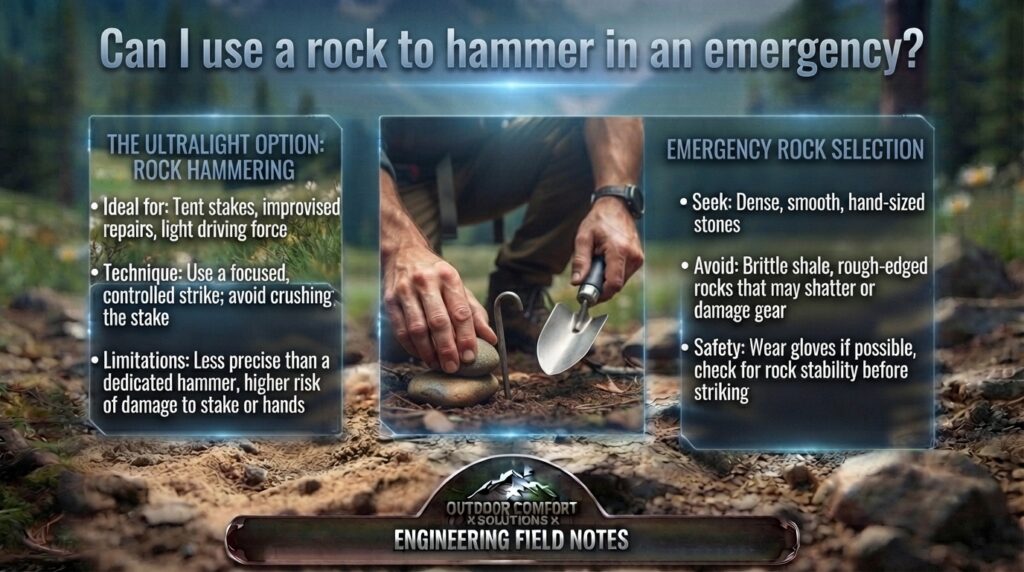
Yes, you can absolutely use a rock to hammer in tent stakes in an emergency or when you are backpacking [1.4.2]. In fact, for many seasoned campers, a “fist-sized rock” is the preferred, lightweight alternative to carrying a heavy mallet [1.3.1, 1.4.2].
However, there is a right way and a wrong way to do it. If you aren’t careful, you can end up with bent stakes, smashed fingers, or a damaged tent [1.2.2].
At besttentstakes.com, we want you to be prepared for any ground condition—from the soft forest floors of Washington to the rocky granite of California. Here is your guide to using nature’s hammer effectively and safely.
The Pro-Guide to Using a Rock as a Hammer
1. Choose the Right Rock
Not all rocks are created equal. Avoid jagged, sharp-edged stones, as they can easily damage the head of your stake or cut through your guy-lines [1.2.2].
- The Ideal Rock: Look for a rock that is roughly the size of your fist, has a flat or slightly rounded surface, and is heavy enough to provide force without being so large that it’s difficult to control [1.4.2].
2. Protect Your Stake Head
If you are using high-quality aluminum stakes, the direct impact of a hard rock can cause “mushrooming” (where the stake head spreads out and deforms) [1.1.1, 1.2.2].
- The Buffer Trick: Place a thick, folded piece of cloth, a leather patch, or even a small, flat, smooth stone between your rock-hammer and the stake [1.2.2]. This absorbs the shock and protects your gear [1.2.2].
3. Focus on Vertical Precision
Bent stakes usually happen because of off-axis strikes [1.3.1]. When using a rock, keep your eyes locked on the head of the stake. Ensure your strike is perfectly vertical (straight down) [1.3.1]. If you strike at an angle, the stake will immediately want to buckle [1.3.1].
When a Rock Isn’t Enough: Alternative Strategies
Sometimes, no amount of hammering will get a stake into the ground. If you are struggling, don’t keep pounding; you will only ruin your gear [1.4.2].
- The “Water Trick”: If the ground is bone-dry and hard, pour a small amount of water around the site. Let it soak in for a few minutes; this softens the soil and makes stake insertion much easier [1.1.1].
- The “Big Rock/Little Rock” System: If the ground is solid rock or a slab, stop trying to stake [1.1.2]. Instead, tie your guy-line to a small stick or rock, place it, and pile a “Big Rock” on top of it to act as an anchor [1.1.2, 1.2.1, 1.5.2].
- Move It: If your stake hits an immovable object (a subterranean rock or root), move it two inches [1.4.2]. A stake forced into a rock will never hold as well as one properly set in soil [1.4.2].
10 Frequently Asked Questions (FAQ)
1. Will a rock ruin my tent stakes? If you strike them hard and directly with a jagged rock, yes. If you use a buffer (like cloth) or a smooth stone, you can minimize damage significantly [1.2.2].
2. Is it better to just push stakes in with my foot? Yes! For most campsites, a firm press with the arch of your boot is better than hammering [1.4.2]. It gives you tactile feedback, letting you feel if you’ve hit a rock before you cause damage [1.4.2].
3. What should I do if my stake bends while I’m using a rock? Stop immediately. Straighten it out (you can often do this against a flat stone) and move to a different spot [1.1.1].
4. Are “tent stake hammers” better than rocks? Yes, for front-country or car camping [1.2.2]. They are balanced for the job and often have a built-in puller hook [1.2.2, 1.4.1]. But for backpacking, they are unnecessary weight [1.4.2].
5. Can I use a rock to pull out a stuck stake? Don’t use a rock as a pry bar. Instead, use a spare stake to hook the loop of the stuck one and pull straight up [1.4.2].
6. What if the ground is frozen? Don’t hammer! Use the “Big Rock” anchor method [1.1.2, 1.5.2]. Hammering frozen ground is the fastest way to snap an aluminum stake [1.3.1].
7. Should I worry about the rock’s weight? Only if you are carrying it! Use a rock you find at the campsite, then leave it there when you go.
8. Are titanium stakes tougher against rock-hammering? Yes, titanium is much more durable than aluminum and can withstand the occasional “emergency hammer” better than most materials [1.4.2].
9. Why do my stakes keep bending even when I’m careful? You might be using stakes that are too thin for the terrain. Consider upgrading to hardened steel or titanium “nail” style pegs if you frequently camp in rocky areas [1.1.1, 1.4.2].
10. How do I hammer stakes into sand? Don’t hammer! In sand, use long, wide-profile anchors, or bury them horizontally as a “deadman” anchor [1.5.1, 1.5.2].
Conclusion
Using a rock as a hammer is a classic camping skill that every adventurer should have in their toolkit. By choosing the right “tool,” using a buffer to protect your gear, and knowing when to switch to an alternative anchoring method, you can secure your shelter in almost any environment—without the extra weight of a mallet.
At besttentstakes.com, we believe the best gear is the kind that adapts to the terrain. Explore our range of durable, impact-ready stakes to ensure your next setup is effortless, no matter where your journey takes you.