

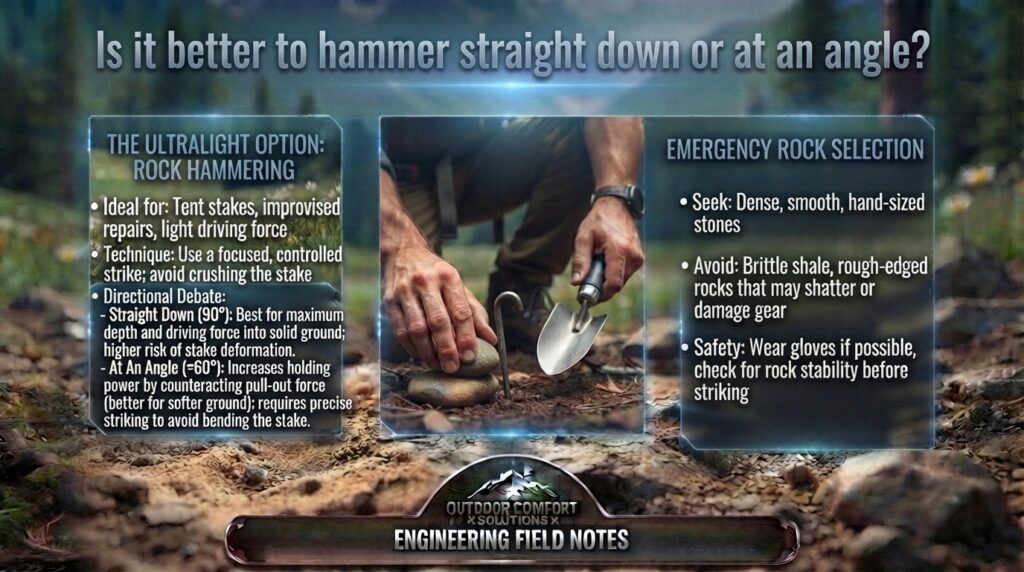
You have arrived at your site, the sun is fading, and you are ready to secure your tent. You have your stakes, your hammer (or your trusty rock), and your guy-lines. But then you pause: Do I hammer this straight down, or should I angle it?
At besttentstakes.com, we frequently examine why tents fail in high winds or loose soil. The most common culprit isn’t the quality of the tent—it’s the physics of the stakeout. The answer to whether you should drive stakes straight down or at an angle is one of the most critical skills a camper can learn.
In this guide, we break down the mechanics of force, the impact of soil types across regions like Texas and Washington, and the definitive “90-Degree Rule” that keeps shelters standing in the worst weather.
The Mechanical Truth: Why Angles Matter
To understand the best way to stake, we must treat your stake and guy-line as a system of vectors.
1. The “Pull-Out” Force
When your tent fabric flaps in the wind, it pulls the guy-line outward.
- If you hammer straight down (90 degrees to the ground): You are relying purely on the friction of the soil against the sides of the stake to hold it in place. If the ground is loose (like sand or wet loam), the stake will slide out like a pin in butter.
- If you hammer at an angle (45-60 degrees away from the tent): You are using the ground as a mechanical anchor. The stake acts as a lever against the soil, forcing the ground to hold the stake in place rather than just relying on friction.
2. The 90-Degree Rule (The Golden Standard)
The most important rule in professional camping is to ensure the angle between the guy-line and the stake is 90 degrees.
If your guy-line comes off the tent at an angle, your stake should be driven into the ground at an angle that is perpendicular to that line. This ensures that the pull force is distributed evenly across the full length of the stake, preventing “leverage” from pulling the head of the stake toward the tent.
Regional Performance: Soil Resistance and Angle
The “perfect angle” can change based on the earth beneath your boots.
| Region | Soil Characteristic | Recommended Angle Strategy |
| Texas | Baked Clay / Hardpan | 45 Degrees: The ground is stiff; you need to fight the pull-out. |
| New York | Loam / Forest Floor | 60 Degrees: Deeper angle ensures the stake doesn’t “walk” out. |
| California | Granite / Rocky | Vertical (as much as possible): You can’t angle into solid rock. |
| Washington | Damp / Soft Soil | 30-45 Degrees: Shallow angle maximizes surface area drag. |
| San Francisco | Coastal Sand | Horizontal (Deadman): You don’t hammer; you bury the stake sideways. |
Tips for the Perfect Stakeout
1. The “Double-Stake” Maneuver
If you are expecting severe storms, do not just drive one stake at a 45-degree angle. Drive a second stake into the ground behind the first one, then connect the guy-line to both. This creates a redundant system that is nearly impossible to pull out.
2. Orient Toward the Wind
Always orient your stake so the guy-line is pulling against the head of the stake. If the stake is angled toward the tent, the wind will pull the stake head straight out of the ground. The stake should always be angled away from the tent.
3. The Depth/Angle Trade-off
In soft ground, an angle is your best friend. However, if you are driving stakes into rocky terrain (common in California or the Adirondacks in New York), don’t force an angle. If you hit a rock, move the stake. A straight, shallow stake in good dirt is better than a bent, angled stake wedged against a rock.
10 Frequently Asked Questions (FAQ)
1. Does hammering straight down ever work?
Yes, in very specific cases: when you are using long, heavy-duty “nail pegs” in extremely hard-packed ground where the stake acts like a bolt.
2. Why does my stake keep pulling out?
You are likely angling it toward the tent or using too short of a stake for the soil density. Angle it away from the tent, and switch to a longer stake.
3. What is the best angle for sandy soil?
Don’t use an angle. In sand, you must bury the stake horizontally (the “deadman” method) to create a wide anchor surface.
4. How do I know if the angle is “90 degrees” to the guy-line?
Eyeball it. If the guy-line and the stake form a perfect “L” shape (with the stake slightly leaned back), you have optimized the hold.
5. Does angling the stake make it harder to remove?
Yes, slightly. But if you’ve done it correctly, you shouldn’t be removing it until the end of your trip anyway!
6. Can I angle titanium stakes?
Yes. Titanium is extremely strong, but it is still subject to the laws of physics. Angling it away from the tent provides the same mechanical advantage.
7. Should I change the angle based on wind speed?
If the wind is extreme, make your angle shallower (further away from the tent) to bury more of the stake’s surface area.
8. What if the ground is uneven?
Focus on the 90-degree rule relative to the guy-line. The earth’s surface is secondary to the tension of the line.
9. Why do my stakes bend when I angle them?
You are likely hammering sideways against the stake head instead of driving it straight into the earth at that angle. You must always hammer parallel to the stake’s shaft.
10. Is there a “best” stake shape for angling?
Y-stakes are excellent for angling because their wide surface area “grabs” the soil, creating a massive pocket of resistance.
Conclusion
The debate between straight-down and angled staking is settled by physics: Angle away from the tent, and aim for a 90-degree relationship between the line and the peg. This setup leverages the entire density of the ground to combat wind, keeping your shelter stable when it matters most.
Whether you are camping on the rocky ridges of California or the loose loams of Washington, the right stake geometry is your best defense against gear failure.
At besttentstakes.com, we provide the high-performance stakes designed to hold that tension, no matter how hard the wind blows. Explore our collection of Y-stakes, nail pegs, and rock anchors to perfect your stakeout on your next adventure.