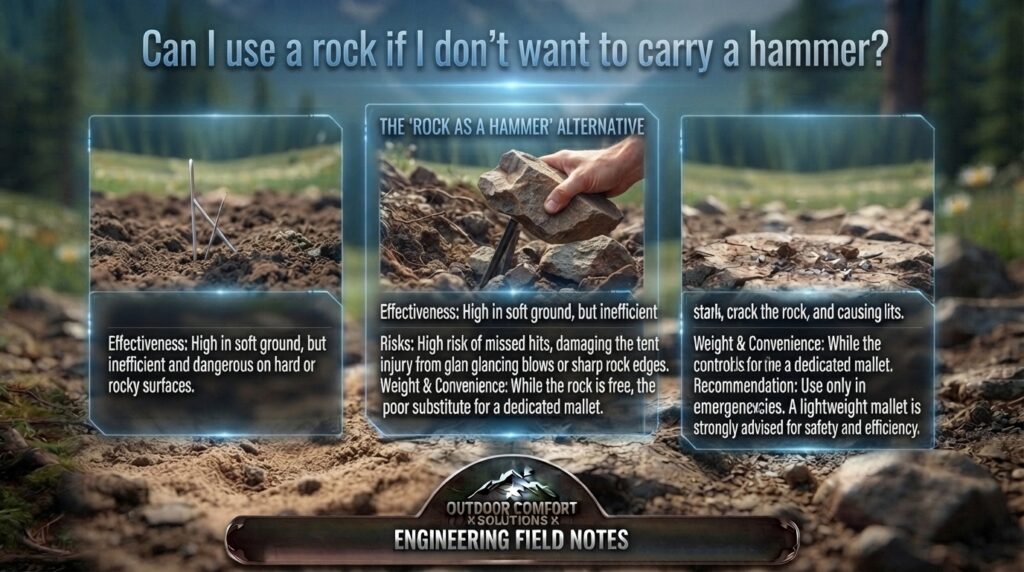
Can I use a rock if I don’t want to carry a hammer?

In the world of outdoor gear, the mantra is often “less is more.” When you are trekking through the rugged landscapes of the Sierra Nevada in California, the dense forests of New York, or the wind-swept plains of Texas, every ounce in your pack matters. One of the most common questions we receive at besttentstakes.com is: “Do I really need to carry a hammer, or can I just use a rock?”
The answer is a resounding yes—you can absolutely use a rock. In fact, most professional hikers and seasoned campers rarely carry a hammer at all. Nature provides the ultimate tool, and learning how to use it will save you weight, money, and space.
In this guide, we will teach you how to master the art of the “rock-hammer,” how to protect your stakes while doing it, and when to put the stone down and try a different technique.
The Rock-Hammer Advantage
Why do professionals skip the hammer? It comes down to versatility and weight.
1. The Weight Penalty
A standard rubber mallet or tent hammer weighs anywhere from 8 to 16 ounces. While that seems small, in the world of ultralight backpacking, that weight is better utilized for extra water, food, or a more comfortable sleeping pad. A rock, by contrast, is free, ubiquitous, and zero-weight when you aren’t using it.
2. The Feedback Loop
When you use a metal hammer, you are isolated from the ground. If you hit a hidden rock or a dense root, the hammer’s weight and speed often force the stake through, leading to a bent or broken peg. When you use a rock you are holding in your hand, you receive immediate tactile feedback. You can feel the resistance of the soil, allowing you to stop before your stake is damaged.
How to Properly Use a Rock (Without Ruining Your Gear)
Using a rock doesn’t mean just bashing your stakes blindly. There is a refined technique to doing it like a pro.
1. The “Fist-Sized” Goldilocks Rule
Don’t grab a boulder, and don’t grab a pebble. Look for a rock that fits comfortably in your palm—roughly the size of a fist. It should have enough mass to drive the stake, but be small enough that you can control the strike with precision.
2. Seek the “Flat-Face” Stone
Avoid jagged or sharp-edged rocks. If you hit your stake with a sharp edge, you create a point-stress concentration that will quickly deform or cut the metal. Look for a stone with a flat or slightly rounded side.
3. The Buffer Technique (Essential!)
This is the secret to gear longevity. Never strike your stake head directly with a raw rock. Place a small, flat “sacrificial” stone on top of the stake head, or wrap a thick piece of cloth or a leather patch over the stake head before striking. This protects your gear from being “mushroomed” or dented by the rock.
Regional Soil Strategy: Know Your Ground
How you use your rock depends entirely on where you are pitching your tent.
| Region | Typical Soil | Rock Strategy |
| Texas | Baked Clay / Hardpan | Use a Buffer: The ground is dense; use a flat rock with a cloth buffer. |
| New York | Forest Loam/Roots | Gentle Taps: Use small, controlled taps to nudge past roots. |
| California | Granite/Rocky | Skip the Rock: Don’t hammer; use a pilot hole or move the stake. |
| Washington | Damp / Soft Soil | Skip the Rock: Use your boot; the ground is too soft for hammering. |
| San Francisco | Beach Sand | Skip the Rock: Bury the stake horizontally (Deadman anchor). |
10 Frequently Asked Questions (FAQ)
1. Will a rock ruin my tent stakes?
Only if you use a jagged rock and strike with extreme, uncontrolled force. Use a flat-faced stone and a protective cloth buffer to keep them in good shape.
2. What if I can’t find a suitable rock?
If you are in a location with no rocks, use your boot. If the ground is too hard for your boot, you are using the wrong stakes for that terrain.
3. Is it better to use a rock or a mallet?
A mallet is more “civilized” for car camping, but a rock is vastly superior for any trip where you have to carry your gear on your back.
4. Can I use a rock on Titanium stakes?
Yes, titanium is incredibly tough and handles rock-hammering better than any other material.
5. Why shouldn’t I just use a rock to pound it all the way down?
Because you will lose the stake! Always leave the head exposed (or the cord loop) so you can retrieve it later.
6. What if I strike the tent by accident?
Always stake out your guy-lines before driving the stake down to prevent the hammer (or rock) from slipping and cutting your tent fabric.
7. Are “Rock Pegs” the same as using a rock to hammer?
“Rock Pegs” are hardened steel stakes designed to be hammered. You can use a rock to drive them into ground that would snap a standard aluminum stake.
8. Can I use a rock to pull out a stuck stake?
No. Never pry with a rock. Use a spare stake to hook the pull-loop and pull straight up.
9. Does the “rock-hammer” method work for all stakes?
No. Avoid hammering thin, wire-like shepherd’s hooks with a rock; they will bend instantly. This method is best for V-stakes, Y-stakes, and nail pegs.
10. What is the biggest mistake when using a rock?
Striking off-axis. If you hit the side of the stake, it will bend. Ensure your rock strike is always parallel to the stake’s shaft.
Conclusion
Carrying a hammer is a choice, not a requirement. By learning to identify the right stone, using a simple buffer to protect your gear, and relying on your boot or a “pilot hole” technique when the going gets tough, you can ditch the extra weight and rely on the terrain itself to help you set up camp.
At besttentstakes.com, we advocate for gear that is light, durable, and terrain-adaptive. Whether you choose to carry a mallet or rely on the “nature-hammer,” the key is having stakes that won’t fail when the wind kicks up.