How to stake a tent in the sun baked caliche soil found in Texas

If you’ve ever tried setting up camp in West Texas, the Hill Country, or parts of the Panhandle during summer, you know the sound: the dull, hollow clack of a tent stake hitting what feels like solid concrete, followed immediately by the sickening bend of cheap aluminum.
That impenetrable ground layer isn’t rock; it’s caliche (pronounced kuh-lee-chee).
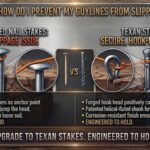
Formed over thousands of years as calcium carbonate cements gravel, sand, and clay together under intense heat, sun-baked caliche is notoriously unforgiving. Standard hook-style aluminum shepherd’s crook stakes don’t stand a chance—they will buckle within two hammer strikes.
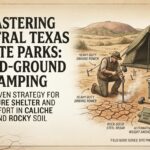
Whether you are pitch-camping in Big Bend, setting up an awning at Palo Duro Canyon, or securing a commercial canopy in Central Texas, this ultimate guide breaks down the physics of caliche soil, the exact gear required, field-tested anchoring techniques, and emergency workaround methods to ensure your shelter stays secure without destroying your gear.
Quick Summary: Caliche Staking Methods Compared
When dealing with hardened calcium carbonate strata, traditional tent stakes fail. Here is how specialized gear and techniques perform in real Texas field conditions.
| Gear / Technique | Penetration Depth | Holding Power | Failure Rate | Best Used For | Primary Drawback |
| Forged Steel S45C Stakes | 8–12 inches | Very High | Low (5%) | Heavy tents, tarps, high winds | Adds weight to your pack |
| Lag Screws (Impact Driver) | 6–10 inches | Maximum | Near Zero (<1%) | Car camping, overlanding, canopy setups | Requires battery power & driver |
| Masonry/Rock Drill Pilot Hole | 6–8 inches | High | Low (2%) | Ultra-hard concrete-like caliche beds | Requires cordless hammer drill |
| Deadman Anchors (Rocks/Sandbags) | 0 inches (Surface) | Moderate | Variable | Backpacking, drill-free zones | Requires finding heavy rocks on-site |
| Standard Aluminum Shepherd Hooks | <2 inches | Zero | Extremely High (>90%) | NEVER (Bends instantly) | Destroys stakes, zero wind resistance |
Section 1: What is Caliche Soil and Why Is It So Unforgiving?
To defeat caliche, you have to understand what makes it different from standard forest dirt or beach sand.
                  ┌─────────────────────────────────┐
                  │ Topsoil / Dust Layer (1-2 in)   │
  ════════════════╪═════════════════════════════════╪════════════════ GROUND LEVEL
                  │ CALICHE HARDPAN LAYER          │
                  │ (Calcium Carbonate Cementation) │  ◄── STAKE BENDING ZONE
                  ├─────────────────────────────────┤
                  │ Bedrock / Sub-surface Strata    │
                  └─────────────────────────────────┘
Caliche is a sedimentary layer formed when calcium carbonate ($\text{CaCO}_3$) dissolves in groundwater, leaches downward through topsoil, and precipitates out as moisture evaporates in arid climates. Over centuries, this process binds surrounding sand, gravel, and silt into a natural concrete matrix.
Physical Factors That Amplify Hardness:
- Desiccation (Sun Baking): During hot, rainless periods across Texas, the clay binders within caliche shrink and harden, transforming semi-pliable soil into a solid subterranean shield.
- Impact Deflection: Caliche rarely forms as a smooth slab; it contains embedded limestone gravel and chert cobbles. When a straight stake strikes an embedded stone inside the hardpan, the force redirects laterally, collapsing the stake wall.
- Friction Lock vs. Shattering: Standard wedge-style stakes try to displace soil sideways. Because caliche has almost zero elasticity, it refuses to displace—instead, it absorbs the kinetic force, transferring it back up into your mallet or hammer.
Section 2: Essential Equipment for Staking in Caliche
Leaving standard plastic or aluminum stakes at home is mandatory when camping in Texas caliche country. Here is the heavy-duty tool kit required for hardpan ground.
1. Forged S45C Steel Stakes (The Gold Standard for Manual Staking)
Discard extruded aluminum or thin steel wire. You need forged S45C carbon steel pegs (often 8 to 12 inches long with a 9–10mm shaft diameter).
- Why They Work: High tensile strength keeps the shaft from flexing when struck with heavy metal tools. The tapered, reinforced tips drive through hardened calcium deposits without mushrooming.
2. Hex-Head Lag Screws + Cordless Impact Driver (The Modern Solution)
Used extensively by overlanders and canopy setters, 5/16-inch or 3/8-inch steel lag screws (8 inches long) coupled with washers offer effortless anchor driving.
- Why They Work: Instead of forcing displacement through blunt kinetic impact, lag screws cut threads directly into the caliche matrix. Powered by a 12V or 18V cordless impact driver, they pull themselves smoothly into the ground in under 5 seconds per corner.
3. A Proper Driving Tool (Ditch the Plastic Mallet)
A lightweight rubber or plastic tent mallet will shatter or bounce right off when striking hard steel against caliche.
- Recommended: A 3-pound mini sledgehammer, a cast-iron camping hammer with a flat strike face, or a heavy engineer’s mallet.
Section 3: Step-by-Step Field Guide to Staking in Caliche
When driving stakes into caliche, relying on brute force alone will ruin gear. Follow this systematic approach to secure your shelter smoothly.
1.Inspect & Clear Top Layer:Prep Phase.
Clear away the top 1–2 inches of dry dust or loose gravel. Locate a flat spot free of visible large limestone outcroppings.
2.Pre-Drill or Soften the Spot:Pilot Hole Phase.
If the ground is rock-hard, use a masonry drill bit (or pour a small splash of water on the spot and wait 2 minutes) to break the surface tension of the caliche layer.
3.Drive at an Angle (45° to 60°):Drive Phase.
Position your forged steel stake angled away from the tent at 45 to 60 degrees. Strike the stake firmly using straight, controlled center-head blows with a steel hammer or mini-sledge.
4.Tension Guy Lines Low to the Ground:Tension Phase.
Attach your guy lines near the base of the stake head to minimize lever action. Use tensioners or a taut-line hitch knot to maintain tension against Texas gusting winds.
Section 4: Water-Softening Technique (The Texas Camper’s Secret)
When you don’t have power tools or a heavy sledge, you can leverage caliche’s chemical weakness: water solubility.
Because caliche contains clay binders alongside calcium carbonate, introducing water temporarily rehydrates the top crust, turning concrete-like soil into dense clay.
  Step 1: Pour ~8 oz Water on Staking Target
                       │
                       ▼
  Step 2: Wait 3–5 Minutes (Capillary Action Absorption)
                       │
                       ▼
  Step 3: Drive Forged Stake (Easier Penetration)
                       │
                       ▼
  Step 4: Sun Bakes Soil Dry ──► Re-hardens & Locks Stake
Pro Tip: In summer heat, soil re-dries rapidly. Once your stake is driven after soaking, the Texas sun will bake the surrounding clay dry within hours, effectively locking the stake head in a natural plaster casting!
Section 5: Alternative Anchoring Methods (When Ground Won’t Give)
If you hit solid, impenetrable caliche sheets or protected bed layers where driving stakes is impossible, switch to alternative anchoring methods.
       [ TENT CORNER / GUY LINE ]
                   │
                   ├─── Attached to Center of Heavy Rock
                   │
  ═════════════════╪═════════════════════════════════ GROUND LEVEL
                   │
         [ LARGE BOULDER / ROCK ANCHOR ]
         (Minimum 30–50 lbs or Tied Around Anchor Rock)
1. The “Rock-on-Stake” & Deadman Method
- Find heavy boulders (20–40 lbs minimum).
- Wrap your guy line securely around the center of the rock using a timber hitch knot.
- Place a second heavy rock in front of the primary anchor rock to block it from sliding along sun-baked dust.
2. Commercial Sandbags & Canopy Weights
- Fill heavy-duty 600D PVC sandbags with local gravel or sand.
- Strap them directly to the base of tent poles or canopy legs. Ensure a minimum weight of 30–40 lbs per leg to counter sudden Texas dust devils or cold fronts.
Section 6: Regional Texas Soil Factors & Weather Warning
Caliche conditions vary across the Lone Star State:
- Texas Hill Country (Austin/San Antonio): Thin topsoil over hard limestone and caliche pockets. Always carry forged steel pegs and a hammer.
- West Texas & Big Bend Region: Dry, sun-baked caliche mixes with igneous rock. Extreme afternoon wind gusts make securing guy lines critical.
- North Texas & Panhandle (Amarillo, Palo Duro): Deep caliche hardpan layers exist below red clay. When dry, it mimics brick; when wet, it turns to sticky grease.
Frequently Asked Questions (FAQ)
1. Can I use standard tent stakes in Texas state parks?
Standard aluminum shepherd-hook or thin plastic stakes included in most retail tent boxes will almost certainly bend or break in Texas state parks located in the Hill Country, West Texas, or Panhandle regions. Upgrading to forged steel pegs or lag screws is recommended.
2. Will hammering stakes into caliche damage my tent equipment?
It can if you use improper tools. Striking soft aluminum stakes with a steel hammer will flatten the stake heads. Always match steel tools with heavy-duty forged S45C carbon steel stakes designed to absorb heavy impacts without deforming.
3. What size lag screws work best for camping in hard soil?
Use 5/16-inch diameter by 8-inch long zinc-plated steel lag screws fitted with a flat washer. Pair them with a cordless impact driver fitted with a 1/2-inch socket driver bit.
4. Does the water-softening method weaken the stake’s holding power?
Temporarily, while the soil is wet, holding power is slightly reduced. However, as the intense Texas heat evaporates the moisture, the clay in the caliche hardens around the stake, resulting in strong retention.
5. How do I remove a steel stake stuck deep in dry caliche?
Do not pull straight up on the guy line ring—this can snap the hook. Tap the sides of the stake gently with your hammer to break the ground seal, or pour a cup of water around the entry hole, wait 3 minutes, then twist the stake with a claw hammer or stake extractor tool.
6. Are screw-in ground anchors (spiral anchors) effective in caliche?
Spiral or dog-tie screw anchors generally fail in caliche because the continuous wide threads hit impenetrable embedded rocks, preventing the anchor from twisting down smoothly. Straight forged stakes or narrow lag screws perform far better.
7. Can I use a hammer drill in backcountry campsites?
In designated campgrounds and car-camping sites, using a small cordless hammer drill with a 1/4″ masonry bit to create pilot holes is common practice. However, ensure local wilderness regulations permit power tools if venturing into backcountry primitive zones.
8. How deep do I need to drive stakes in caliche to hold against Texas winds?
Aim for a minimum depth of 6 to 8 inches. In strong winds, depth matters less than material rigidity and driving the stake at a proper 45-degree angle away from the shelter.
9. What knot should I use for tensioning guy lines on rock anchors?
The Taut-Line Hitch or the Trucker’s Hitch are ideal. They allow you to adjust line tension easily without re-tying knots as winds shift or rocks settle.
10. Why do my steel stakes rust after camping in Texas?
Caliche contains minerals and alkaline salts that can strip surface coatings over time. Clean dirt off your stakes after each trip, dry them thoroughly, and wipe them down with a thin coat of mineral oil or WD-40 before storage.
Conclusion
Pitching a tent in Texas caliche doesn’t have to end in bent gear and frustration. By swapping out flimsy aluminum pegs for forged steel stakes or lag screws, carrying a heavy-face hammer or impact driver, and using techniques like water softening or deadman anchors, you can build a rock-solid camp anywhere in the Lone Star State.