
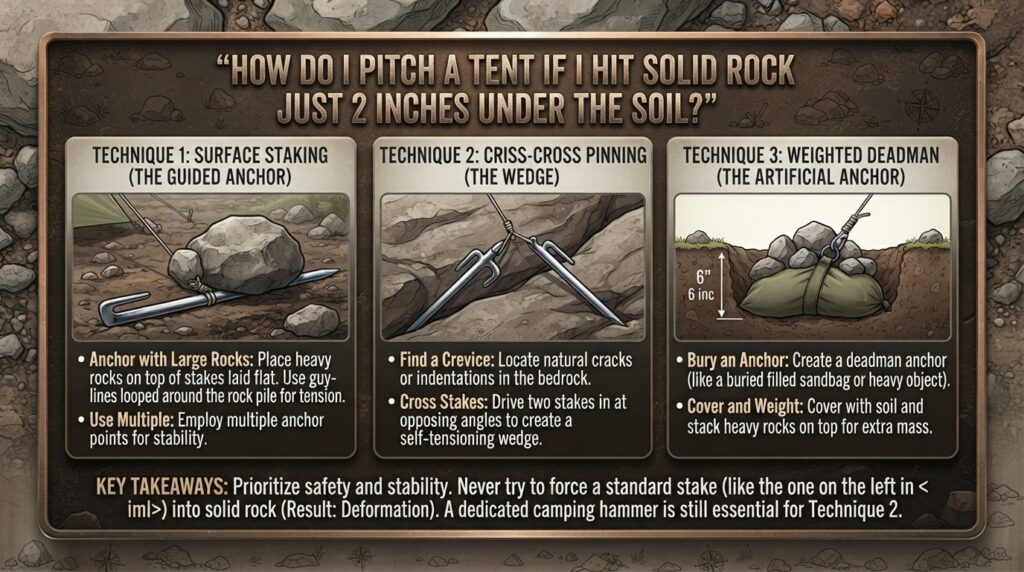
Striking an impenetrable slab of granite or limestone just two inches beneath the topsoil is a classic camping curveball. Whether you are setting up along a riverbed in the Texas Hill Country, camping on exposed granite in the California Sierra, or pitching on slate in Upstate New York, attempting to force a stake into solid bedrock will only result in bent metal and ruined gear.
When subterranean bedrock blocks your stakes, you must pivot from ground-anchoring to gravity-anchoring and friction-anchoring.
1. Emergency Field Techniques: Anchoring Without Deep Stakes
If your site offers shallow soil over rock, use these four field-tested alternative pitching methods:
1.1. The Little-Rock / Big-Rock Method:Use weight instead of depth.
Tie your guyline securely around a smooth, fist-sized rock (the Little Rock). Place a second, much heavier boulder (the Big Rock) directly on top of the guyline, sitting just in front of the little rock to create an unbreakable mechanical stopper.
2.2. The ‘Deadman’ Log or Board Anchor:Horizontal friction anchor.
Tie your guyline around the center of a sturdy branch, heavy log, or flat piece of slate. Dig a shallow 2-inch horizontal trench, place the wood or stone flat inside, and cover it with dirt, gravel, and heavy rocks.
3.3. Extreme-Angle Surface Skittering:Parallel pinning strategy.
Instead of driving your stake vertically or at 45 degrees, lay high-strength Y-beam or titanium nail stakes almost completely flat against the soil surface (10 to 15-degree angle). Drive them into the top 1.5 inches of dirt and weigh down the exposed heads with heavy flat stones.
4.4. Anchor to Nearby Natural Features:Structural cross-tensioning.
Extend your guylines using spare cordage or webbing and tie off directly to heavy tree trunks, sturdy exposed root systems, or large immovable boulders surrounding your campsite perimeter.
2. Structural Anchoring Mechanics: Gravity vs. Tension
Understanding how force vectors work when pitching on shallow soil prevents your tent from collapsing under high wind loads:
Standard Ground Staking:
[ Tent Tension Line ] ────► [ Vertical / 45° Stake Driven 6-8" Deep ] ──► Soil Friction

Bedrock / Shallow Anchoring:
[ Tent Tension Line ] ────► [ Little Rock Stopper ] ◄── [ Big Rock Weight (20-40 lbs) ] ──► Gravity
When you cannot access soil depth, gravity and friction take over. A single 25-pound rock placed over a Little-Rock anchor provides more than enough resistance to withstand 30+ mph wind gusts without relying on deep soil penetration.
3. Recommended Gear for Shallow, Rocky Soil
Not all camping gear is created equal when dealing with shallow bedrock. Here is how different stake styles and tools perform:
| Gear Type | Performance in 2-Inch Soil | Best Use Case |
| Shepherd’s Crook Wire Stakes | ❌ Useless. Bends immediately on rock impact. | Soft lawn grass only. |
| Short 7075-T6 Y-Beam (6-inch) | 🟨 Fair. Holds in shallow dirt when weighed down with rocks. | Light gravel and topsoil. |
| Titanium Nail / Pin Pegs | 🟩 Good. Can slide into thin 2-inch rock fissures. | Crag seams and tight rock cracks. |
| Cordage / Webbing Extensions | 🏆 Essential. Allows tying off to distant trees and boulders. | Shallow bedrock & granite slabs. |
| Freestanding Tent Frame | 🏆 Best Shelter Type. Holds its own shape without stakes. | Any rock, concrete, or shallow site. |
10 Large Frequently Asked Questions (FAQ)
1. Will a freestanding tent blow away if I can’t drive stakes into the ground?
Yes, if unanchored. While a freestanding tent keeps its structural shape without stakes, a strong gust of wind can easily roll or flip it. Always anchor all corners and guylines using heavy rocks or logs.
2. What is the “Little-Rock / Big-Rock” method?
It is a rock-anchor technique where you tie your guyline around a small rock that acts as a stopper, then stack a larger 20–30 lb rock in front of it to hold tension through gravity.
3. Can I jam my tent stakes horizontally into rock cracks?
Yes! Titanium nail stakes or thin metal pins can often be wedged into narrow natural cracks or fissures in bedrock slabs to create extremely secure anchor points.
4. How much weight do I need per corner to secure a tent in high winds?
Aim for at least 15 to 25 pounds of rock weight per main corner anchor, and 10 to 15 pounds for secondary guyline points, depending on wind conditions.
5. Should I put a footprint under my tent on shallow, rocky ground?
Absolutely. A heavy-duty footprint or Tyvek ground sheet is essential on shallow soil to prevent sharp subterranean rock edges from tearing your tent floor.
6. Can I use water bladders or dry bags as tent anchors?
Yes. If rocks are scarce, fill heavy-duty dry bags or canvas sacks with loose gravel, sand, or water, tie your guylines around them, and use them as weight anchors.
7. What type of knot is best for tying guylines around anchor rocks?
A bowline knot or a taut-line hitch works best. The taut-line hitch allows you to easily adjust line tension after placing heavy rocks on the anchor.
8. Will heavy rocks chafe or cut my tent’s guylines?
Sharp granite or limestone edges can fray cordage under wind tension. Wrap a rag, spare sock, or piece of bark around the guyline where it contacts sharp rock edges.
9. What should I do if a sudden storm hits while camping on shallow bedrock?
Double up on rock weight immediately. Stack multiple large stones on every corner and guyline anchor, and place heavy gear bags inside the tent corners to add internal ballast.
10. Is a non-freestanding (trekking pole) tent usable on shallow rock sites?
Non-freestanding tents require tension to stay upright, making them harder to pitch on rock. However, using the Little-Rock/Big-Rock method on every guyline allows you to pitch trekking pole shelters securely without deep stakes.
Conclusion
Hitting solid rock just two inches below the soil does not mean your campsite is ruined. By shifting your strategy from driving deep stakes to utilizing gravity anchors, rock-stacking methods, and natural features, you can set up a rock-solid, wind-resistant shelter anywhere nature takes you.