
You are breaking down camp after a windy night along the breezy headlands near San Francisco, navigating the rocky granite of California’s Sierra Nevada, pitching a tent in the damp, root-choked soil of Washington State, hammering through the sun-baked clay of Texas, or dealing with the shale-heavy earth of upstate New York. As you pull up your gear, you notice one of your premium ultra-light titanium tent stakes has taken an unfortunate curve after hitting a hidden subsurface boulder.
Because titanium is famously tough—used in aerospace engineering, medical implants, and high-end backpacking gear—a common camp-hack temptation arises: “Titanium has a massive melting point. Can I just grab my camp stove or a propane torch, heat the bend until it glows, and easily bend it back straight?”
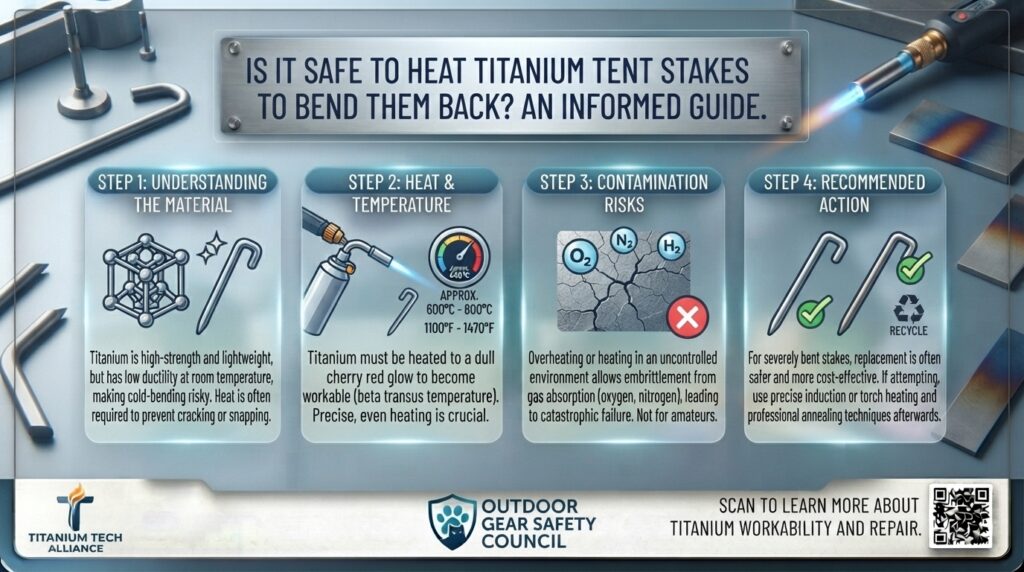
It sounds logical on the surface, but when applied to ultra-light backpacking gear, heating a titanium tent stake with a camp stove or torch to bend it back is unsafe and structurally disastrous. While titanium won’t melt like aluminum, applying uncontrolled high heat causes severe chemical embrittlement, transforming a resilient stake into a brittle piece of metal that will snap under the slightest pressure.
The Metallurgy: Why Heat Destroys Titanium Stakes
To understand why a torch or camp stove ruins a titanium stake, we have to look at how titanium behaves under thermal stress. Unlike steel or aluminum, titanium has a unique, highly reactive chemical personality when exposed to high temperatures.
1. High-Temperature Oxidation and Embrittlement
At room temperature, titanium forms a protective oxide layer that makes it corrosion-resistant. However, when you heat titanium above approximately 1,000°F (538°C)—easily achievable with a pocket torch or roaring camp stove—its atomic structure opens up.
- It aggressively absorbs atmospheric gases, specifically oxygen, nitrogen, and hydrogen.
- This absorption creates a brittle surface layer known in metallurgy as alpha-case.
- The dissolved gases interstitialize within the metal crystal lattice, locking the dislocations and destroying the material’s natural elasticity.
2. The Loss of “Spring-Back” Resilience
The primary reason backpackers love Grade 5 titanium stakes is their incredible “spring-back” memory. They can flex significantly under high wind loads and return to their original shape. When you heat-treat or torch titanium in an uncontrolled backyard or campsite environment, you permanently ruin this springiness. The stake becomes dead, brittle, and prone to snapping clean in half the next time you drive it into the ground.
3. Thermal Conductivity Traps
Titanium has relatively low thermal conductivity compared to aluminum or copper. This means heat stays concentrated right where you apply the flame. Instead of dispersing evenly, the hot spot overheats while the rest of the stake remains cold, creating violent thermal gradients that warp the crystalline structure unevenly.
Can You Straighten Titanium Without Heat? (Cold-Working)
Yes! Unlike aluminum, which suffers severely from work-hardening, titanium can be safely cold-worked to a much higher degree, provided the bend isn’t an acute, sharp kink.
How to Fix a Bent Titanium Stake Safely:
- Inspect for Cracks: Look closely at the bend. If there are visible surface fractures or sharp creases, the stake is done for; retire it immediately.
- Use a Flat Surface: Lay the bent stake flat on a solid rock or dense piece of timber.
- Tap Gently: Use a smooth-faced mallet, a heavy stone, or the flat back of a hatchet to tap the curve back into alignment. Titanium’s elasticity will often help it spring back into a mostly straight configuration without needing any heat whatsoever.
Material Comparison: Titanium vs. Other Stakes Across US Terrains
Different American landscapes demand different material characteristics. Here is how titanium compares when dealing with extreme regional soils:
| Material | Weight | Elasticity / Spring-Back | Reaction to Camp Stove Heat | Best Regional Terrain Match |
| Titanium (Grade 5) | Ultra-Lightweight | Excellent | Absorbs oxygen/nitrogen, becomes brittle and snaps | Rocky alpine zones (Sierra Nevada, Cascades) |
| Aluminum (7075/6061) | Ultra-Lightweight | Moderate | Loses temper, turns soft and pliable | General backpacking, forest loam |
| Forged Steel | Heavy | Low (Stiff) | Tolerates heat well (though unnecessary) | Hard clay (Texas), frozen ground (New York winter) |
| Composite / Resin | Lightweight | Poor | Melts instantly | Sandy soil, coastal dunes (San Francisco/Pacific Coast) |
Product Reviews: Top Titanium and Heavy-Duty Stakes
If your titanium stakes have suffered structural damage or you are looking to upgrade your kit for diverse camping across the US, consider these top-rated options:
1. Vargo Titanium Nail Stakes
- Best For: Rocky ground, weight-conscious backpackers, and durability in the Pacific Northwest and California.
- Material: Grade 5 Titanium.
- Why We Love Them: These thick nail-style stakes bite deep into rocky soil and resist bending far better than thin wire shepherd hooks. If they do take a minor curve, they handle cold-hammering exceptionally well.
2. MSR Ground Hog Stakes (Aluminum Alternative)
- Best For: All-around versatility in varied soils (Washington loam, New York state parks).
- Material: 7000-series aluminum.
- Why We Love Them: While they aren’t titanium, their Y-beam geometry provides superior holding power in loose or semi-firm earth where round stakes might slip.
3. Coleman Heavy-Duty Steel Pegs
- Best For: Car camping and punishing ground conditions like sun-baked Texas clay.
- Material: Forged Steel.
- Why We Love Them: Unbreakable and immune to heat issues. If you are car camping where pack weight doesn’t matter, steel stakes drive through dense, unyielding earth effortlessly.
Expert Tips for Tent Stake Maintenance
Keeping your stakes straight and functional means fewer headaches when setting up camp after dark.
- Never drive stakes into solid rock: If you hit granite or a hidden boulder, do not force it. Move the stake a few inches away or angle it at 45 degrees over the obstacle.
- Ditch the hammer when possible: Use the heel of your boot or a rubber mallet rather than sharp, jagged rocks that can gouge or notch titanium.
- Pull straight up: When packing up camp in windy San Francisco coastal areas or muddy Washington trails, pull the stake straight up by its head or use a secondary stake for leverage. Pulling on the guyline adds lateral shear stress.
- Pack terrain-specific backups: Always keep a mix of stakes in your kit. Relying solely on ultra-light titanium in rocky terrain or heavy clay is a recipe for bent gear.
10 Comprehensive FAQs
1. Will heating a titanium stake melt it over a camp stove?
No. Titanium has an extremely high melting point of around 3,030°F (1,668°C), which far exceeds the maximum output of a standard backpacking camp stove or pocket torch.
2. Why does heating titanium make it brittle?
At temperatures above 1,000°F, titanium reacts chemically with the surrounding air, absorbing oxygen, nitrogen, and hydrogen. This creates a brittle surface layer and internal contamination known as alpha-case, causing the metal to snap easily.
3. Can I use an oxy-acetylene torch to fix a titanium stake?
No. An oxy-acetylene torch generates intense, localized heat that will rapidly oxidize and ruin titanium unless performed in a specialized inert-gas welding chamber (argon shield). Doing it in open air destroys the metal.
4. Is it safe to cold-bend a titanium tent stake?
Yes. Titanium has high elasticity and can be cold-worked safely. If the stake has a smooth curve, you can tap it straight against a hard rock or log with a mallet without compromising its structural integrity.
5. What should I do if my titanium stake has a sharp crease?
If the stake is sharply kinked or creased rather than gently curved, the metal fibers at the bend are already compromised. Discard and replace it, as it will likely snap during the next windstorm.
6. Are titanium stakes better than aluminum stakes?
Titanium offers a superior strength-to-weight ratio, higher resistance to permanent bending, and better elasticity than aluminum of equivalent thickness, making it ideal for rocky backcountry terrain.
7. How can I get a stuck titanium stake out of hard soil?
Avoid rocking it back and forth or pulling on the attached cord, which can warp the shaft. Instead, hook the eyelet with another stake or use a multi-tool to lift it straight upward.
8. Do titanium stakes rust or corrode?
No. Titanium is virtually immune to corrosion, rust, and oxidation under normal environmental conditions, even when left wet in muddy Washington soils or exposed to salty ocean air near San Francisco.
9. What stakes work best in hard Texas caliche clay?
Lightweight titanium or aluminum backpacking stakes will struggle against dry Texas clay. For car camping or basecamps in Texas, heavy-duty forged steel pegs or spiral screw stakes are necessary.
10. How many spare stakes should I bring on a backpacking trip?
Always pack at least two extra stakes. Stakes can easily get lost in brush, overlooked in dark campsite teardowns, or damaged on tough terrain, ensuring your shelter stays secure.
Conclusion
While titanium is one of the toughest and most resilient materials available for backpacking gear, it is not invincible to improper workshop treatments. Attempting to heat a bent titanium stake over a camp stove or torch in an unshielded environment introduces atmospheric gases that cause severe embrittlement and catastrophic failure.
Save your camp stove for cooking meals, rely on safe cold-working techniques with a mallet for minor bends, and invest in dependable, terrain-appropriate gear to keep your tent anchored securely across any landscape.