How to secure a large family tent in high winds on open camping ground

Few outdoor experiences match the joy of a family camping trip. Setting up a basecamp on an open prairie in Texas, along the rugged coastlines of Washington and California, or near the exposed bluffs of New York provides spectacular views and unforgettable memories.
However, open camping grounds share a common, volatile vulnerability: high winds.
When a severe gust front or sudden thunderstorm sweeps across an open landscape, it acts as an invisible wall of force. A standard 4-person to 8-person family cabin tent possesses large, vertical fabric walls that act exactly like a ship’s sail.
Without proper stabilization, a 40 mph gust can easily snap fiberglass poles, rip out stock stakes, and flatten or launch your expensive shelter.
If you are a digital creator or outdoor enthusiast building your gear knowledge on besttentstakes.com, understanding the structural mechanics of high-wind anchoring is critical.
Securing a massive tent in high winds on exposed terrain requires a blend of aerodynamic placement, heavy-duty specialized anchoring systems, and advanced tensioning techniques.
1. The Physics of Wind vs. Large Family Tents
To safely anchor a large shelter, you must first understand the structural forces at play. Most multi-room or cabin-style family tents are designed to maximize internal livable volume. This means they feature tall ceilings, steep vertical walls, and wide profiles.
While comfortable for standing upright, this geometry is highly un-aerodynamic.
[Wind Vector ──>]  | [Tent Wall]  ──> Creates Positive Drag Force
                   |  (Pushes wall inward, compressing poles)

                  /  [Dome/Tunnel] ──> Creates Negative Lift Force
                 /                     (Acts like an airplane wing, lifts tent upward)
When high-velocity air collides with a flat, vertical tent panel, it creates intense positive drag pressure, pushing the fabric and frame inward. Simultaneously, as air compresses and accelerates over the curved roof of the tent, it creates a zone of low pressure above the shelter. This generates negative lift force—the exact physical phenomenon that allows airplanes to fly.
If your anchor pins fail, this upward lift can physically yank your tent out of the earth, scattering your sleeping bags, cots, and gear across the campground.
2. Advanced Site Selection on Open Terrain
When camping on completely open ground, you do not have the luxury of a dense forest canopy or a deep mountain valley to block incoming gales. However, micro-topography features exist on almost any open campground if you know what to look for.
- Utilize Micro-Windbreaks: Look for small topographical depressions, single large boulders, low-lying scrub brush, or artificial structures like park picnic tables and shade lean-tos. Pitching your tent downwind of even a 3-foot-tall earth berm or solid table reduces the direct impact velocity striking the lower half of your tent poles.
- Avoid “Wind Funnels”: Never set up your basecamp at the precise mouth of a canyon, the dead center of a narrow gap between two hills, or directly on an exposed coastal ridge line. These geographical configurations create a Venturi effect, physically compressing the wind and drastically increasing its destructive velocity relative to the surrounding landscape.
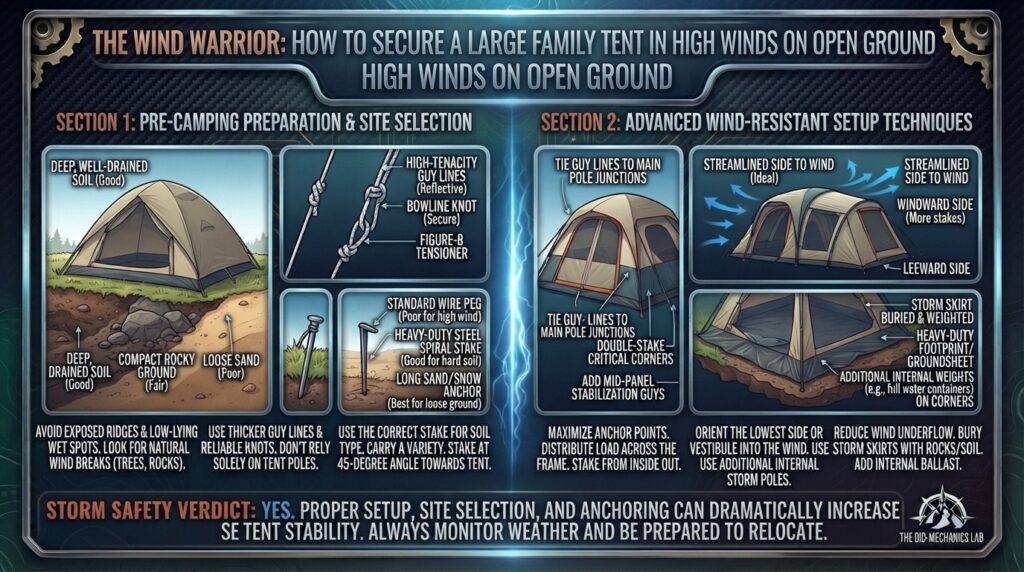
- Orient for Aerodynamics: Identify the prevailing wind direction using a weather app or local conditions. Always point the lowest, narrowest, and most sloped profile of your tent directly into the wind. Never let the broad, flat side doors or massive window panels face oncoming gusts.
3. The Ultimate Defense: Anchoring Systems Explained
The thin, shiny steel wire hooks or yellow plastic pins that come bundled inside your factory tent bag are completely useless in a real windstorm. They lack the surface area to hold in loose soil and bend instantly under stress. To secure a massive family shelter, you must match your stakes to the specific geological soil conditions of the region.
Heavy-Duty Steel and Titanium T-Stakes
For hard-packed clay, rocky soils, and high-desert landscapes—common across central Texas, inland California, and up-state New York—standard stakes will fail or bend during installation.
- The Best Choice: 12-inch heavy-duty steel T-stakes or forged steel spikes (such as those used for large canvas wall tents).
- Why They Work: Forged steel can be driven directly into rocky hardpan using a 3-pound sledgehammer without deforming. The T-shaped cross-section or ribbed steel body provides exceptional mechanical resistance against lateral pulling forces.
Large Aluminum Sand and Snow Anchors (U-Flukes)
If you are pitching your basecamp along the coastal beaches of San Francisco, the sandy shores of Washington’s Olympic Peninsula, or the loose alluvial desert plains of West Texas, traditional stakes will easily slice through the substrate under the lift force of the tent.
- The Best Choice: 12-to-18-inch wide aluminum sand flukes or scoop-style stakes.
- Why They Work: These stakes feature a wide, curved “U” profile that maximizes physical surface area contact with loose soil. Under tension, the scoop digs deeper into the sand rather than pulling free. On pure beach sand, you can also bury these stakes horizontally 1.5 feet deep as a “deadman anchor,” tying the guyline to the center of the buried stake.
Heavy-Duty Ground Screw Anchors
For maximum holding power in soft-to-medium loam soils, grasslands, and wet, muddy fields (frequently encountered during rainy seasons in Washington and New York), screw-in anchors offer unmatched security.
- The Best Choice: Polyurethane or steel screw-style ground anchors driven into the earth using an impact driver or steel turning rod.
- Why They Work: Like a wood screw cutting into a timber beam, the deep helical threads of a ground screw lock mechanically into the undisturbed subterranean root and soil structure. A single high-quality screw anchor can provide over 500 pounds of vertical pull-out resistance.
4. Step-by-Step Guide to Bulletproofing Your Tent
Securing a large family tent in an open, windy environment requires methodical execution. Follow this strict sequence to ensure your shelter stands firm:
1.Layout and Base-Staking:Do this before raising the frame.
Spread the tent body flat on your footprint. Before assembling or lifting any poles, immediately stake down the windward corners (the side facing the wind). This keeps the tent anchored to the ground like a flat sheet, preventing it from acting as a sail while you work.
2.Assemble and Sleeve the Poles:Keep the profile low.
Assemble your heavy-duty steel or aluminum pole frame. Keep the tent as low to the ground as possible while sliding the poles through the sleeves or clipping the inner body. If using a cabin tent, insert the roof poles first before standing the vertical legs upright.
3.Execute the 45-Degree Staking Rule:Drive stakes deep into the earth.
Drive your heavy-duty stakes into the ground at a precise 45-degree angle pointing away from the tent. Never drive a stake straight up-and-down or tilted toward the tent; a vertical stake has significantly less holding power against a horizontal pull vector. Drive the stake all the way down until the head is flush with the soil to eliminate leverage forces that snap stake shafts.
4.Deploy and Equalize All Storm Guylines:Distribute structural load.
Extend every single guyline attached to the rainfly. Tie them out to separate stakes located well away from the tent body. Ensure each line runs perfectly straight from the structural pole connection loop to the ground stake, creating an external skeletal support system.
5. Master Guide: Guylines and Tensioners
Your guylines are the true unsung heroes of storm survival. They transfer the wind’s destructive force off the fragile tent fabric and frame, channeling it directly down into your heavy-duty stakes.
Material Choice: Static Core vs. Dynamic Core
Never use cheap, stretchy nylon rope for your storm guylines. You need high-tensile, reflective static lines (such as 3mm to 4mm paracord with a UHMWPE/Dyneema core). Dyneema possesses zero stretch under load, ensuring that when a 50 mph gust hits the tent, the fabric cannot deflect far enough to buckle the internal poles.
Advanced Tensioning with Line-Loks
To keep your lines taut as the storm rages, employ heavy-duty nylon or aluminum Line-Loks or aluminum three-hole tensioners. These mechanical devices use friction to lock your guylines into place.
As demonstrated in the technical rigging paths above, threading your guyline correctly through a specialized tensioner creates a high-friction loop that allows you to easily adjust line tension from outside the storm flap without re-tying complex knots.
6. Comprehensive Regional Weather & Soil Comparison Matrix
To optimize your gear selection for besttentstakes.com, review how environmental conditions vary across the specific target states.
| State / Region | Primary Wind Profile | Typical Soil Composition | Ideal Stake Type | Recommended Guyline Configuration |
| Texas (Open Plains & Big Bend) | High-velocity thermal gusts, sudden dry microbursts ($35\text{–}50\text{ mph}$) | Hard-packed clay, caliche, loose limestone rock | Forged Steel 12-inch Spikes / T-Stakes | Maximum tension, dual-point staking on windward side |
| Washington (Coastal Beaches & Cascades) | Persistent marine gales, sustained wet frontal systems ($30\text{–}45\text{ mph}$) | Wet organic loam, loose river rock, deep beach sand | Aluminum Sand Flukes or Large Ground Screws | Static Dyneema lines, high water-shedding tension angles |
| California (High Sierra & Coastline) | Alpine ridge winds, high-pressure Santa Ana gusts ($40\text{–}60\text{ mph}$) | Decomposed granite, hard gravelly sand, solid bedrock | Forged Steel Pins / Heavy T-Stakes | Multi-directional guy arrays, rock-stacking overlays |
| New York (Exposed Lakefronts & Adirondacks) | Severe summer thunderstorm downbursts, squall lines ($35\text{–}55\text{ mph}$) | Compact forest loam, clay, dense root systems | Helical Ground Screws or Heavy Steel Stakes | Shock-absorbing bungee loops paired with static lines |
| San Francisco (Coastal Headlands) | Dense, heavy, damp oceanic wind walls ($25\text{–}40\text{ mph}$) | Damp sandy soil, soft shale, coastal grass turf | Wide U-Profile Aluminum Flukes | Salt-resistant heavy polymer tensioners, low-profile pitch |
7. Professional Tips for Surviving a Gale on Open Ground
If you find yourself trapped on an open campground during an unexpected high-wind event, implement these professional field tactics immediately:
- The Double-Staking Method: If the wind is pulling a critical guyline stake loose from the soil, drive a second stake roughly 12 inches directly behind the first. Run an additional short loop of cord from the head of the front stake to the base of the rear stake. This shifts the leverage point and doubles your pull-out resistance.
- Weigh Down the Internal Footprint: Place heavy coolers, filled water jugs, heavy duffel bags, and packed plastic storage bins directly in the windward corners inside your tent. This internal ballast works directly against the negative lift forces trying to pull the floor of the tent upward into the sky.
- Keep All Openings Sealed Tight: The moment the wind begins to pick up, zip every door and window completely closed. If you leave a window half-zipped on the windward side, wind will rush inside the tent, inflating it like a balloon. This creates immense internal pressure that will explode the seams and rip the rainfly clean off the frame.
8. 10 Critical Frequently Asked Questions (FAQs)
1. Can fiberglass tent poles survive high winds, or should I upgrade to aluminum?
Fiberglass poles are highly susceptible to catastrophic failure in high winds. They tend to splinter along their length under sharp, structural flexing. For large family tents pitched on open terrain, high-strength aluminum poles (like 7001 or 6061 T6 alloys) or heavy steel frames are vastly superior. Aluminum flexes elastically under load and absorbs the wind’s kinetic energy without breaking, allowing the tent to safely bounce back into shape.
2. What is the correct angle to drive a tent stake into the ground for maximum wind security?
You should always drive a tent stake into the ground at a 45-degree angle pointing directly away from the tent body. This creates an optimal biomechanical angle of resistance. When the guyline pulls against the stake, the force is transferred down the length of the shaft into the deep earth, rather than pulling the stake upward out of its entry channel.
3. Should I keep my tent guylines tightly rigid or allow for some flexibility during a storm?
Your guylines should be tensioned tightly to prevent the tent frame from collapsing inward, but adding a heavy-duty inline tension bungeecoard or polyurethane shock absorber to the stake loop is a professional secret. These small shock loops flex under sudden, violent microbursts, absorbing the initial peak impact force and protecting your rainfly’s fabric seams from tearing apart.
4. How do I anchor a large family tent when camping on solid rock or concrete?
When camping on solid rock where driving a stake is physically impossible (such as exposed granite platforms in California or limestone shelves in Texas), you must use a “deadman rock anchor” system. Wrap your guyline multiple times securely around a heavy, anchor-point rock (minimum 30 pounds), then stack three or four additional heavy rocks directly on top of the line and the anchor rock to lock it firmly in place via friction and mass.
5. Why did my tent’s rainfly rip off even though my stakes stayed firmly in the ground?
This failure happens when the guyline connection tabs on the rainfly lack proper structural reinforcement. High-quality tents feature reinforced bar-tack stitching and extra fabric patches at every single guyout loop. If your tent lacks this, high winds will tear the webbing loop right out of the lightweight polyester fabric panel, rendering your stakes useless.
6. Is an instant “pop-up” family tent safe to use on open, windy plains?
Generally, no. Instant pop-up or telescoping hub tents are highly vulnerable to high-wind destruction. Their integrated, pre-attached joint mechanisms and long, straight leg sections create major leverage points. Under intense wind loads, the central hub connections or locking plastic pins can fail or collapse inward under compression, trapping occupants inside.
7. How do I prevent my tent stakes from spinning or loosening in shifting wind conditions?
When winds continuously shift directions (a common issue during severe New York or Texas thunderstorms), a single-pin stake can rotate in its hole, allowing the guyline loop to slip off the hook. To prevent this, use stakes with deep notched heads, enclosed eyelets, or T-profiles that prevent the cord from sliding up over the top of the stake shaft regardless of the pulling angle.
8. Does a footprint sheet help secure a tent against high winds?
While a footprint’s main job is protecting the tent floor from rocks and water puncture, it plays a safety role in high winds. Always look for a footprint that features grommets or webbing loops that lock directly onto your tent’s corner frame pins. When you stake down the footprint along with the tent corners, you create a unified, double-layered base anchor system that prevents wind from getting underneath the floor fabric.
9. Should I drop my tent’s expandable awnings and canopies when a storm hits?
Absolutely. Large front awnings, sunroom expansions, and extended porch canopies must be collapsed, rolled up, and tightly toggled away the moment high winds are forecasted. These large, flat horizontal sheets of fabric create massive aerodynamic lift zones that act as parachutes, easily ripping frames apart.
10. How can I safely pull heavy-duty stakes out of the hard ground after a storm?
Never pull a heavy stake out using your tent’s fragile guyline cord or webbing loops—this will tear the fabric connections. Instead, use a specialized steel stake extractor tool, or slide a spare heavy-duty steel stake horizontally underneath the hook of the buried stake to create a T-handle lever, pulling straight upward along the 45-degree entry path.
Conclusion: Engineering Peace of Mind on Exposed Grounds
When building out your essential camping strategy checklists for besttentstakes.com, never treat your anchoring gear as an afterthought. A large family tent is an exceptional investment that provides unmatched comfort, spatial freedom, and a beautiful home-away-from-home for your loved ones. However, its expansive physical scale demands an equally robust anchoring strategy when nature turns hostile.
By trading out cheap factory pegs for a regional toolkit of forged steel spikes, sand flukes, and ground screws, you establish an unbreakable foundation. Pair those high-performance stakes with static Dyneema lines, precise 45-degree driving vectors, and smart aerodynamic orientation.
Whether you are weathering a sudden microburst on the wide Texas plains, a heavy marine gale on the Washington coast, or a mountain squall in New York, a professionally anchored shelter ensures your family remains warm, dry, and completely safe through the night.