
There is no worse feeling in camping than being woken up in the middle of the night by the violent whipping of a loose rainfly, only to discover that your tent stakes have pulled completely out of the ground.
When your anchors fail, your tent loses its structural integrity, your rainfly sags, and water can begin pooling on your tent floor. But why does this happen? Is the wind too strong, is the soil too weak, or are you just using the wrong stakes?
The short answer is that tent stakes pull out due to a mismatch between soil density, stake surface area, and the angle of tension. In this comprehensive guide, we will break down the physics of anchor failure, the different reasons your stakes aren’t holding, and the professional techniques you need to ensure your tent stays firmly pinned to the earth.
The Physics of Hold: Why Stakes Fail
To stop a stake from pulling out, you must understand the forces at play. Your tent’s guy lines exert a diagonal pull up and away from the ground.
   [Tent]
     \
      \  (Upward Tension Force)
       \
________\________ [Ground Level]
        /
       /  (Opposing Friction Force)
      /
   [Stake at 45°]
A stake stays in place because the friction and weight of the compressed soil pressing against the stake are greater than the pulling force of the wind against the tent fabric. If the soil shifts, liquefies, or lacks density, that friction drops to zero, and the stake slips out like a knife from butter.
Top 6 Reasons Your Tent Stakes Pull Out of the Ground
If you are constantly battling loose pegs, one of these six common culprits is usually to blame:
1. Incorrect Pithing Angle (The 90-Degree Mistake)
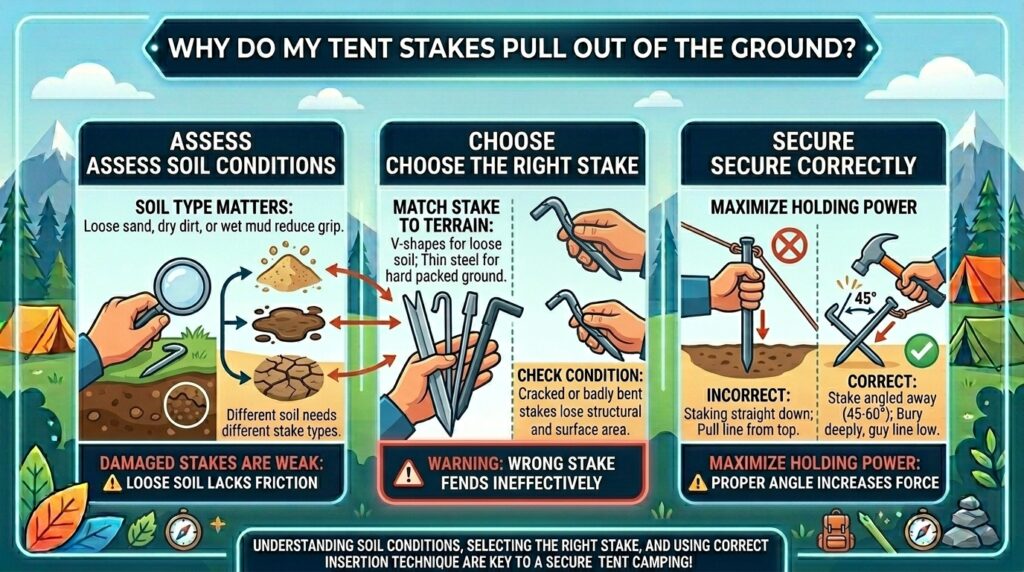
The single most common mistake campers make is driving stakes straight down into the ground at a 90-degree angle. When a stake is vertical, the upward pull of the guy line aligns perfectly with the exit path of the stake, making it incredibly easy for the wind to yank it straight up.
2. Low Soil Density (Sand, Snow, and Mud)
Standard stakes rely on tight, compacted dirt to hold them in place. If you are camping on a sandy beach, loose forest duff, thick mud, or fresh snow, the soil particles easily slide past one another. The stake doesn’t have enough surface area to grab onto anything solid.
3. Using the Wrong Stake Profile
If you are using thin, smooth metal wire skewers in loose or wet soil, they will pull out instantly. Smooth metal provides almost no frictional resistance against loose earth. You need specific geometric profiles to bite into different soil types.
4. Soil Saturation (The Rain Factor)
A campsite that held perfectly dry during the afternoon can fail completely during a midnight downpour. As water saturates the dirt, it turns hard earth into liquid mud, drastically reducing the soil’s shear strength and allowing the stake to slide out effortlessly.
5. Inadequate Guy Line Tension Adjustment
Tents naturally stretch when they get wet or cold (especially nylon tents). When the fabric sags, it slaps violently against the wind. This creates a rhythmic, hammering “jerk” action on the guy line that slowly pumps the stake upward until it breaks free.
6. The Stake is Too Short
Standard 6-inch stakes work well in stiff backyard lawns, but they do not penetrate deep enough to bypass the loose organic topsoil layer of a natural forest or beach.
How to Stop Tent Stakes from Pulling Out
Fixing this problem requires a combination of the right gear, proper angles, and advanced backcountry rigging techniques.
Step 1: Master the 45-Degree Angle Rule
Always drive your stakes into the ground at a 45-degree angle pointing directly away from the tent. This forces the upward pulling force of the guy line to pull against the entire length of the buried shaft, maximizing soil friction and resistance.
Step 2: Upgrade Your Stake Geometry
Match your stake’s shape to your campsite environment:
- For Loose Soil/Sand: Use U-shaped, T-flanged, or wide plastic stakes. The wider the face of the stake, the more soil it has to plow through to escape.
- For High Winds: Use Y-beam aluminum stakes (like the MSR Groundhog). The three-sided design locks into the earth and resists twisting or pulling out under multi-directional wind loads.
- For Maximum Hold: Use Screw-in pegs. These physically thread into the earth like a drywall anchor, offering the highest pull-out resistance on the market.
Advanced Backcountry Rigging: The “Deadman Anchor”
What happens if your stakes keep pulling out and you don’t have specialized sand or snow pegs? You use an advanced outdoor survival technique called the Deadman Anchor.
                       [Tent Guy Line]
                             /
                            /
      _____________________/_____ [Ground Level]
     |                    /      |
     |        =======O===/       |
     |        [Buried Log/Rock]  |
     |___________________________|
- Tie your tent’s guy line securely around the middle of a thick, heavy stick, a log, or a large flat rock.
- Dig a trench 6 to 12 inches deep in the loose sand, snow, or mud.
- Place the stick or rock horizontally inside the trench.
- Bury the object completely, compacting the sand or snow firmly on top of it.
- The immense weight of the buried mass makes it virtually impossible for the tent to pull the anchor out.
Emergency Field Fixes: What to Do Tonight
If your stakes are pulling out right now and you are stuck in a storm, try these immediate fixes:
- The Big Rock Trick: Drive your stake in as best as you can, then find a massive boulder (15-20 lbs) and place it directly on top of the buried stake head. This physically pins the anchor down.
- Double-Staking: Drive two stakes into the ground, one behind the other, about 6 inches apart. Loop the guy line around the first stake, then run an extra piece of cordage from the first stake to the second stake. This distributes the wind load across two anchors.
- Tree/Root Anchoring: If the ground won’t hold, bypass the ground completely. Extend your guy lines using extra paracord and tie them directly to the bases of nearby trees, heavy bushes, or exposed, sturdy roots.
Frequently Asked Questions (FAQ)
Why do my stakes pull out but my friends’ stakes stay put?
They are likely using stakes with a wider profile (like Y-beams or V-stakes) or driving them at a more aggressive 45-degree angle. Check their setup and compare it to yours.
Does the loop at the top of the stake matter?
Yes. Your guy line should be hooked underneath the notch or notch-hook of the stake as close to the ground as possible. If the guy line is pulling from the very top tip of a high-protruding stake, it creates leverage that easily pulls the peg out.
How deep should a tent stake be driven?
Ideally, a tent stake should be driven completely flush with the ground, leaving only the guyline loop exposed. This minimizes the leverage the wind has to pull it out and prevents it from becoming a tripping hazard.
Summary: A Bulletproof Setup
Stakes pull out because of bad angles and low-surface-area gear. To prevent anchor failure on your next trip:
- Pitch at a 45-degree angle away from the tent.
- Drive the stake completely flush with the earth.
- Switch out thin wire pegs for Y-beam aluminum or wide U-shaped plastic anchors depending on your terrain.
Keywords: tent stakes pulling out of ground, how to secure tent stakes in loose soil, best tent pegs for wind, sand camping tent anchors, deadman anchor camping, tent staking techniques, fix loose tent.