

When pitching a tent, most campers don’t give a second thought to how far their pegs are entering the dirt. You hammer it until it feels relatively firm, throw the guy line over it, and call it a day.
But getting the depth wrong is one of the leading causes of ruined camping trips. If a stake is too shallow, a gust of wind will yank it right out. If you try to force it too deep into the wrong terrain, you risk snapping or bending your expensive gear.
So, how deep should a tent stake actually be driven?
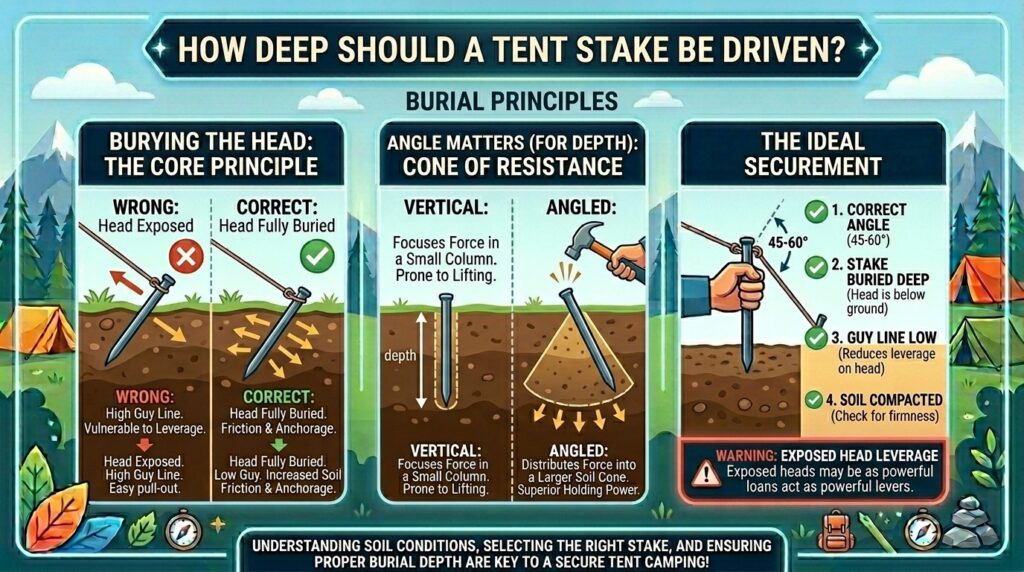
The definitive rule of thumb is that a tent stake should be driven completely flush with the ground, leaving only the notch or hook exposed. This minimizes the leverage the wind has to pull it out and maximizes soil friction. However, the exact depth depends heavily on your stake length, soil type, and weather conditions.
In this comprehensive guide, we will break down the precise mechanics of tent stake depth, how to handle different soil profiles, and the crucial mistakes you need to avoid to keep your shelter secure.
1. The Core Rule: Why “Flush with the Ground” is Non-Negotiable
Many beginners leave 2 to 3 inches of the stake protruding from the dirt because it makes the stake easier to pull out when breaking camp. This is a major structural mistake.
Leaving a stake partially exposed creates a high leverage point. When the wind catches your tent, the guy line pulls at the top of that exposed metal. This turns the stake into a lever, allowing the wind to easily rock it back and forth, loosening the surrounding soil until the anchor fails completely.
INCORRECT (High Leverage)          CORRECT (Zero Leverage)

       [Guy Line]
          \                                   \ [Guy Line]
           \                               ____\___________ [Ground]
          __|__ [Ground]                  |    X           |
         |  X  |                          |    X           |
         |  X  |                          |    X           |
         |_____|                          |____X___________|
     (Acts as a lever;                (Force is distributed
     easily pulls out)                 deep underground)
When you drive the stake completely flush, the upward physical force of the guy line pulls directly against the solid mass of the earth, distributing the load evenly across the entire buried shaft.
2. Soil vs. Depth: A Quick-Reference Matrix
Standard tent stakes are typically 6 to 8 inches long, but varying ground conditions require different depths and specialized lengths.
| Soil Type | Ideal Stake Length | Required Buried Depth | Best Stake Type |
| Hard-Packed Dirt/Clay | 6 to 7 inches | Flush (100% buried) | Forged Steel or Aluminum V-Pegs |
| Rocky/Alpine Ground | 6 inches | As deep as possible until hitting rock | Heavy-Duty Rock Pegs |
| Loose Forest Duff/Loam | 8 to 10 inches | Flush (100% buried) | Aluminum Y-Beams (e.g., MSR Groundhog) |
| Sand or Snow | 12 to 18 inches | Deep burial / Sub-surface anchoring | Wide ABS Plastic or Snow Flukes |
3. How Terrain Changes the Depth Rules
A. Hard-Packed Clay and Gravel
In highly compacted earth, driving a standard 8-inch stake all the way flush can be incredibly difficult. If you hit a subterranean rock layer at 4 inches, do not keep hammering. Forcing it will bend or shatter the peg.
- The Fix: If you cannot get the stake flush, pull it out and re-drive it at a more aggressive 45-degree angle, which allows it to travel horizontally through the shallower, softer topsoil layer while still remaining low to the ground.
B. Forest Duff and Loose Loam
Forest floors are often covered in a thick layer of decomposing leaves, twigs, and soft organic matter. This top 3 inches of soil has almost no holding power.
- The Fix: If you use a standard 6-inch stake here, only 3 inches of it will be gripping real dirt. For forest floors, you need to upgrade to longer 9-to-10-inch stakes to ensure the lower half of the anchor penetrates deep into the dense subsoil beneath the loose debris.
C. Sand and Snow
In sand and snow, standard depth metrics are completely useless. A 6-inch peg driven flush will slide right out under the slightest tension.
- The Fix: You need specialized sand/snow stakes that are at least 12 to 16 inches long. Alternatively, you must abandon traditional vertical staking altogether and use the “Deadman Anchor” technique, where the stake is tied horizontally to the guy line and buried 1 to 2 feet completely under the surface.
4. The 3 Most Common Stake Depth Mistakes
Avoid these frequent campsite errors to ensure your tent stays firmly pinned to the earth:
- The Tripping Hazard: Leaving stakes protruding several inches out of the ground turns your tent perimeter into a minefield of obstacles, especially at night. Stepping on a protruding stake can injure your foot, bend the stake, or rip the tent’s guy line loops.
- Driving at a 90-Degree Angle: Never drive a stake straight down into the dirt. Always angle it at 45 degrees pointing away from the tent. This maximizes the resistance against the upward and inward pull of the tent’s rainfly.
- Using Your Boot to Drive the Stake: Pressing a stake down with your foot often stops the moment you feel moderate resistance, leaving the stake dangerously shallow. Always use a proper rubber mallet or camping hammer to tap the stake flush with the ground safely.
5. Frequently Asked Questions (FAQ)
How do I pull a tent stake out if it is driven completely flush?
Because flush stakes are hard to grab with your fingers, most high-quality stakes come with a small loop of pull-cord attached to the head. Simply slip another stake, a stick, or a dedicated stake-remover tool through that cord loop and pull upward.
What should I do if the ground is too hard to drive the stake flush?
If the ground is impenetrable, drive the stake as deep as it will comfortably go without bending. Then, find a heavy, flat boulder (weighing at least 15–20 pounds) and place it directly on top of the exposed stake head. This physically clamps the anchor down and prevents it from levering out.
Can a tent stake be driven too deep?
Technically, no—the deeper a stake is, the more holding power it has. However, if you drive it so deep that the hook or eyelet is buried beneath the dirt, it can cause mud and moisture to degrade your guy lines, and it will make the stake incredibly difficult to locate and retrieve when it’s time to pack up.
Summary: Checklist for a Perfect Pitch
To guarantee a bulletproof tent setup on your next adventure, run through this quick checklist for every single stake you drive:
- [ ] Is the stake pointing at a 45-degree angle away from the tent?
- [ ] Is the head of the stake driven completely flush with the soil level?
- [ ] Is the guy line hooked securely underneath the notch, as close to the ground as possible?
- [ ] Did you avoid forcing the stake past a subterranean rock obstacle?
By ensuring your anchors are driven to the proper depth, you can sleep soundly knowing your tent will withstand whatever the weather throws your way.
Keywords: how deep should a tent stake go, tent stake depth guide, how to drive tent stakes, camping gear tips, tent peg flush with ground, best way to hammer tent stakes, secure tent anchors.