

The Definite Packing Guide: How Many Tent Stakes Do You Actually Need for a Tent? Imagine this: you’ve driven three hours to an incredible remote campsite.
The sun is setting, the wind is picking up, and you unroll your tent only to realize you only have six stakes in your gear bag—but your tent has ten attachment points.
Getting the number of tent stakes wrong is a rite of passage for beginner campers, but it can quickly turn a relaxing weekend into a stressful survival situation.
So, how many tent stakes do you actually need for a tent?
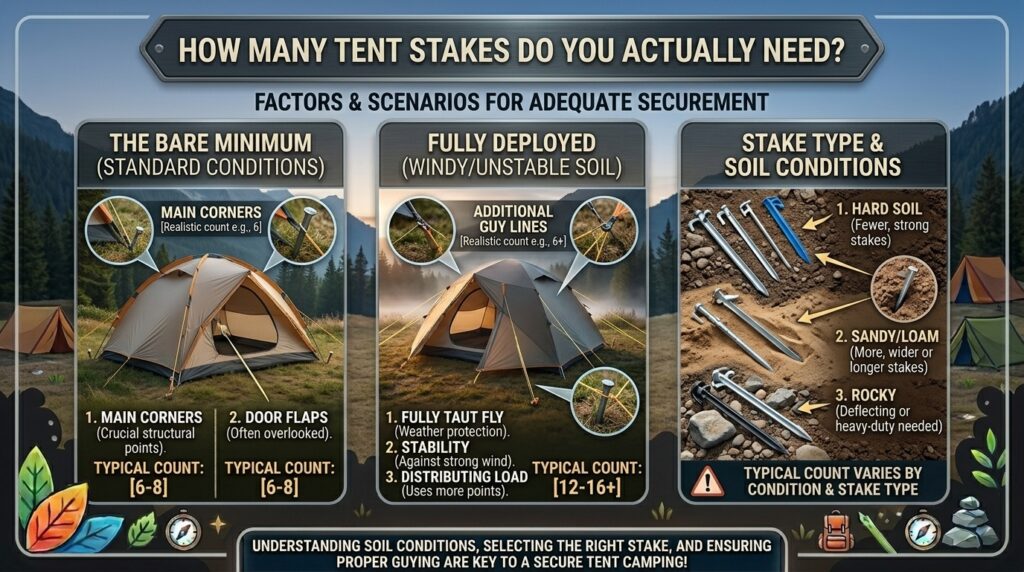
The short answer is: At an absolute minimum, you need enough stakes to secure the main corners of your tent body and your rainfly vestibules (usually between 4 and 8 stakes). However, to fully secure a tent against high winds and rain, you need a complete set that covers every single guy line and ventilation point (typically between 10 and 16 stakes).
In this guide, we will break down the exact math behind tent stakes, how tent size dictates your packing list, and why you should never leave the house with just the bare minimum.
1. The Golden Rule of Stake Calculation: Core vs. Full Pitch
When calculating your stake count, you must distinguish between a Core Pitch and a Full Storm Pitch.
    [Vestibule Stake]
          \
           \
     [Corner 1]-------[Corner 2]
         |               |
         |   TENT BODY   |
         |               |
     [Corner 3]-------[Corner 4]
           /
          /
    [Vestibule Stake]
The Core Pitch (The Bare Minimum)
This is what you need on a perfectly calm, clear night just to keep the tent standing and geometric.
- 4 Stakes for the main corners of the tent floor.
- 2 Stakes for the rainfly vestibules (the front and back flaps that open up to let you inside).
- Total: 6 Stakes
The Full Storm Pitch (The Maximum Protection)
This is what you need if there is a chance of rain, high winds, or changing weather patterns overnight.
- 4 Stakes for the tent floor corners.
- 2 to 4 Stakes for the vestibules and doors.
- 4 to 6 Stakes for the external guy lines (the ropes attached to the sides of the rainfly that pull the fabric taut and prevent the tent poles from snapping in severe wind).
- 2 Stakes for ground-level rainfly ventilation vents.
- Total: 12 to 16 Stakes
2. Stake Requirements by Tent Size (Quick Reference Table)
Tent sizing dictates how much fabric acts as a “sail” in the wind. Use this quick matrix to audit your gear bag before your next trip.
| Tent Size / Type | Core Pitch (Minimum) | Full Storm Pitch (Recommended) | Safe Number to Pack (Includes Spares) |
| 1-Person Backpacking Tent | 4 to 5 stakes | 8 to 10 stakes | 12 stakes |
| 2-Person Standard Tent | 6 stakes | 10 to 12 stakes | 14 stakes |
| 4-Person Family Tent | 6 to 8 stakes | 12 to 14 stakes | 16 stakes |
| 6+ Person Cabin Tent | 8 to 10 stakes | 16 to 20 stakes | 22 stakes |
| Ultralight Trekking Pole Tent | 6 stakes | 10 stakes | 12 stakes |
3. Why You Must Stake Out Your Guy Lines (Even on Warm Nights)
Many casual campers skip using the extra guy lines that dangle from the sides of their rainfly because they think stakes are only meant to keep the tent from blowing away. This is a critical misconception. Staking out your guy lines solves two invisible problems:
A. Condensation Prevention
When you stake out every guy line, you pull the rainfly completely taut and outward, away from the inner mesh tent body. If the rainfly sags and touches the inner mesh, the moisture from your breath (condensation) will transfer straight through into your sleeping bag, causing you to wake up wet.
B. Structural Integrity
Modern lightweight tents rely on a tension network. The poles bend to create shape, but the guy lines pull in the opposite direction to lock that shape in place. Without guy lines securely staked down, a 25 mph gust of wind can easily fold an aluminum or fiberglass tent pole completely in half.
4. The “Safety Buffer”: Why You Should Always Pack 4 Extra Stakes
No matter what the manufacturer’s manual says, never carry exactly the number of stakes your tent requires. You should always carry a safety buffer of 4 extra stakes for three distinct reasons:
- The “Crunch” Factor: As covered in our guide on Why Do Tent Stakes Bend So Easily?, hitting underground rocks can instantly ruin a cheap aluminum or steel peg. Having a spare means your setup isn’t compromised.
- The Mystery Disappearance: Tent stakes are notorious for vanishing into thick grass, autumn leaves, or deep sand when you break camp. Bright orange or yellow stakes help, but losses still happen.
- The Double-Staking Trick: If you encounter unexpected loose soil or high winds, you can drive two stakes into the ground in a “V” shape at a single guy line anchor point to double your holding power.
5. Frequently Asked Questions (FAQ)
Do freestanding tents actually need stakes?
Yes. While a “freestanding” tent means the pole structure allows the tent to stand up on its own inside your living room without pegs, it acts like a giant kite outside. A minor gust of wind can easily lift an unstaked freestanding tent and roll it across a campground—potentially with your gear still inside it.
What happens if I don’t have enough stakes for a trip?
If you find yourself short on stakes in the backcountry, look to your environment. You can use heavy boulders, thick logs, or wrap your guy lines around the bases of nearby trees or sturdy roots using a rolling hitch knot to secure your tent.
Should I buy different stakes than the ones that came with my tent?
Almost always. Most tents come packaged with the cheapest possible thin wire steel skewers. Upgrading to a set of 10 to 12 high-quality Y-beam aluminum stakes (such as the MSR Groundhog) will vastly improve your tent’s stability and lower your pack weight.
Summary: The Final Packing Checklist
Before you head out into the woods, lay your tent out in your backyard or living room and complete this simple audit:
- Every single loop at the bottom corners of the tent floor.
- Count every vestibule door tie-down point on the rainfly.
- Count every guy line loop stitched halfway up the walls of the rainfly.
- Add those numbers together, add 4 extra stakes for emergencies, and that is your magic number.
By keeping a fully stocked stake bag, you ensure that no matter how hard the wind blows or how rocky the ground is, your home away from home will remain safely anchored to the earth.
Keywords: how many tent stakes do I need, tent stake packing list, do freestanding tents need stakes, guy line setup camping, how many pegs for a 4 person tent, tent anchor guide, camping gear essentials.