Can I use sticks found in the forest instead of carrying backup stakes?

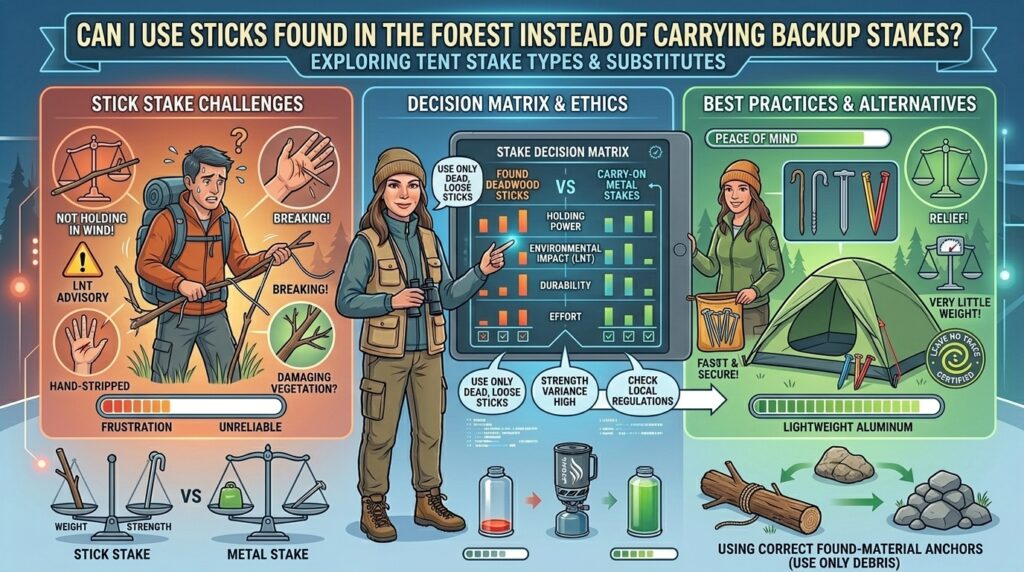
Can I use sticks found in the forest instead of carrying backup stakes? When preparing for a backcountry trip—whether you are packing ultralight for a trek through the high-elevation granite passes of California’s Sierra Nevadas, navigating the damp, root-filled coastal forests of Washington, setting up camp in the dense woodlands of New York, or exploring the rugged terrain of Texas—every ounce in your pack is heavily scrutinized.
It is a classic ultralight dilemma: Do I really need to carry a full set of backup tent stakes, or can I just carve sticks from the forest floor if one bends or breaks?
The short answer is yes, in an emergency or survival scenario, natural sticks can serve as functional tent stakes. However, relying on found wood as a planned substitute for backup stakes on a standard backpacking trip is fraught with structural risks, environmental Leave No Trace concerns, and severe vulnerability during high winds.
In this exhaustive, optimized guide tailored for besttentstakes.com, we will evaluate the physics of makeshift wooden stakes, examine when improvisation works (and when it fails catastrophically), compare natural wood against manufactured titanium and aluminum stakes, and provide expert tips for managing your stake kit in the backcountry.
1. The Physics of Tent Stakes: Manufactured vs. Natural Wood
To understand why carrying dedicated backup stakes is safer than trusting random forest debris, we must examine how tent stakes interact with the earth.
When a sudden alpine gust hits your tent wall, tremendous lateral and pulling forces are transferred down your guylines. A manufactured stake (such as a Y-beam aluminum stake or a titanium nail) is engineered with specific tensile strength, surface area, and cross-sectional geometry to maximize friction and resist bending.
When you substitute a stick found on the forest floor, you introduce massive structural variables:
- The Decay Factor (Rot): Unless you select a freshly fallen, dense hardwood branch, most wood lying on a moist forest floor has already begun internal decomposition. Dead, punky wood will snap instantly under sudden guyline tension.
- Lack of Uniformity: Natural branches taper unevenly, twist, and feature knots that make driving them straight into hard-packed or rocky soil nearly impossible without splintering the wood.
- The Slippage Problem: Manufactured stakes have notches, hook heads, or textured profiles designed to keep guyline cordage securely locked in place. A smooth stick will allow guyline loops to slide right up and slip off under tension, collapsing your shelter.
2. When Can You Successfully Use Sticks as Stakes?
While using sticks as primary gear is discouraged, knowing how to improvise a natural stake is an essential bushcraft and emergency survival skill. You can successfully use forest sticks if you meet specific environmental conditions and follow proper carving techniques.
Ideal Conditions for Improvised Stick Stakes:
- Soft, Loamy, or Forest Duff Soils: If the ground is deep, soft organic matter or damp forest loam, a stout, thick stick can be driven deep enough to gain adequate friction.
- Low-Wind Environments: If you are camped deep in a heavily sheltered valley or dense forest canopy where winds are negligible, makeshift stakes experience minimal stress.
- Emergency Survival Situations: If you accidentally lose your stake bag while miles deep on a remote trail in Washington or Northern California, foraging for wood is a viable temporary fix to keep your shelter up.
How to Craft an Effective Emergency Stick Stake:
- Select the Right Wood: Look for a living-fallen or very dry, dense hardwood branch (such as oak, maple, or hickory) roughly the thickness of a broom handle (at least 1 inch thick and 8 to 10 inches long). Avoid brittle pine or punky, spongy deadwood.
- Carve a Retention Notch: Using your pocketknife, carve a deep, clean notch or angle-cut near the top of the stick. This prevents the tent guyline loop from sliding up and slipping off the top.
- Sharpen the Tip: Whittle a clean, tapered point on the bottom end so it can penetrate the soil cleanly rather than mushrooming and splitting upon impact.
- Leave a Natural Branch Spur (Optional): If you find a sturdy branch with a small lateral twig shooting off near the top, trim it down to create a natural hook that anchors your guyline securely.
- Drive at an Angle: Insert the stick into the ground at a 45-degree angle pointing away from your tent, maximizing holding power against pulling forces.
3. The Hidden Dangers and Drawbacks of Relying on Forest Sticks
Planning to skip backup stakes in favor of forest foraging introduces several major drawbacks that can ruin a backcountry trip:
A. Environmental Impact (Leave No Trace Violations)
The Leave No Trace (LNT) principles explicitly state that campers should avoid damaging live vegetation and minimize disturbance to the natural landscape.
- The Issue: Ripping sturdy branches off standing trees, stripping bark, or scouring pristine forest floors for thick stakes damages local ecosystems and leaves unnatural scars on the landscape. In high-use recreation areas across California and New York, stripping down woody debris also disrupts micro-habitats for insects, fungi, and small ground-dwelling wildlife.
B. Severe Weather Vulnerability
If a midnight squall rolls across your campsite—bringing high winds common in exposed alpine areas or open Texas plains—improvised wooden stakes are the first point of failure. A snapped stick means a collapsed tent wall, leaving you exposed to wind and driving rain.
C. Time and Energy Consumption
After a grueling 10-mile day on the trail, the last thing you want to do is spend 30 minutes hunting for the “right” branches, stripping bark, whittling notches, and trying to hammer splintered wood into rock-hard or frozen dirt using a heavy rock. Dedicated metal stakes can be hammered into the ground in under 60 seconds.
4. Product Reviews: The Best Ultralight Backup Stakes to Carry Instead
Instead of gambling your shelter security on forest debris, carrying two or three dedicated backup stakes adds a negligible weight penalty (less than an ounce total) to your pack. Here are three top-tier backup stakes recommended for your kit.
1. MSR Groundhog Mini Stakes
- Best For: All-around durability and rock-solid holding power in diverse soils.
- Weight: 0.35 oz per stake (10g)
- Review: The smaller sibling of the legendary MSR Groundhog, the Mini version provides exceptional Y-beam holding power while packing down to just 6 inches. They are virtually indestructible, slip easily into a corner of your stake bag, and add almost zero weight to your pack.
2. Vargo Titanium Nail Pegs
- Best For: Rocky, hard-packed soil where aluminum stakes bend.
- Weight: 0.25 oz per stake (7g)
- Review: Crafted from solid titanium, these pin-style nail stakes can be hammered directly into hard rock strata, frozen ground, or dense roots without bending or breaking. They are the ultimate bulletproof backup stake to toss into your kit “just in case.”
3. MSR Carbon Core Stakes
- Best For: Ultralight minimalists who refuse to compromise.
- Weight: 0.2 oz per stake (6g)
- Review: Combining a carbon fiber core wrapped in an aluminum shell, these stakes offer an extraordinary strength-to-weight ratio. They provide reliable holding power and won’t weigh you down, ensuring you always have spare anchors when you need them.
5. Comprehensive Comparison Table: Improvised Sticks vs. Dedicated Backup Stakes
| Feature / Metric | Improvised Forest Sticks | MSR Groundhog Mini | Vargo Titanium Nail Pegs |
| Weight Penalty | 0 oz (Found on site) | 0.35 oz (10g per stake) | 0.25 oz (7g per stake) |
| Holding Power in Wind | Low to Moderate (Prone to snapping/slipping) | High (Y-beam design bites soil) | High (Rigid nail profile penetrates hard ground) |
| Time to Deploy | 5 to 15 minutes (Hunting, whittling, carving) | 15 seconds (Ready to drive) | 15 seconds (Ready to drive) |
| Leave No Trace Impact | Moderate to High (Disturbs forest floor/woodland) | Zero (Pack it in, pack it out) | Zero (Pack it in, pack it out) |
| Durability | Very Low (Rotten wood snaps under load) | High (Anodized aluminum resists bending) | Maximum (Solid titanium will not break) |
| Cost | Free | ~$3.00 per stake | ~$4.00 per stake |
6. Expert Tips: Smart Stake Management for Backpackers
To ensure you never find yourself forced to forage for broken branches in the middle of a storm, follow these professional gear management tips:
- Always Pack 2 to 10% Extra Stakes: Never pack the exact minimum number of stakes your tent requires. If your tent needs 6 stakes, carry 8. If you lose one in deep brush or bend one on a hidden rock, you have instant backups without resorting to bushcraft.
- Color-Code Your Stakes: Wrap a small band of bright reflective tape or neon flagging cord around the heads of your backup stakes. This prevents you from leaving them behind in tall grass or dark forest duff during early-morning pack-ups.
- Carry a Multi-Tool or Pocketknife: If you must improvise a stake in an absolute emergency, having a sharp knife to carve a secure retention notch is essential. Trying to tie a guyline to a smooth, un-notched stick usually ends with the line slipping off.
- Inspect Soil Conditions Before Pitching: In rocky regions like New England or parts of Washington, don’t force a thin aluminum stake straight into a boulder. Angle the stake or use a “deadman anchor” technique (tying your guyline to a heavy rock or log resting on the surface) instead of smashing your gear.
- Store Stakes Externally: Keep your soiled, muddy stake bag in an outside mesh pocket of your backpack rather than inside your main compartment, keeping your sleeping bag and clothes clean.
Frequently Asked Questions (FAQs)
1. Can I use sticks found in the forest instead of carrying backup stakes?
Yes, but strictly as an emergency backup or survival technique. For planned backpacking trips, relying on sticks is inefficient, damages the environment, and creates a high risk of tent collapse during high winds.
2. How do I keep a tent guyline from slipping off a smooth wooden stick?
You must use a pocketknife to carve a deep, clean retention notch near the top of the stick. Looping your guyline cord directly into this notch prevents it from sliding upward and slipping off.
3. What kind of wood makes the best emergency tent stake?
Select dense, freshly fallen hardwoods like oak, maple, or hickory that are at least 1 inch thick. Avoid softwoods or rotting, spongy deadwood found on damp forest floors.
4. How much extra weight do backup tent stakes add to my pack?
Carrying two dedicated ultralight backup stakes (like titanium nails or mini aluminum stakes) adds less than 0.6 ounces (17 grams) total to your pack weight—a negligible penalty for guaranteed shelter security.
5. Do improvised stick stakes violate Leave No Trace principles?
Yes, gathering wood from standing trees or extensively disturbing forest ground litter can violate Leave No Trace guidelines, as it removes organic habitat and leaves visible human alterations in natural areas.
6. What is a “deadman anchor,” and can I use it with rocks or logs?
If you cannot drive stakes into hard or rocky ground, a deadman anchor involves tying your tent guyline around a heavy rock or a thick log and burying it or weighting it down heavily on the surface.
7. Why do manufactured stakes hold better than sticks?
Manufactured stakes feature optimized cross-sectional geometries (like Y-beams or V-channels) and high-tensile strength that maximize friction against soil displacement, whereas natural wood is brittle, uneven, and prone to rotting.
8. Can I use sticks as stakes in sandy or snowy environments?
In deep sand or snow, standard stakes often pull straight out. In these conditions, burying a thick horizontal stick (acting as a “deadman toggle” anchor) attached to your guyline is actually a standard, highly effective winter survival technique.
9. What should I do if I bend a tent stake on the trail?
Do not throw it away immediately. Even a bent aluminum or titanium stake can often be hammered flat with a smooth rock and reused for the remainder of your trip.
10. Where is the best place to buy reliable backup tent stakes?
You can find high-quality, lightweight aluminum and titanium backup stakes at specialty outdoor retailers, camping supply stores, or online directly through resources like besttentstakes.com.
Conclusion
While carving a makeshift wooden stake out of forest debris is a fun bushcraft skill to practice in a survival simulation, relying on forest sticks instead of carrying backup tent stakes is a risky gamble. Between the threat of rotten wood snapping under pressure, the lack of proper guyline retention, and the needless disturbance of local woodland ecosystems, makeshift sticks are a poor substitute for dedicated gear.
By tossing two or three ultralight titanium or aluminum backup stakes into your kit on besttentstakes.com, you ensure absolute shelter security, protect the wilderness you came to enjoy, and guarantee a peaceful night’s sleep no matter what weather Mother Nature throws your way across California, Washington, New York, Texas, or beyond.