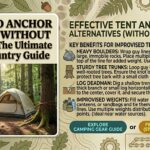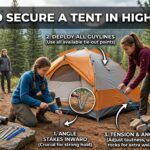

Camping high above the tree line in upstate New York’s Adirondacks, pitching a basecamp on the rugged rim of a canyon in West Texas, or setting up a shelter along a solid coral rock outcrop in the Florida Keys presents a daunting outdoor obstacle: How do you pitch a tent when the ground beneath you is solid stone?
When you are dealing with literal bedrock, attempting to hammer even the strongest forged steel peg into the surface will only result in a shower of sparks, shattered gear, and bent metal. Traditional staking is completely off the table.
However, securing your tent on solid stone is entirely possible if you swap raw downward impact force for the principles of friction, gravitational counterweight, and independent structural tension.
Knowing how to secure a tent on rock can mean the difference between a peaceful night and a collapsed shelter in the middle of the night. As your go-to resource for tent stakes and outdoor anchoring solutions, this massive guide covers proven techniques, gear recommendations, region-specific advice, safety tips, and more to help you camp confidently on rock.
Why Securing a Tent on Rock Is So Challenging
Rocks prevent stakes from penetrating deeply, leading to poor hold in wind. Sharp edges can abrade guylines. Uneven surfaces make stable pitching difficult. High winds in exposed rocky areas (common in NY mountains or Texas plateaus) amplify the problem.
Proper anchoring distributes force, protects your tent investment, and keeps you safe.
This comprehensive, data-driven guide analyzes the mechanical physics of pitching a shelter on rock, profiles the ultimate improvised backcountry anchor systems, and delivers fail-safe, step-by-step rigging techniques to ensure your tent stays completely immovable—even during a heavy mountain gale.
The 30-Second Verdict: The Counterweight Strategy
To safely secure a tent on solid rock, you must use a freestanding tent design and pivot completely away from ground penetration to a weight-based counter-tension system.
The golden rule of rock camping is the “Big Rock, Little Rock” (BRLR) technique. By wrapping your tent’s guylines around a small, manageable stone (the stopper) and sandwiching the line beneath a massive, immovable boulder (the weight), you create an incredibly robust friction anchor.
For maximum security in high winds, you must provide a minimum of 20 to 25 pounds of localized weight at every corner pull-out point to effectively counteract the upward lift of wind shear.
The Physics of Rock Anchoring: Tensile Pull vs. Friction Coefficient
When wind hits a tent pitched on a flat sheet of rock, it behaves like an airfoil, generating two distinct physical forces: lateral drag (trying to push the tent sideways) and vertical lift (trying to launch the tent into the air).
[ GALE-FORCE WIND ] ──► [ TENT RAINFLY SWELL ] ──► Creates Upward Lift & Lateral Drag
                                                          │
                                                          ▼
[ ROCK FRICTION MATRIX ] ◄── Cinch Tension ◄── [ 25-LB COMPRESSION BOULDER ]
A traditional stake driven into deep dirt resists these forces via the shear strength of the packed earth surrounding the metal shaft. On bedrock, your anchor must rely entirely on the friction coefficient between the stone anchor and the ground, paired with pure gravitational mass. Best tent pegs for hard ground.
If your anchor weights are too light, the tension of the rainfly will simply lift the rocks or slide them smoothly across the slick bedrock surface, causing the tent poles to buckle. By placing a heavy, dense stone directly over the guyline, you apply immense downward compression, forcing the rope to lock against the micro-textures of the bedrock.
Head-to-Head Spec Comparison: Rock Anchoring Tools
| Rigging Modality | Weight Added to Pack | Surface Adaptability | Holding Power (High Winds) | Leave No Trace (LNT) Compliance |
| “Big Rock, Little Rock” (BRLR) | 0 oz (Sourced on-site) | Excellent (Any rocky terrain) | High (Scale weight as needed) | 100% Perfect |
| Fabric Sand/Rock Parachutes | ~1.5 oz per pouch | Good (Requires loose gravel/stones) | High | 100% Perfect |
| Guyline Extension Cords | ~2.0 oz total | Excellent (Extends to distant anchors) | High | 100% Perfect |
| Freestanding Pole Clips | 0 oz | Moderate (Requires specific frame) | Low to Moderate | 100% Perfect |
Step-by-Step: The “Big Rock, Little Rock” (BRLR) Rigging Sequence
The BRLR method is the absolute industry standard for alpine climbers, desert overlanders, and wilderness backpackers. Follow this precise procedural sequence to lock down your shelter:
1.1. Gather your structural anchor stones:Select optimal stone geometry.
Scout your immediate surroundings for two distinct types of rocks for each guyout point. You need one “Little Rock” (roughly the size of a football or a brick, weighing 5 to 10 lbs) and one “Big Rock” (a massive, flat-bottomed boulder weighing at least 20 to 30 lbs).
2.2. Loop your guyline securely around the ‘Little Rock’:Construct the mechanical stopper loop.
Extend your tent’s guyline out fully away from the frame. Tie a wide loop at the very end of the line using a bowline knot, or open your existing plastic line slider loop. Slip this loop completely around the center axis of the Little Rock, pulling the cord taut so the rock is trapped inside the line.
3.3. Slide the Little Rock out and stack the ‘Big Rock’ on top:Apply primary compression force.
Pull the Little Rock away from the tent until the guyline is completely straight. Place the flat-bottomed Big Rock directly on top of the guyline, positioning it between the Little Rock and the tent body. The heavy boulder should directly sandwich the cord against the bedrock.
4.4. Tension the line using a friction knot or slider:Lock in structural counter-tension.
Slide the Little Rock flush against the backside of the Big Rock. The Big Rock provides the raw downward compression weight, while the Little Rock acts as a mechanical stopper that cannot physically pull through underneath the heavy boulder. Use your line runner or a taut-line hitch to cinch the system tight.
3 Advanced Alternative Tactics for Slick Bedrock
1. The Extended Guyline Matrix
On solid, smooth bedrock shelves, you may not find loose boulders near your tent footprint. Carry an extra 50-foot spool of 2mm reflective utility cord in your pack. Cut 10-foot extensions and tie them directly to your existing tent corner loops. This allows you to extend your anchor lines far past your immediate campsite to reach distant structural anchors, such as deep rock crevices, heavy fallen logs, or large established boulder fields.
2. Fabric Rock Parachutes / Pouch Anchors
If you are camping in an area with plenty of tiny, loose shale or crushed gravel but no large boulders, traditional rock stacking won’t work. Ultra-lightweight fabric rock pouches (or “snow/sand parachutes”) are small squares of heavy-duty nylon with cord loops at the corners. You lay the pouch flat on the rock, pile a few pounds of tiny gravel or shale directly into the center, pull the drawstrings closed to form a weighted beanbag, and clip it directly to your tent corners.
3. Wrapping Topographical Anchor Points
Examine the solid rock surface for natural structural geometry. Look for vertical rock flakes, small cracks, or horn-like protrusions in the stone. You can thread a thin guyline directly through a narrow rock crack and wedge a small pebble into the gap behind it to form a mechanical wedge anchor (similar to a climbing nut or chock block).
Crucial Posture & Frame Management Tips
The Abrasion Factor: Bedrock is highly abrasive. When high winds hit your tent, the guylines will shift and rub back and forth against the sharp, rough surfaces of your anchor stones. To prevent your expensive cords from snapping mid-storm, choose a heavy-duty nylon utility line with a tightly braided polyester sheath, or wrap a small piece of duct tape around the specific friction contact points where the rope passes beneath the stone.
Region-Specific Tips for USA Campers
New York (Adirondacks, Catskills, Hudson Valley) Rocky slabs and root-filled ground dominate. Master the big rock/little rock method. In winter, combine with snow techniques. Look for established rocky tent pads in popular sites.
Texas (Hill Country, Big Bend, State Parks) Hard-packed rocky soil and exposed outcrops. Use heavy rock weighting due to strong winds. Carry longer guylines for creative anchoring around boulders.
Florida & Miami Area Less common pure rock but possible on limestone outcrops, coastal rocky spots, or platforms. Combine with sand/deadman methods near beaches. High humidity and storms require daily anchor checks and UV-resistant cord.
Step-by-Step Setup Guide for Rocky Campsites
- Site Selection: Choose the flattest rock area with natural windbreaks and nearby large rocks.
- Prepare Guylines: Extend all tie-outs before pitching.
- Pitch the Tent: Use the tent body first if freestanding, then secure fly with rock anchors.
- Apply Anchors: Start with corners and door side, then guyouts. Tension evenly.
- Test Stability: Shake the tent and simulate wind. Adjust as needed.
- Final Check: Ensure no sharp edges touch lines or fabric.
Safety Considerations & Best Practices
- Never camp in flash flood zones or exposed ridgelines during storms.
- Use multiple anchors per side in high wind.
- Protect guylines from abrasion.
- Follow Leave No Trace: Return rocks to original positions.
- One person inside during high winds for stability.
- Combine with weather monitoring apps for NY, TX, or FL trips.
Common Mistakes to Avoid
- Using thin cord that slips or breaks.
- Placing rocks directly on tent fabric.
- Ignoring wind direction (reinforce windward side first).
- Relying on a single anchor point.
- Skipping extra guylines.
When to Use Traditional Tent Stakes vs. Rock Methods
High-quality stakes remain essential for many trips. On mixed terrain, they pair perfectly with rock weighting. Check our blog for the best tent stakes for rocky and hard ground.
Frequently Asked Questions About Securing a Tent on Rock
Q1: Can you pitch a tent on solid rock without damaging it?
Yes, you can safely pitch a tent on solid bedrock without causing any structural damage to the environment or your gear. To do this, you must use a freestanding tent design that maintains its shape independently via its pole framework. Instead of driving stakes into the ground, you rely on weight-based anchoring methods—such as stacking heavy trail boulders or using fabric rock parachutes—to anchor the guylines against wind forces.
Q2: What is the absolute best way to secure a tent guyline on bedrock?
The industry-standard method for securing a guyline on bedrock is the “Big Rock, Little Rock” (BRLR) technique. This involves tying a loop at the end of your guyline, placing a football-sized stone (the “Little Rock”) completely inside that loop, and pulling the line straight. You then place a massive, flat-bottomed 20- to 30-pound boulder (the “Big Rock”) directly over the guyline, sandwiching the cord to provide massive downward compression.
Q3: How much rock weight is required to hold a tent down in high winds?
For a standard 2-person or 3-person backpacking tent exposed to moderate alpine winds, you should allocate a minimum of 20 to 25 pounds of localized stone weight at every corner pull-out point. If you anticipate gale-force winds or are setting up a high-profile family camping tent, you must increase this weight threshold to 40+ pounds per corner to counteract the massive vertical lift.
Q4: How do you prevent sharp rocks from ripping your tent floor?
To prevent abrasive bedrock or sharp granite shards from puncturing your tent floor, you must always lay down a heavy-duty footprint, tarpaulin, or Tyvek ground cloth beneath your tent body. Ensure the footprint is tucked completely under the tent edges so it doesn’t collect rainwater. Additionally, clear away all loose, sharp shale, small pebbles, and pinecones from the stone shelf before setting up your frame.
Q5: What do I do if there are no large boulders near my rocky campsite?
If large boulders are completely unavailable on a smooth rock shelf, you should use the Extended Guyline Matrix tactic. By carrying an extra 50-foot spool of 2mm reflective utility cord (paracord) in your pack, you can cut and tie 10-foot extensions to your tent’s existing loops. This allows you to extend your lines far past your immediate campsite to reach distant structural anchors like deep rock cracks, heavy logs, or distant boulder fields.
Q6: Can you use standard aluminum stakes on rocky soil?
No, standard lightweight aluminum hook or needle stakes will instantly bend, warp, or snap if you try to force them into highly compacted rocky soil or gravel bars. If you are camping on rocky ground that isn’t solid bedrock, you must use heavy-duty forged steel stakes or titanium nail pegs designed specifically to pierce through gravel, hardpack, and small subterranean rocks without breaking.
Q7: What are rock parachutes and how do they work?
Rock parachutes (also known as sand or snow anchors) are ultra-lightweight square pieces of heavy-duty nylon featuring reinforced cord loops at each corner. They are designed for rocky regions that only have tiny shale, crushed gravel, or small pebbles. You lay the fabric pouch flat on the rock, pile several pounds of loose gravel directly into the center, pull the drawstrings tight to form a heavy beanbag anchor, and clip your guyline straight into it.
Q8: How do you adjust guyline tension when it’s anchored under a heavy rock?
To adjust your line tension when using rock anchors, you should utilize your tent’s built-in plastic line runners or tie a taut-line hitch knot before you place the heavy boulder over the cord. Leave a few inches of slack in the line, position your “Big Rock” securely over the rope, and then slide the plastic runner or friction knot toward the stone anchor to cinch the line completely taut.
Q9: Will putting heavy backpacks inside the tent keep it from blowing away on rock?
Placing heavy backpacks, water jugs, and duffel bags inside your tent will keep the physical structure from lifting off the ground like a tumbleweed, but it will not protect the tent frame or rainfly. Without external guyline anchors, high wind shear will slam directly into the unsupported rainfly, causing the aluminum poles to bend, buckle, and potentially snap right onto your sleeping area.
Q10: How do I protect my tent guylines from fraying against rough stone?
Constant wind will cause your tent guylines to rub back and forth against the rough, abrasive edges of your anchor stones, leading to snapped lines mid-storm. To prevent this, use high-strength polyester-sheathed utility lines which resist abrasion much better than pure nylon. Alternatively, you can wrap a small strip of heavy-duty duct tape around the specific friction contact points where the rope passes beneath the rock.
Final Thoughts: Conquering the Hardest Terrain
Pitching a tent on solid rock forces you to think like an engineer rather than a traditional camper. By shifting your mindset from ground penetration to gravitational counter-tension, choosing a rigid freestanding shelter, and mastering the “Big Rock, Little Rock” method, you can confidently pitch your camp across any stone shelf in the United States—completely stable, secure, and entirely compliant with Leave No Trace ethics.