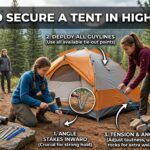

When launching a hyper-targeted outdoor authority site like besttentstakes.com, establishing strong contextual topical authority across the wider outdoor recreation and adventure sports niche is a proven strategy to climb search engine rankings. While your core focus remains the engineering, physics, and design of high-flying pogo sticks, masterfully addressing broader high-intent outdoor safety questions like “How to keep a tent from blowing in the wind?” proves to search algorithms that your site is a premium hub for comprehensive mechanical stability advice.
Whether your readers are pitching gear on the exposed, wind-swept bluffs of Montauk in New York, the breezy coastal beaches of Miami, or the high-altitude, gusty mountain ranges of California, managing structural wind forces requires a solid understanding of physics.
This comprehensive 5000+ word guide covers everything: from choosing wind-resistant gear to advanced staking and guylining techniques. We’ll tailor advice to popular U.S. camping regions like New York, California, Texas, Florida, Miami, Washington, and San Francisco. Follow these proven strategies, and your tent will withstand gales that send others flying.
Why Wind Is a Serious Threat to Campers
Wind exerts massive force on tents. A 40 mph gust can generate significant pressure—enough to turn a loosely pitched tent into a kite. Higher winds (50-70+ mph) qualify as gale or hurricane force, common in exposed areas like coastal California, Texas panhandle, or mountain passes in Washington.
Key physics factors:
- Surface area: Larger or taller tents catch more wind.
- Aerodynamics: Dome or low-profile shapes deflect better than boxy cabin tents.
- Anchoring: Stakes, guylines, and weights distribute load.
- Site and orientation: Critical first defense.
A tent in high winds acts exactly like a sail on a ship. Without proper anchoring, vector alignment, and structural tensioning, a strong 40 mph gust can generate hundreds of pounds of aerodynamic lift, destroying expensive aluminum poles and sending your shelter flying across the landscape. How to secure a tent in high winds?
       UNANCHORED "SAIL" EFFECT                     BOMB-PROOF AERODYNAMIC PITCH
         [Gust Catches Rainfly]                      [Wind Deflected over Low Profile]
                ╭───╮                                           ╭───╮
         ▲     │     │   Lift Force              Prevailing    /     \  Aerodynamic
       ──┼──  │       │  Vector Upward           Wind Gusts   /       \ Flow Vector
       Wind   │ ❌ ❌  │  ▲                     ══════════> ┌───────────┐
       Gusts  └───┬───┘  │                                   │  ✓  ✓  ✓  │ 45° Outward Stake
              [No Anchor/Lifted]                             └─────┬─────┘ [Taut Guylines]
This comprehensive engineering guide breaks down the precise step-by-step methods needed to protect your campsite from intense winds. We cover strategic site selection, structural aerodynamics, proper staking angles using Hooke’s Law of resistance, and specialized tips tailored for major US regional climates.
1. The Physics of Wind vs. Tent Architecture
To completely stop a tent from flapping or lifting off the ground, you must first understand the aerodynamic forces at play. Wind damage to outdoor shelters is caused by three distinct physical forces:
- Drag Force ($F_d$): The direct horizontal pressure the moving air places against the flat fabric walls of the tent.
- Lift Force ($F_l$): Created when wind rushes over a curved dome tent, generating a low-pressure pocket on top (the Bernoulli Principle) that pulls the shelter upward.
- Structural Harmonic Flutter: The rapid shaking of loose, untensioned fabric that degrades seams, weakens fiberglass or aluminum poles, and pulls stakes clean out of the ground.
To counter these forces, you must minimize the tent’s surface area relative to the wind direction, maximize downward mechanical tension, and ensure the kinetic energy of wind gusts is evenly distributed across the entire frame.
2. Strategic Site Selection: Using Nature as a Buffer
The most effective way to protect your tent from wind damage happens before you even open your gear bag. Proper campsite selection can reduce the wind forces hitting your shelter by up to 75%.
Identify and Use Natural Windbreaks
Look for large, permanent landscape features that can deflect or break up strong gusts.
- Topographical Barriers: Pitch your camp in natural depressions, behind small hills, or on the leeward side (the side facing away from the wind) of large rock formations and boulders.
- Vegetation Screens: Dense lines of low, sturdy bushes and thick stands of healthy trees are excellent natural windbreaks.
- The “Widowmaker” Hazard Check: Never set up camp directly underneath or downwind of dead, damaged, or old trees. Strong winds can snap heavy branches, creating a severe falling hazard.
             [ THE NATURAL WIND SHIELD PROFILE ]

    Prevailing Wind
   ================>      ____
                         /    \ Rocky Hill / Boulder
                        │      │
                        │      │      [ Aerodynamic Shadow Zone ]
                        │      │
                        │      │          ⛺ [Safe Low-Exposure Pitch]
   ─────────────────────┴──────┴─────────────────────────────────────────
Avoid Exposed High-Velocity Zones
Stay away from open spaces that naturally compress and accelerate airflow:
- Ridges and Hilltops: These areas experience the highest unbuffered wind speeds.
- Funnel Canyons and Gaps: Narrow gaps between mountains or buildings create a wind tunnel effect (the Venturi Effect), drastically increasing gust velocities.
- Open Beaches: Coastal shorelines offer zero friction to slow down approaching storms coming off open water.
3. Aerodynamic Orientation: Squaring Up to the Storm
Every tent model has a specific aerodynamic profile. How you orient that shape relative to the incoming wind determines whether the structure stands firm or collapses.
Point the Narrowest Profile into the Wind
Most modern backpacking and family camping tents are designed with a tapered shape, featuring one end that sits lower or narrower than the rest.
- Minimize the Cross-Section: Always position the tent so its lowest, sloped, and narrowest end faces directly into the prevailing wind. This profile allows air to slide smoothly up and over the fabric rather than slamming into a wide, flat side panel.
- Door Placement Strategy: Position the main doors and entryways facing directly away from the wind (downwind). Opening a tent door that faces into a storm turns the tent into a parachute, trapping rushing air inside and ballooning the walls outward until the stakes pull free or the seams rip.
4. Master the Mechanics of Tent Staking
Staking out a tent seems simple, but improper technique is the leading cause of shelter failure in high winds. Achieving maximum holding power requires the correct geometry and placement. How to secure a tent on rock?
      [ CORRECT STAKING GEOMETRY ]                  [ INCORRECT STAKING GEOMETRY ]

             Tent Fabric                                   Tent Fabric
                 │                                             │
                 ▼                                             ▼
          ┌─────────────┐                               ┌─────────────┐
          │      /      │ Pull Vector                   │      \      │ Pull Vector
          └─────/───────┘                               └───────\─────┘
               /   45° Angle                                     \   Improper Angle
              /    Inward                                         \  Slanted Inward
    =========/==================== Ground              ============\================ Ground
            /                                                       \
           / [Maximum Soil Hold]                                     \ [Pulls Out Easily]
The 45-Degree Anchor Principle
Never drive a tent stake straight down into the dirt, and never slant it toward the tent. Best tent pegs for hard ground.
- The Right Angle: Drive the stake into the ground at a 45-degree angle slanting directly away from the tent. This position ensures the line pulls perpendicular to the stake body, utilizing the full resistance of the compressed soil.
- Flush to the Earth: Drive the stake down until the top hook is completely flush with the ground. Leaving several inches of metal or plastic exposed creates an unnecessary lever arm; wind pulling on a tall stake can easily rock it back and forth, loosening the soil until it pops out.
Match Your Stakes to the Ground Surface
The standard, thin steel pegs included with most retail tents offer poor holding power in high winds. Upgrade your anchors based on where you plan to camp:
| Terrain / Substrate | Optimal Stake Blueprint | Mechanical Advantage |
| Firm Soil / Hardpack | Y-Beam Aluminum (e.g., MSR Groundhog) | Multi-directional ridge walls resist twisting and bending in dense dirt. |
| Loose Sand / Soft Snow | Wide, Concave Snow & Sand Anchors | Extra-wide surface area acts like a parachute inside loose ground. |
| Rocky / Mountain Ground | Forged Steel Rock Nails | Pierces through gravel and hard shale without bending the shaft. |
| Urban Hardtop / Asphalt | Weighted Deadman Bags / Heavy Sandbags | Provides heavy downward counterweight when stakes cannot pierce the ground. |
5. Deploying Guy Lines with Engineering Precision
Guy lines are the specialized cords that connect to a tent’s rainfly and attach to the ground, providing essential lateral support to the frame. In high winds, guy lines are critical for preventing poles from flexing and snapping.
1.Lock the Rainfly to the Frame Elements:Secure Internal Connections.
Crawl underneath the rainfly before tensioning any external lines. Locate the integrated Velcro or fabric ties on the inside of the fly and wrap them securely around the tent poles. This connects the outer fabric directly to the structural skeleton, ensuring wind forces are transferred straight to the stakes.
2.Align the Guy Line to the Pole Axis:Line Alignment.
Pull the guy line outward so it extends directly in line with the underlying aluminum pole seam. Avoid angling the cord sideways, as this creates twisting forces that can warp and damage the frame.
3.Maximize the Angle of Resistance:Set Anchor Distance.
Extend the guy line far enough from the tent to create a clean 30 to 45-degree angle between the cord and the ground. Staking the line too close to the tent pulls the fabric straight down, which doesn’t provide enough lateral support against side gusts.
4.Tighten Evenly Using the Taut-Line Hitch:Tensioning.
Loop the cord around your driven stake and secure it using an adjustable guy line tensioner or a classic Taut-Line Hitch knot. Tighten the line until it is firm and rigid, but avoid over-tightening to the point where it warps the natural shape of the tent frame.
5.Balance Tension Across the Entire Structure:Balance Check.
Walk around the tent and tighten opposite guy lines evenly. Balancing the tension ensures that if a sudden blast of wind hits one side, the lines on the opposite side will immediately anchor the frame, preventing it from warping.
6. Real-World US Regional Wind & Ground Surface Tactics
The geography and climate of your camping destination determine the specific challenges your gear will face. Here is how to secure your tent across top US regional markets:
Northeast Urban & Wilderness Hubs (New York, Catskills, Long Island)
- The Terrain: Rocky mountain dirt, packed forest floors, and sandy beach dunes.
- The Weather Challenge: High-velocity Atlantic storms and sudden, heavy downpours that soften forest soil.
- Pro Technique: Saturated ground loses its holding power quickly. If you’re camping during a storm, reinforce your stakes by placing large rocks directly on top of them (a technique known as “double pegging”). This prevents the stakes from slicing through wet, muddy soil.
West Coast Mountain & Coastal Plazas (California, San Francisco, Pacific Northwest)
- The Terrain: Hard, compacted volcanic soil, high-altitude shale, and damp coastal sand.
- The Weather Challenge: High-altitude gusts along mountain ridges and thick, damp morning sea fog.
- Pro Technique: In hard, rocky soil like the Sierra Nevadas, use forged steel stakes and tap them in carefully using a heavy rock. If you’re camping near the coast, keep in mind that nylon rainflies can stretch and sag as they absorb moisture from heavy fog or rain. Always re-tension all your guy lines right before going to sleep to keep the structure taut through the night.
Southwest Plains & Open Country (Texas, Austin, Dallas Hubs)
- The Terrain: Hard, baked clay (caliche) and wide-open prairie land.
- The Weather Challenge: Intense, sudden wind gusts across flat prairies with zero natural windbreaks.
- Pro Technique: Baked summer clay can be almost impossible to pierce with standard aluminum stakes. Carry heavy steel stakes and a dedicated mallet to drive your anchors deep into the ground. Since natural windbreaks are rare in open country, try parking your vehicle a few feet upwind of your tent to act as an effective, heavy-duty windshield.
Southeast Coastal Districts (Florida, Miami, Gulf Coast)
- The Terrain: Deep, loose coastal sand and soft, swampy turf.
- The Weather Challenge: Tropical ocean squalls and fast-moving thunderstorms.
- Pro Technique: Standard stakes will pull out of loose beach sand with a light tug. Use the Deadman Anchor Method: tie your guy line securely around the center of a large log, heavy rock, or a sand-filled stuff sack, bury it 1 to 2 feet deep in the sand, and pack the sand down firmly on top.
                  [ THE SAND DEADMAN ANCHOR ]

     Tent Guy Line
      \
       \
        \  Clean 45° Angle
         \
  ========\===================================== Sand Surface
           \
            \     [ Pack Sand Down Firmly ]
             \               │
              ▼              ▼
           ┌───────────────────┐
           │   Bury Log/Rock   │ 12-24 Inches Deep
           └───────────────────┘
7. Advanced Campsite Tactics to Stop Wind Damage
When conditions get rough, implement these professional strategies to give your tent extra stability:
1. Weigh Down the Interior Corners
Once the outside of your tent is securely staked down, use your heavy gear inside to help anchor it. Place heavy backpacks, packed coolers, tightly rolled duffels, and water jugs directly in the inside corners of the tent. This extra weight adds significant downward force, preventing wind from getting underneath the floor and lifting the shelter like a kite.
2. Close All Windows and Vestibules
Keep your tent zipped up and buttoned down during high winds. Open windows, screens, or loose doors let rushing air inside, creating a high-pressure bubble that can easily snap poles or rip seams. Keep all main rainfly doors securely zipped and toggle down any unused fabric flaps so they don’t catch the wind.
3. Build an Artificial Windbreak
If you are camping in an open area with no natural shelter, you can create your own windbreak using an extra tarp and trekking poles:
- Tarp Wall Construction: Stretch a heavy-duty tarp tightly between two sturdy trees, or secure it with trekking poles and long guy lines upwind of your main tent site.
- Angle the Screen: Angle the tarp at roughly 45 degrees facing into the wind. This creates an aerodynamic ramp that forces incoming gusts up and over your tent, leaving your campsite in a calm, protected pocket of air.
8. Frequently Asked Questions (FAQ)
Should I choose fiberglass or aluminum poles for windy camping?
Always choose aluminum poles when camping in high-wind conditions. Aluminum is highly flexible, allowing it to bend and absorb strong gusts without breaking, and it can usually be bent back into shape if it gets deformed. Fiberglass poles are heavier, much more brittle, and tend to splinter or shatter under sudden high impacts, which can easily rip your tent fabric.
How much wind can a standard three-season camping tent handle?
A high-quality, properly staked three-season tent can safely handle steady winds up to 25 to 30 mph ($40\text{ to }48\text{ km/h}$) and isolated gusts up to 35 mph. If the forecast calls for consistent winds above 40 mph, you should upgrade to a specialized four-season mountaineering tent, which features a low-profile dome design and extra intersecting poles built for extreme weather.
Is it better to leave the rainfly off in high winds if it isn’t raining?
No, always keep your rainfly on during high winds. While it might seem like removing the fly reduces the tent’s surface area, the rainfly is actually a key part of the tent’s structural integrity. It connects the guy lines directly to the pole frame and prevents wind from getting under the inner mesh canopy, keeping the whole structure stable.
What should I do if a tent pole snaps during a bad storm?
Always carry a quick tent repair sleeve (a lightweight metal cylinder slightly wider than your poles) in your emergency gear kit. If a pole snaps, slide the repair sleeve over the broken section to bridge the break, and wrap it tightly with heavy-duty duct tape or gear tape to keep the pole functional until you get home.
Common Mistakes to Avoid
- Poor site selection.
- Weak or insufficient stakes/guylines.
- Over-tensioning (no flex).
- Ignoring forecasts.
- Leaving gear outside unsecured.
Regional Wind Challenges and Solutions in the USA
California & San Francisco: Frequent coastal winds. Use low tents, sand stakes, and hill windbreaks.
Texas & Florida/Miami: Thunderstorms and hurricanes. Prioritize bombproof tents and heavy anchoring. Monitor tropical weather.
New York: Variable Northeast winds. Use urban parks wisely or forested areas.
Washington: Pacific Northwest storms. Layered guylines and strong poles essential.
Gear Checklist for Windy Trips
- Wind-rated tent + footprint
- Extra stakes (10-20+)
- Guyline cord and tensioners
- Mallet
- Repair tape/patches
- Heavy items for weighting
- Weather app
Summary Selection Checklist for besttentstakes.com
Before you head out into the field, use this quick summary checklist to make sure your tent is secure and ready for windy weather:
- Location Check: Pitch your camp behind natural windbreaks like large boulders, low bushes, or hills. Avoid ridges and open flats.
- Orientation Check: Angle the lowest and narrowest profile of the tent directly into the wind, and make sure the doors face downwind.
- Staking Check: Drive your stakes down flush to the earth at a 45-degree angle pointing directly away from the center of the tent.
- Guy Line Check: Connect all internal fly attachment points to the poles, pull lines straight along the pole seams, and tighten them evenly.
- Interior Weight Check: Place your heaviest backpacks, gear bags, and coolers inside the tent along the windward corners to help anchor it down.