
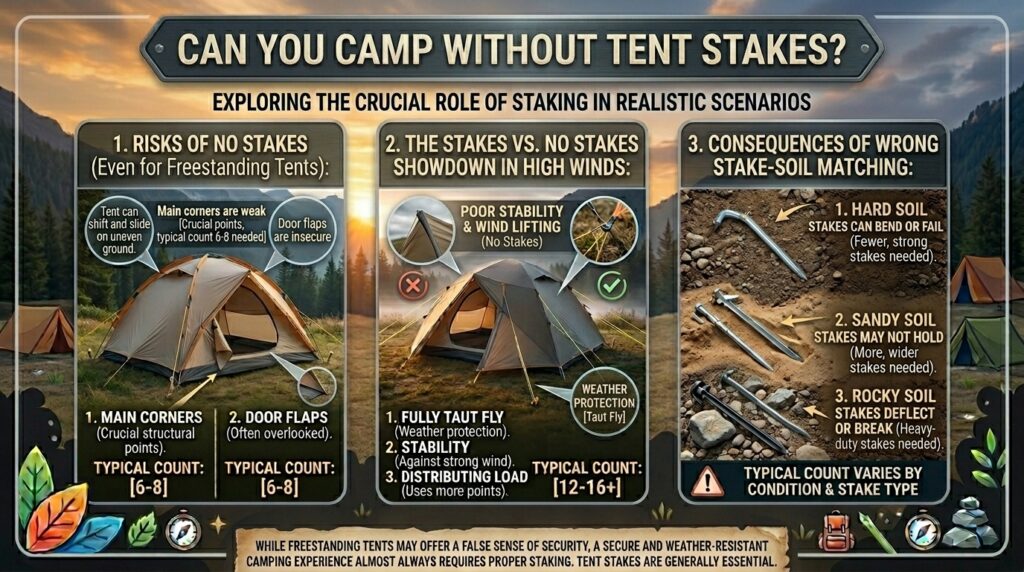
It is a camper’s worst nightmare. Can You Camp Without Tent Stakes? You hike five miles deep into the wilderness, find the perfect scenic clearing, unroll your tent, and reach into your pack—only to realize your tent stake bag is sitting comfortably on your garage workbench at home. Or perhaps you’ve arrived at a campsite only to find the ground is solid, impenetrable rock or loose, shifting beach sand where standard pegs are completely useless.
This leaves you with a crucial question: Can you actually camp without tent stakes?
The short answer is yes, you can absolutely pitch a tent without tent stakes. While stakes are the most convenient way to anchor a shelter, you can successfully secure both freestanding and non-freestanding tents using natural campsite elements like heavy rocks, logs, sturdy trees, buried objects (deadman anchors), or specialized sandbags.
In this ultimate comprehensive guide, we will teach you the physics of stakeless camping, step-by-step methods to anchor your tent using what mother nature provides, and how to ensure your shelter doesn’t take flight during an overnight storm.
1. Freestanding vs. Non-Freestanding Tents: The Crucial Difference
Your success in camping without stakes depends almost entirely on the structural design of your tent.
FREESTANDING TENT                  NON-FREESTANDING TENT
   (Self-Supporting)                  (Requires Tension)

        _---_                              _---_
       /     \                            /  |  \
      /       \                          /   |   \
     /_________\                        /____|____\
  [Holds shape naturally]            [Collapses without anchors]
If You Have a Freestanding Tent
Most modern dome and cabin tents are freestanding. This means the flexible fiberglass or aluminum poles cross over each other to create a self-supporting skeleton.
- The Good News: Inside a living room, a freestanding tent will hold its shape perfectly without a single stake.
- The Catch: Outside, it acts like a giant kite. If you don’t anchor it down, a sudden gust of wind will roll your tent (and your expensive sleeping gear inside it) right into the nearest river or canyon.
If You Have a Non-Freestanding Tent
Many ultralight backpacking tents, trekking pole shelters, and tarps are non-freestanding. They do not have a rigid pole frame and rely entirely on structural tension to stay upright.
- The Reality: Without stakes or solid external anchor points pulling the guy lines taut, a non-freestanding tent is just a flat, useless piece of nylon laying on the ground.
2. 5 Genius Ways to Anchor Your Tent Using Natural Elements
If you find yourself in the backcountry without a single peg, do not panic. Look around your immediate environment and utilize these five field-tested rigging techniques:
Method 1: The “Big Rock” Wrap (Best for All Terrains)
Rocks are the ultimate substitute for tent stakes. This method works perfectly for securing the main corners of a freestanding tent.
- Find four large, heavy rocks (weighing at least 15–20 pounds each). Ensure they don’t have sharp, jagged edges that could slice your tent fabric.
- Place a rock inside or directly on top of each loop at the corners of your tent floor.
- For your guy lines, loop the cordage completely around a smaller “anchor rock,” tie it off, and then stack a massive “weight rock” directly on top of the cord to pin it to the earth.
Method 2: The Log Leverage
If you are camping in a heavily forested area, fallen timber can act as an indestructible anchoring system.
- Gather thick, heavy branches or logs.
- Pull your tent’s guy lines out horizontally and tie them directly around the center of the logs using a timber hitch or a taut-line hitch knot.
- Roll the logs outward away from the tent until the fabric is completely taut. If the wind picks up, roll smaller logs or pile dirt against them to keep them from rolling back.
Method 3: Tree and Root Anchoring
Why try to force a piece of metal into the earth when nature has already driven massive wooden anchors deep underground?
- Position your tent within a few feet of sturdy trees or exposed, solid roots.
- Extend your tent’s guy lines using spare paracord or utility cord.
- Tie the extended lines directly around the base of the trees or underneath heavy roots. This provides an anchor that cannot be pulled out by even gale-force winds.
Method 4: The Sand/Snow Sandbag (The Soft Ground Solution)
If you are camping on a beach or a glacier, regular stakes won’t hold anyway. You need to rely on volume and mass rather than piercing power.
- Take your tent’s stuff sack, empty grocery bags, or spare clothing dry-bags.
- Fill them completely to the brim with loose sand or heavy snow.
- Tie your tent’s guy lines around the cinched tops of these makeshift sandbags. The sheer mass of the shifting sand inside the bags creates massive frictional resistance.
Method 5: The “Deadman Anchor” (The Ultimate Wilderness Survival Fix)
This is an advanced backcountry technique that works exceptionally well for non-freestanding tents that require intense structural tension.
                       [Tent Guy Line]
                             /
                            /
      _____________________/_____ [Ground Level]
     |                    /      |
     |        =======O===/       |
     |        [Buried Log/Rock]  |
     |___________________________|
- Tie your tent’s guy line securely around the middle of a thick 12-inch stick or a flat rock.
- Dig a trench in the dirt, sand, or snow about 8 to 12 inches deep.
- Place the stick or rock horizontally inside the trench.
- Bury it completely, stepping on the dirt or snow to pack it down hard. The upward pull of the tent now has to lift pounds of compacted earth to fail.
3. Important Risks of Stakeless Camping (And How to Mitigate Them)
While camping without stakes is entirely possible, it comes with a few inherent dangers that you must actively manage:
- Fabric Abrasion: Ropes rubbing constantly against abrasive granite rocks during a windy night can quickly fray and snap. Mitigation: Place a piece of clothing, bark, or a sock between the sharp edges of the rock and your guy line.
- Loss of Internal Volume: Without stakes pulling the walls of your rainfly outward, the fabric can sag inward, severely reducing your interior living space. Mitigation: Always use the Log or Tree methods for your side guy lines to pull the walls outward.
- Severe Condensation: If your rainfly sags and touches the inner mesh wall of your tent due to poor tension, your breath will condense on the fabric and drip directly onto your sleeping bag. Mitigation: Ensure whatever natural anchor you use keeps the rainfly stretched completely tight.
4. Frequently Asked Questions (FAQ)
Is it safe to sleep in an unstaked tent if my body weight is inside?
Only in completely calm weather. While your body weight will keep the tent floor on the ground, a strong midnight gust can still collapse the upper poles onto your face or rip the rainfly right off the top of the frame. Never rely solely on your body weight to anchor a tent.
Can I make DIY tent stakes out of sticks?
Yes! If the ground is soft enough to accept wood, you can use a pocket knife to whittle strong, hard branches (like oak or pine) into sharp wedges. Carve a deep notch near the top of the stick to catch your guy lines, and you have a completely functional set of emergency wooden pegs.
What knots do I need to know to camp without stakes?
You only need to know two essential knots: the Bowline Knot (to create a secure loop around trees or rocks) and the Taut-Line Hitch (a friction hitch that allows you to adjust the tension of your guy line without untying the rope).
Summary: Mother Nature is Your Anchor Kit
Forgetting your tent stakes doesn’t mean your camping trip is ruined. By identifying whether your tent is freestanding or non-freestanding, mastering the Big Rock Wrap, and knowing how to rig a Deadman Anchor, you can confidently pitch a secure shelter anywhere on the planet.
The golden rule of outdoor survival is adaptability—and with these techniques in your back pocket, you’ll never fear a missing stake bag again.
Keywords: camping without tent stakes, how to anchor a tent without stakes, tent stakes alternative, how to pitch a tent on rocks, deadman anchor camping, freestanding tent wind protection, wilderness survival shelter rigging.