
Complete Ultralight Guide About Tent Stakes: The Best Lightweight Tent Stakes for Backpacking
Every ounce counts when you are miles deep into a backcountry thru-hike. You spend hundreds of dollars upgrading to a featherweight shelter, a minimalist sleep system, and a trimmed-down pack. Yet, many backpackers completely overlook one critical variable that can make or break their sleep system: their tent stakes.
Most commercial tents come packaged with heavy steel or soft aluminum pegs that bend on the first impact with a rock. Worse yet, they frequently pull right out of the earth during unexpected midnight windstorms. If you want your tent to stay taut and structurally secure through severe weather without adding dead weight to your back, upgrading to premium, lightweight tent stakes is essential.
The absolute best lightweight tent stake for overall backpacking is the MSR Mini Groundhog. Weighing just 0.35 ounces, its masterfully engineered Y-beam profile offers an elite balance of low weight, structural durability, and multi-surface holding power across diverse backcountry soil types. For extreme weight-saving purists, carbon-fiber needle pegs or minimalist titanium shepherd’s hooks drop your weight down to an unbelievable 0.2 ounces per peg.
Why Lightweight Tent Stakes Matter for Backpacking
A typical backpacking tent needs 6–12 stakes. Using heavy stakes can add 8–16 ounces (or more) to your base weight — a significant burden over hundreds of miles. The best ultralight options weigh under 0.4 oz per stake while still delivering reliable holding power. They save energy, reduce fatigue, and allow you to carry more food, water, or safety gear.
However, going too light can mean compromised durability or poor holding power in wind — a dangerous tradeoff in places like the exposed ridges of the Sierra Nevada or gusty Colorado plateaus.
Types of Lightweight Tent Stakes
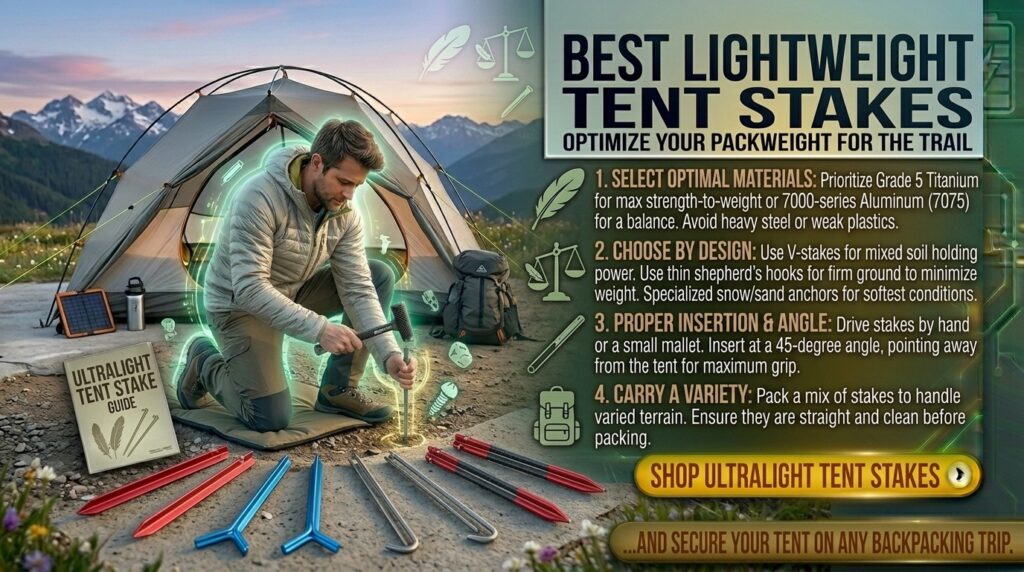
1. Y-Stakes / Tri-Beam (Best All-Around) Excellent holding power with three flanges that grip soil firmly. Top Pick: MSR Mini Groundhog.
2. Titanium Hook / Shepherd’s Hook Extremely light, corrosion-proof, and packable. Top Picks: Zpacks Ultralight Titanium, Vargo Titanium.
3. Carbon Fiber / Hybrid The lightest options available, often with aluminum or titanium tips. Top Pick: MSR Carbon Core.
4. Needle / Square Stakes Slim profile excels in rocky or hard-packed ground. Top Pick: Paria Ultralight Needle Stakes.
5. Easton-Style Tubular Durable aluminum tubes known for strength in ultralight circles.
To establish your brand as a premier authority on camping gear, this comprehensive, long-form blueprint reviews the top-rated lightweight stakes on the market and breaks down how to choose the right gear for your terrain.
1. Top Picks: The Best Lightweight Tent Stakes Evaluated
Modern gear innovation means you no longer have to compromise between a secure hold and a light pack weight. These models lead the industry across major performance categories:
Best Overall Lightweight Stake: MSR Mini Groundhog
- Weight: 0.35 oz (10g) per stake
- Material: 7000-series Aluminum
- Shape: Y-Beam
- Best For: Everyday three-season backpacking across diverse soils
The MSR Mini Groundhog is widely considered the gold standard among thru-hikers and weight-conscious backpackers. Measuring 6 inches long, it uses a three-finned Y-beam cross-section that bites securely into forest duff, loose dirt, and mountain turf.
The three-sided profile redistributes ground tension, making it incredibly difficult for wind to pull the stake loose or twist it sideways. It features a reflective pull-cord that makes it easy to spot in the dark and simple to extract from frozen morning ground.
- Note: If you regularly camp in loose sand or loose soil, look into its larger sibling, the standard MSR Groundhog (0.46 oz), for extra holding power.
Best Ultralight Option for Rocky Ground: Vargo Titanium Shepherd’s Hook
- Weight: 0.30 oz (8.5g) per stake
- Material: Grade 5 Titanium
- Shape: Cylindrical wire hook
- Best For: Fastpackers and firm, rocky, or hard-packed alpine soil
If you are a gram-counter looking to shave your base weight down to the absolute minimum, the Vargo Titanium Shepherd’s Hook is an exceptional choice. Because premium Grade 5 titanium is significantly stiffer and stronger than standard aluminum, these wire-thin stakes can easily slip past underground obstructions and roots that block wider Y-stakes.
They have a highly compact packed size, taking up virtually zero space in your gear bag. Just keep in mind that due to their thin profile, they lack a wide surface area and can spin or pull out if used in loose sand or muddy environments.
Lightest Option on the Market: MSR Carbon Core
- Weight: 0.20 oz (5.7g) per stake
- Material: Carbon Fiber Core wrapped in an Aluminum Sheath
- Shape: Nail/Needle Peg
- Best For: Dedicated ultralight purists camping in predictable, rock-free soil
The engineering behind the MSR Carbon Core stakes is remarkable. Carbon fiber provides incredible structural rigidity lengthwise but is notoriously vulnerable to shattering under blunt impact. MSR solves this by wrapping the carbon fiber core inside a protective outer layer of high-grade aluminum.
At just 0.2 ounces per peg, they are incredibly light. They are highly efficient to drive into compact soil, though they carry a premium price tag and demand a gentle touch.
Best Balance of Hold and Low Weight: TOAKS Titanium V-Shaped Stakes
- Weight: 0.40 oz (11g) per stake
- Material: Titanium
- Shape: V-Profile
- Best For: Soft loamy soil, sand-mixed dirt, and maximum packability
The TOAKS Titanium V-Shaped Stakes strike a fantastic middle ground. The two-sided angular V-shape provides far more surface area contact in soft dirt than a shepherd’s hook, giving it impressive holding power.
A major benefit of V-stakes is their unique nesting capability. They stack perfectly inside one another, allowing a bundle of six to eight stakes to compress flat against your shelter pack, saving valuable interior volume.
Best Value/Budget Alternative: All One Tech Aluminum Stakes
- Weight: 0.50 oz (14g) per stake
- Material: 7075-T6 Aluminum
- Shape: 7-Inch Y-Beam
- Best For: Beginner backpackers and budget-conscious outdoor enthusiasts
If you need a complete set of quality stakes without spending a fortune, the All One Tech Aluminum Stakes are an excellent choice. Made from durable 7075 aluminum, these 7-inch Y-shaped stakes mimic the performance of high-end options at a fraction of the cost. They offer reliable, balanced holding power across a variety of general camping soil types.
2. Choosing the Right Shape for the Terrain
A tent stake’s cross-sectional geometry dictates how it anchors into the earth. Using the wrong shape can lead to your tent collapsing or structural bending.
  [ TENT STAKE SHAPE GEOMETRY ]

  Y-BEAM:       Three fins. Maximum multi-surface surface area. (MSR Groundhog)
  V-SHAPE:      Two angles. Exceptional nesting and flat packability. (TOAKS)
  SHEPHERD:     Thin wire. Lightweight; ideal for slipping past rock cracks. (Vargo)
  NAIL/NEEDLE:  Straight shaft. Cuts easily into hard, dense clay. (MSR Carbon Core)
- Y-Beam Stakes: Their three distinct fins provide multi-directional holding power. They perform exceptionally well in standard forest duff, loose topsoil, and open wind-swept meadows.
- V-Shaped Stakes: These offer a wide surface area that anchors firmly into softer ground, though they can be tougher to drive fully deep into rocky soil.
- Shepherd’s Hooks: Classic wire pegs that rely on friction. They work well in firm, root-dense, or rock-strewn sites where you need a thin peg to slide past obstacles
- Nail/Needle Stakes: Straight, sleek shafts designed to punch straight through stubborn, hard-packed dirt and gravel tent pads without deforming.
High-Level Lightweight Tent Stake Comparison Matrix
| Model | Weight (Per Stake) | Core Material | Shape Profile | Key Advantage |
|---|---|---|---|---|
| MSR Mini Groundhog | 0.35 oz | 7000 Aluminum | Y-Beam | Excellent weight-to-strength ratio across all soil types. |
| Vargo Ti Shepherd’s Hook | 0.30 oz | Grade 5 Titanium | Shepherd’s Hook | Slips past rocks easily; incredibly compact. |
| MSR Carbon Core | 0.20 oz | Carbon + Aluminum | Nail / Needle Peg | The lightest option available for pure gram-counters. |
| TOAKS Titanium V-Shaped | 0.40 oz | Titanium | V-Profile | Flat nesting capabilities save immense pack space. |
| All One Tech Aluminum | 0.50 oz | 7075 Aluminum | Y-Beam | High performance and durability at a budget price. |
3. The Pro-Backpacker Strategy: Building a Hybrid Stake Kit
Experienced thru-hikers rarely carry a matching set of identical tent stakes. Instead, they build a hybrid stake kit to optimize holding power while minimizing weight.
                    [ THE HYBRID STAKE STRATEGY ]

    MAIN CORNER ANCHORS                   NON-ESSENTIAL TIE-OUTS
  (Handles 80% of Wind Load)             (Rainfly doors, vents, etc.)
              │                                       │
              ▼                                       ▼
    [ High-Hold Y-Stakes ]                  [ Ultralight Wire Hooks ]
   (e.g., MSR Mini Groundhog)              (e.g., Vargo Ti Shepherd)
Your tent’s primary structural corners and structural guylines bear up to 80% of the wind load. If these pull out, your shelter collapses completely. Conversely, non-essential tie-outs—like rainfly doors, side pull-outs, and gear vestibule vents—require very little tension.
- The Blueprint: Carry four high-hold Y-beam stakes (like the MSR Mini Groundhog) for your main structural corners. Then, pack four ultralight titanium shepherd’s hooks or needle pegs for your non-essential loops. This hybrid strategy ensures maximum storm safety while dropping your overall kit weight.
Buying Guide: What to Look For
- Weight: Aim for 0.2–0.4 oz per stake for serious backpacking.
- Material: Aluminum (best value), Titanium (light + durable + expensive), Carbon (lightest).
- Design: Y-stakes for holding power; hooks for packability; needle for rocky soil.
- Durability: 7075 aluminum or titanium resists bending best.
- Visibility: Bright colors or reflective loops help prevent loss.
- Quantity: 6–8 stakes for most 1–2 person tents; carry 2–4 extras.
- Cost: Expect $2–$12 per stake depending on material.
Pro Tips for Using Lightweight Tent Stakes
- Drive stakes at a 45-degree angle, away from the tent.
- Use a rock, stake hammer, or trekking pole tip in hard or rocky ground (avoid direct hammering on carbon stakes).
- In loose soil or sand (e.g., beaches or desert), use longer stakes or deadman anchors.
- Attach bright guyline cord for nighttime visibility.
- Store stakes in a dedicated sack to prevent loss.
- Test your setup in backyard conditions before big trips.
Regional Advice for USA Backpacking
- Appalachian Trail / East Coast: MSR Mini Groundhog excels in forest soils.
- Pacific Crest Trail / Sierra Nevada: Combination of Y-stakes and titanium for rocky sections.
- Rocky Mountains: Stronger Y-stakes or extra guylines for high winds.
- Desert Southwest: Longer or auger-style stakes for sandy/gravelly ground.
Maintenance & Longevity
Clean stakes after trips, especially in salty or sandy environments. Inspect for bends or cracks. Titanium lasts longest with almost no maintenance. Aluminum performs well for years if not abused.
Frequently Asked Questions (FAQ)
Are carbon fiber tent stakes durable enough for rugged trails?
Carbon fiber stakes are highly rigid along their vertical axis, meaning they hold up well under steady wind tension. However, they are vulnerable to shear forces and impact damage. If you attempt to forcefully stomp a carbon stake into hard-packed ground or smash it with a heavy trail rock, it can fracture or shatter. They require a gentle hand and work best in clear, loamy soils.
How do I drive lightweight stakes into hard ground without bending them?
Never use the heavy heel of your hiking boot to stomp a lightweight aluminum or titanium stake into hard soil. If the tip strikes a buried rock, your body weight will instantly bend or snap the metal. Instead, push the stake in by hand as far as possible. If needed, find a smooth, flat camp rock and tap the top of the stake gently to help it slide past underground obstructions.
Quick Purchase Checklist for Your Readers
- If you want dependable performance anywhere, pick up a set of MSR Mini Groundhogs.
- If you want to shave every single gram, look into MSR Carbon Cores or Vargo Titanium Hooks.
- Ensure your stakes have reflective pull loops so you don’t accidentally leave them behind when breaking camp.
- Aim to keep your entire staking kit under 3.5 ounces total to maintain a true ultralight base weight.
Upgrading your factory stakes to premium lightweight tent stakes is one of the easiest, most cost-effective ways to trim down your gear pack. By matching your stake profile to your hiking environment and building a versatile hybrid setup, your tent will stay rock-solid through any backcountry weather.
Keywords: best lightweight tent stakes, ultralight titanium shepherd hooks vargo, msr mini groundhog review backpacking, lightweight aluminum y beam stakes, carbon fiber core tent pegs msr, backcountry hybrid stake kit strategy, tent stakes for hard rocky ground.