
The Ultimate Camping Guide: Are Plastic Tent Stakes Better Than Metal?
Every camper eventually faces the ultimate gear dilemma when packing for the great outdoors: Should you use plastic tent stakes or stick with traditional metal pegs? If you are setting up camp on a windy ridge, pitching a canopy at a sandy beach, or preparing for a rainy weekend in the woods, the type of anchor you choose can mean the difference between a secure shelter and a collapsed tent in the middle of the night.
The short answer is neither is universally “better”—it completely depends on the terrain, weather conditions, and your camping style. In this ultimate deep-dive guide, we will break down the structural physics, material pros and cons, environmental impacts, and specific use cases to help you choose the perfect stake for your next adventure.
The Core Comparison: Plastic vs. Metal at a Glance
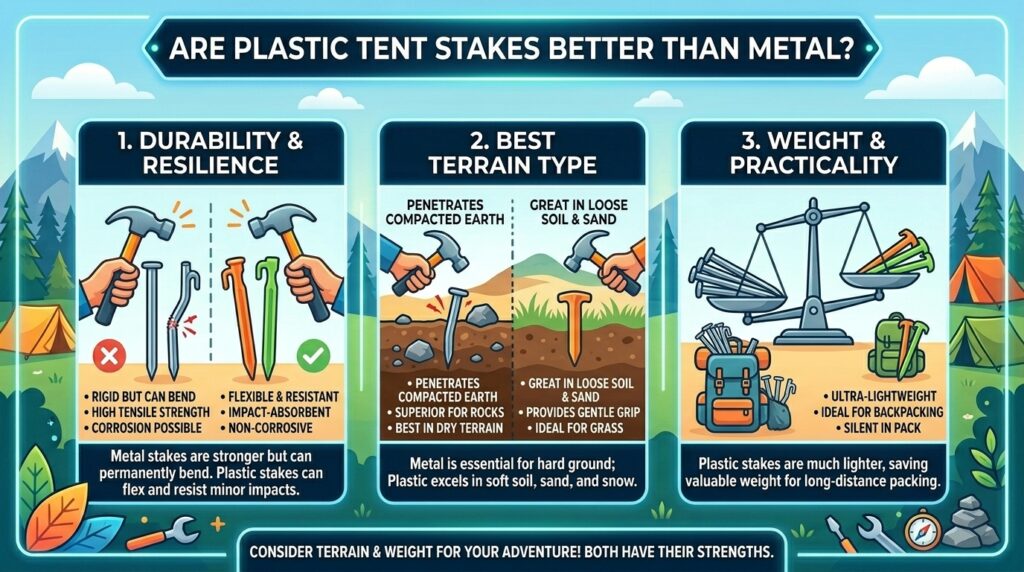
Before we dive into the technical details, here is a quick-reference matrix comparing high-quality ABS plastic stakes against standard aluminum and forged steel options.
| Feature | ABS Plastic Stakes | Aluminum (7000-Series) | Forged Steel Stakes |
| Best Terrain | Sand, Snow, Loose/Soft Soil | Rocky, Hard-Packed Earth | Gravel, Clay, Frozen Ground |
| Weight | Moderate | Ultra-Lightweight | Very Heavy |
| Holding Power | High (in loose soils) | Medium | Extremely High |
| Durability | High flexibility, can crack | Tends to bend under stress | Virtually indestructible |
| Holding Profile | Wide T-shape or spiral | Y-beam, V-shape, or skewer | Solid cylindrical rod |
| Cost | Budget-friendly | Mid to High | Expensive |
1. Deep Dive: Plastic Tent Stakes
When most people think of plastic tent stakes, they think of the cheap, neon-yellow pegs sold in bargain bins. However, modern outdoor engineering utilizes high-grade polymers like ABS (Acrylonitrile Butadiene Styrene) and polycarbonate, which offer surprising durability. Plastic tent stakes best for sea beach or desert area.
The Advantages of Plastic Stakes
- Massive Surface Area & Holding Power: Plastic stakes are typically designed with a wide “T-profile” or a spiral design. This thickness creates a massive footprint underground, forcing the surrounding soil to compact against the stake. This results in superior holding power in loose mediums.
- Rust and Corrosion Proof: Unlike steel, plastic will never rust, corrode, or degrade when exposed to salt water, high humidity, or acidic soil.
- High Visibility: Most plastic stakes are manufactured in bright orange or neon yellow. This drastically reduces the chances of tripping over guy lines at night or losing your stakes in thick grass.
- Safety for Bare Feet: If you accidentally step on an ABS plastic stake at a beach or music festival, it yields slightly and has rounded edges, making it far safer than a sharp metal hook.
The Disadvantages of Plastic Stakes
- Brittleness in Extreme Cold: In freezing temperatures, polymers contract and become highly brittle. Hitting a plastic stake with a mallet in sub-zero weather can cause it to shatter instantly.
- Failure in Hard Terrain: Try driving a thick plastic stake into rocky dirt or clay, and the tip will quickly “mushroom” or snap off. They lack the piercing capability required for dense ground.
- Bulkiness: Because they rely on thickness for structural strength, plastic stakes take up significantly more room in a backpack.
2. Deep Dive: Metal Tent Stakes
Metal stakes are the industry standard for a reason. However, “metal” is a broad category encompassing everything from cheap wire skewers to aerospace-grade titanium.
Aluminum Stakes: The Backpackers’ Choice
Aluminum (especially 7000-series aircraft aluminum) strikes the perfect balance between weight and strength.
- Pros: Incredible strength-to-weight ratio. Designs like the “Y-beam” (pioneered by the MSR Groundhog) offer immense structural rigidity, allowing them to pierce tough dirt without bending.
- Cons: Thin aluminum skewers bend easily if they hit an underground rock, and they can be difficult to pull out of the ground without a tool.
Steel Stakes: The Heavy-Duty Car Camping Standard
Forged steel anchors are built for maximum destruction of the ground beneath them.
- Pros: They can be driven straight through gravel, thick tree roots, and hard clay using a heavy framing hammer without bending or breaking.
- Cons: They are incredibly heavy. Carrying a dozen steel stakes on a backpacking trip is out of the question. They are also prone to rusting over time if the protective coating chips off.
Titanium Stakes: The Premium Elite
- Pros: Lighter than aluminum and stronger than steel. Perfect for ultralight hikers who face rocky trails.
- Cons: Extremely expensive and thin, meaning they slip right out of loose or sandy soil.
3. The Verdict: Which is Better for Specific Scenarios?
To optimize your gear setup, matching your stake material to your expected campsite terrain is critical.
A: Beach Camping and Sand
- Winner: Plastic
- Why: Metal stakes act like a knife through butter in the sand; they slide right out under the slightest tension. Long plastic stakes with wide fins or T-channels grab onto loose sand particles and create friction, keeping your tent grounded against coastal winds.
B: Alpine, Rocky, or Mountainous Terrain
- Winner: Metal (Aluminum Y-Beams or Forged Steel)
- Why: A plastic stake will simply break upon impact with subterranean rocks. You need the sharp, reinforced point of a metal peg to slide between rocky crevices or shatter through hard-packed dirt.
C: Winter and Snow Camping
- Winner: Tie (Specialized Plastic or Aluminum Snow Flukes)
- Why: Standard metal and standard plastic both perform poorly here. For snow, you need wide, anchor-style stakes. However, if using standard gear, heavy-duty extra-long plastic stakes wrapped in frozen snow (the “deadman anchor” technique) perform exceptionally well because they don’t transfer cold to your hands as quickly as metal does.
D: Casual Car Camping & Festivals
- Winner: Plastic
- Why: If you are pitching a tent on manicured park grass or festival grounds, large plastic stakes are cheap, easy to drive in with a basic rubber mallet, highly visible to drunk festival-goers, and won’t ruin a lawn mower if left behind.
4. Engineering Context: Why Shape Overrules Material
While material matters, the geometric shape of the stake dictates its true structural limits. A poorly designed metal stake will fail faster than a brilliantly engineered plastic stake.
- The Skewer (Pin): Usually metal. Poor surface area holding power, but great for piercing hard ground.
- The Y-Beam / V-Angle: Usually aluminum. Three or two distinct intersecting planes provide maximum resistance to bending from all directions.
- The T-Beam / Flanged: Usually plastic. Capitalizes on thickness to prevent the stake from twisting under the tension of a heavy wind load.
- The Screw / Spiral: Available in both heavy-duty plastic and steel. These screw into the ground like a drywall anchor, offering the highest pull-out resistance available in loose earth.
5. Frequently Asked Questions (FAQ)
Can I use a regular hammer on plastic tent stakes?
It is not recommended. A standard steel household hammer delivers a sharp, concentrated kinetic shock that can easily crack or shatter plastic heads. Use a rubber mallet, a wooden block, or your boot heel with gentle, rhythmic pressure.
Do plastic tent stakes degrade in the sun?
Yes, over an extended period. Standard plastics are vulnerable to UV degradation, which breaks down plastic polymers, making them chalky and brittle. Look for stakes explicitly labeled as UV-resistant ABS plastic to prevent this.
What is the best all-around compromise?
If you want a single set of stakes that handles 80% of situations, purchase a set of 7000-series aluminum Y-beam stakes. They offer the puncture power of metal with a widened profile that mimics some of the surface-area benefits of plastic.
Summary: How to Build the Perfect Stake Kit
Experienced campers rarely rely on just one type of stake. The ultimate pro-tip for setting up a bulletproof campsite is to build a hybrid stake kit:
- Keep 4 heavy-duty plastic or spiral stakes in your bag for the primary corners of your tent if you encounter loose soil.
- Keep 8 aluminum Y-beam stakes for your rainfly guy lines and vestibules where precision and wind resistance are mandatory.
- Throw in 2 forged steel rock pegs to use as “pilot holes” if you ever hit unexpectedly frozen or rocky ground.
By understanding the strengths and weaknesses of both materials, you will never have to worry about your tent taking flight in a storm again.