
We’ve all been there: you’re hammering a tent stake into what looks like soft dirt, you hit a hidden subterranean rock, and crunch. Your perfectly straight stake is now shaped like a banana.
If you are out in the backcountry or prepping for your next camping trip, you’re likely wondering: Can I straighten a bent tent stake, or is it permanently ruined?
The short answer is yes, you can straighten most metal tent stakes, but it will never be as strong as it was before. For plastic stakes, the answer is almost always a hard no.
In this ultimate guide, we’ll dive into the science of metal fatigue, step-by-step methods to fix your bent pegs in the field or at home, and how to know when a stake is past the point of saving.
The Golden Rule: The Science of Metal Fatigue
Before you grab a hammer to fix your gear, it’s crucial to understand work hardening and metal fatigue.
When a metal stake bends, the molecular structure at the point of the bend is stretched and stressed. When you bend it back, you are stressing those same molecules a second time.
The Result: The metal becomes brittle. While the stake might look perfectly straight after you fix it, its yield strength has been severely compromised. It will bend much easier the next time it encounters a rock, and eventually, it will snap entirely.
Material Breakdown: Can Your Stake Be Saved?
Whether a stake can be salvaged depends heavily on what material it is engineered from.
1. Steel Skewers and Forged Steel Pegs
- Salvageability: Excellent (9/10)
- The Verdict: Heavy steel stakes and thin galvanized steel wire pegs are incredibly resilient. Steel has high ductility, meaning it can tolerate being bent and straightened a few times before structural failure occurs.
2. Aluminum Stakes (V-Shaped, Y-Beam, or Tubular)
- Salvageability: Moderate to Poor (4/10)
- The Verdict: Most modern backpacking stakes are made of 7000-series aircraft aluminum. While ultra-light and strong, aluminum is a brittle metal. If a Y-beam or V-shaped stake bends, forcing it back into shape often causes micro-fractures. It is highly likely to snap during the straightening process.
3. Titanium Stakes
- Salvageability: Poor (2/10)
- The Verdict: Titanium has incredible “spring memory.” It resists bending fiercely, but if you manage to actually deform a titanium peg, bending it back usually causes it to break instantly.
4. ABS Plastic Stakes
- Salvageability: Impossible (0/10)
- The Verdict: If a plastic stake bends, it has undergone plastic deformation or stress whitening. Attempting to bend it back will cause it to snap cleanly in half. Discard and replace it.
How to Straighten a Bent Tent Stake: 3 Methods
If you have a metal stake that is worth saving, use one of these three methods depending on whether you are stuck at a campsite or working in your garage at home.
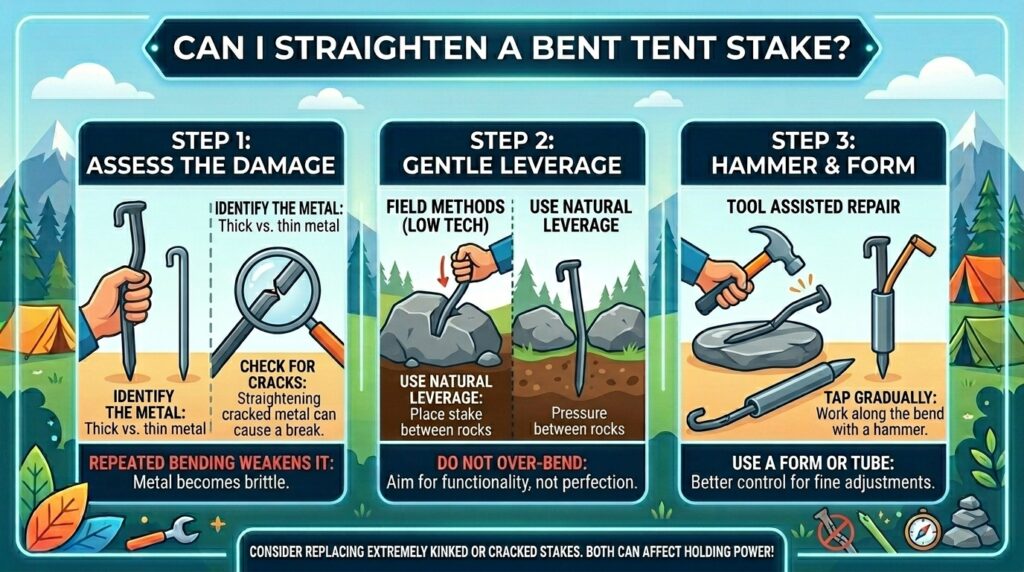
Method 1: The Campsite “Two-Rock” Method (In the Field)
If you are in the backcountry and absolutely need this stake to hold up your rainfly tonight, use this primitive but effective method.
- Find a Flat, Hard Surface: Look for a large, flat boulder or a thick log to act as an anvil.
- Position the Stake: Place the bent stake on the rock with the “hump” or apex of the bend facing upward.
- Find a Striking Rock: Grab a smooth, hand-sized stone.
- Tap Gently: Do not smash it with full force. Deliver light, controlled taps directly to the apex of the bend. Roll the stake slightly between taps to ensure you aren’t flattening the cylindrical shape of the peg.
Method 2: The Tree/V-Grip Method (In the Field)
This method works best for minor curves in thin steel or aluminum skewers where you don’t want to risk flattening the metal with a rock.
- Find a Tight Space: Look for a tight fork in a tree branch, a gap between two closely growing trees, or even the eyelet of a heavy-duty picnic table.
- Leverage the Bend: Slide the bent portion of the stake into the gap, using the tree as a natural vise.
- Apply Slow Pressure: Slowly and smoothly pull the exposed end of the stake in the opposite direction of the bend. Avoid jerky movements, which can snap the metal.
Method 3: The Bench Vise & Mallet Method (At Home)
This is the cleanest, most effective way to restore a high-quality forged steel stake to near-perfect straightness.
[Bench Vise Jaw] ->  | (Stake) |  <- [Bench Vise Jaw]
                        ^
                 Apply pressure to bend
- Clamp the Stake: Place the bent section of the stake inside the jaws of a workshop bench vise.
- Tighten Slowly: Sometimes, simply cranking the vise closed on the bend will flatten it back into a perfect line.
- Use a Wooden or Rubber Mallet: If the bend is severe, clamp one end of the stake firmly in the vise. Use a rubber mallet or a wooden block (to protect the metal coating) to tap the protruding bent section back into alignment.
When to Throw a Bent Stake Away
Don’t let a compromised stake ruin a costly camping trip. Toss the stake in the recycling bin if you notice any of the following warning signs:
- Stress Whitening or Cracking: If you see a pale line or a visible hairline fracture at the bend site, the metal is structurally dead. It will snap under the tension of a windy night.
- Kinking: If the stake didn’t just curve but folded sharply into a sharp “V” shape, the structural integrity is gone.
- The Hook is Broken: If the head or hook of the stake is bent away from the main shaft, it will no longer securely hold your tent’s guy lines.
How to Prevent Your Stakes from Bending in the First Place
The best way to fix a bent tent stake is to never bend it at all. Implement these professional camping techniques to protect your gear:
- Ditch the Framing Hammer: A heavy household hammer delivers too much concentrated kinetic force. Use a soft-faced rubber mallet or a dedicated aluminum camping hammer.
- The 45-Degree Angle Rule: Never drive a stake straight down at a 90-degree angle. Drive it into the ground at a 45-degree angle pointing away from the tent. This distributes the physical load evenly down the shaft.
- Listen to the “Tap”: When driving a stake, use light, rapid taps rather than heavy swings. If the stake stops moving and you hear a metallic ping, stop hitting it. You have hit a rock. Pull it out, move it a few inches over, and try again.
- Create a Pilot Hole: If camping on hard-packed clay or gravel, carry one ultra-heavy-duty steel “rock peg.” Use it to hammer a pilot hole into the ground, pull it out, and then easily slide your lightweight aluminum stake into the pre-made hole.
Frequently Asked Questions (FAQ)
Can you heat an aluminum tent stake to straighten it?
No. While heating steel makes it easier to work with, heating 7000-series aluminum completely destroys its heat-treatment (T6 temper). Heating it with a blowtorch will permanently soften the aluminum, making it as weak as a soda can.
Are bent tent stakes dangerous?
They can be. If a structurally weakened stake snaps under high wind loads, the tensioned guy line can whip back violently. Additionally, a tent that collapses in a storm due to failed anchors can damage your expensive tent poles or rip the rainfly fabric.
How many extra tent stakes should I carry?
A good rule of thumb is to always carry 4 extra stakes beyond what your tent and rainfly require. This gives you an instant buffer if you snap or irretrievably bend a few pegs in tough ground.
Summary: Repair or Replace?
If you have a standard steel wire stake, feel free to bend it back using a rock or a vise. If you have a premium aluminum Y-beam or plastic stake, attempting to straighten it is usually a losing battle.
Upgrading your kit to higher-quality stakes like the MSR Groundhog or forged steel pegs, and changing your hammering technique, will save you time, money, and frustration on the trail.