
How to Secure a Tent in Windy Conditions: The Ultimate Giant Guide for Safe and Stable Camping
Wind can transform an amazing camping trip into a stressful survival challenge within minutes. A peaceful evening around the campfire may suddenly become:
- Loud tent flapping
- Bent poles
- Loose guylines
- Flying gear
- Sleepless nights
- Collapsing shelters
Strong wind is one of the biggest enemies of any tent setup. Even expensive tents can fail if they are not anchored correctly.
Many campers underestimate how much force wind creates. A tent acts almost like a sail. Once gusts begin pushing against the fabric, enormous pressure transfers into:
- Tent poles
- Guylines
- Stakes
- Anchoring points
That is why learning how to secure a tent in windy conditions is one of the most important camping skills you can develop.
Whether you are:
- Backpacking in the mountains
- Camping on the beach
- Hiking above tree line
- Car camping during storms
- Camping in deserts
- Facing unexpected bad weather
Proper wind-resistant setup techniques can protect:
- Your shelter
- Your gear
- Your sleep
- Your safety
This guide covers everything you need to know about:
- How to secure a tent in windy conditions
- Best tent setup methods
- Wind-resistant tent positioning
- Tent stakes and guylines
- High-wind camping strategies
- Storm preparation
- Tent orientation
- Windproof anchoring methods
- Rocky ground staking
- Sand anchoring
- Emergency wind protection
- Camping safety
- Common wind camping mistakes
- Best tents for windy weather
- Pole protection
- Guyline tension systems
By the end of this complete guide, you will know how to secure almost any tent against strong wind and difficult weather conditions.
Why Wind Is Dangerous for Tents? How to secure a tent in windy conditions?
Wind creates powerful stress across your shelter.
As wind hits a tent:
- Fabric catches air pressure
- Poles flex repeatedly
- Stakes experience pulling force
- Guylines tighten and loosen constantly
If any weak point fails, the entire structure becomes unstable.
Strong wind can cause:
- Broken poles
- Torn rainflies
- Pulled-out stakes
- Tent collapse
- Water leaks
- Flying gear
In severe weather, poor setup can even create safety risks.
Understanding Wind Pressure on Tents
Tents behave like flexible aerodynamic structures.
The more surface area exposed to wind:
- The greater the force
- The higher the stress
This is why large family tents often struggle more in storms compared to smaller backpacking tents.
The First Rule: Campsite Selection Matters Most
The best wind protection starts before you even unpack your tent.
Choosing the right campsite dramatically reduces wind exposure.
Avoid Open Exposed Areas
Open areas receive maximum wind force.
Avoid:
- Hilltops
- Open beaches
- Wide empty fields
- Ridge lines
- Exposed cliffs
These areas amplify gusts.
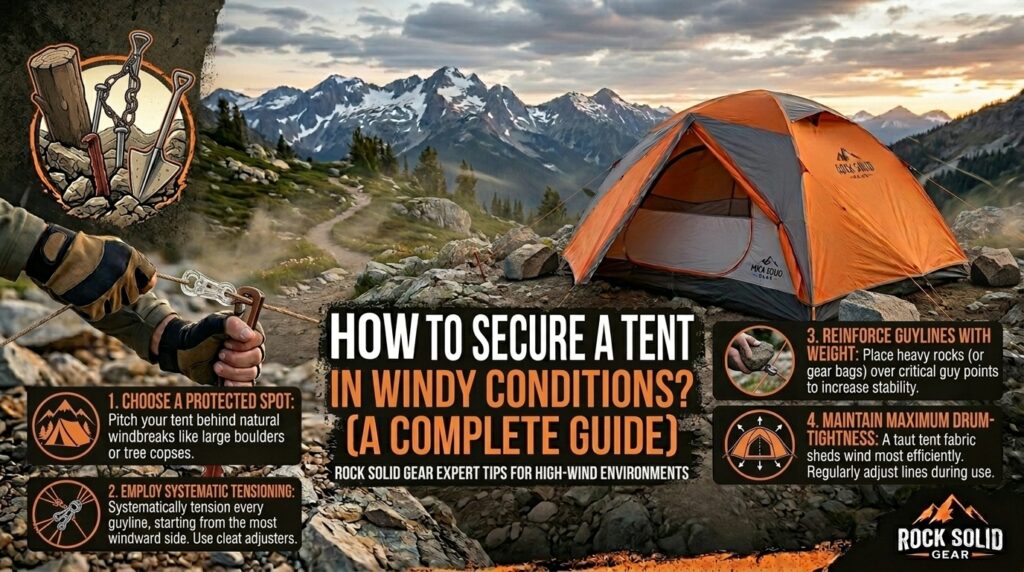
Use Natural Windbreaks
Natural barriers reduce wind pressure significantly.
Good windbreaks include:
- Trees
- Bushes
- Hills
- Large rocks
- Forest edges
Even partial protection helps.
But Avoid Dangerous Trees
Do not camp under:
- Dead branches
- Unstable trees
- Rotten trunks
Strong wind can cause falling limbs.
Low Ground vs High Ground
Many campers choose high areas for views, but lower protected areas are often safer during storms.
However:
- Avoid flood-prone valleys
- Avoid drainage channels
Balance protection with drainage safety.
Tent Orientation Is Extremely Important
One of the biggest beginner mistakes is ignoring wind direction.
Face the Smallest Side Toward the Wind
The narrowest end of the tent should face incoming wind.
This reduces:
- Wind resistance
- Fabric pressure
- Pole stress
Most backpacking tents are specifically designed for this setup.
Why Broadside Wind Is Dangerous
If wind hits the largest side of the tent:
- Pressure increases dramatically
- Fabric flexing becomes extreme
- Stakes pull harder
- Pole stress multiplies
Proper orientation alone can massively improve tent stability.
Use Every Tent Stake
Some campers skip stakes during calm weather.
This becomes dangerous in windy conditions.
Use:
- Every corner stake
- Every guyline point
- Every reinforcement loop
Manufacturers add these attachment points for a reason.
Why Tent Stakes Matter So Much? How to secure a tent in windy conditions?
Tent stakes are the foundation of wind resistance.
Weak stakes create:
- Loose tents
- Pullouts
- Structural instability
High wind demands stronger anchors.
Best Tent Stakes for Windy Conditions
The best stakes depend on terrain.
Best Stakes for Hard Ground
Use:
- Steel nail stakes
- Titanium nail stakes
These resist bending and penetrate compact soil.
Best Stakes for Soft Soil
Use:
- Y-stakes
- V-stakes
- Wide-profile stakes
These create stronger grip.
Best Stakes for Sand
Use:
- Sand stakes
- Long stakes
- Deadman anchors
Sand requires extra holding surface.
Stake Angle Matters More Than Most People Realize
Never place stakes straight down vertically.
The best angle is:
- Around 45 degrees away from the tent
This creates stronger pull resistance.
Why the 45-Degree Angle Works
Angled stakes:
- Resist pullout better
- Increase friction
- Distribute force efficiently
Vertical stakes pull loose more easily under wind pressure.
Deeper Stakes Hold Better
Insert stakes deeply whenever possible.
Shallow stakes fail faster during gusts.
Only the top hook or head should remain visible.
Use Strong Guylines
Guylines dramatically improve tent stability.
They:
- Spread wind force
- Reduce pole strain
- Stabilize tent walls
In windy weather, guylines become essential.
Why Many Campers Ignore Guylines
Some people think guylines are optional.
In strong wind, they are critical structural support systems.
Skipping guylines increases collapse risk dramatically.
Tighten Guylines Properly
Guylines should feel:
- Firm
- Balanced
- Evenly tensioned
Avoid:
- Extremely loose lines
- Over-tightened lines
Over-tightening increases stress on poles and stakes.
Use Adjustable Guyline Tensioners
Tension adjusters allow:
- Fast setup
- Easy corrections
- Wind adaptation
Weather changes constantly.
Adjustable systems improve flexibility.
Reflective Guylines Improve Safety
Reflective lines help prevent:
- Nighttime tripping
- Campsite accidents
Especially useful during storms and darkness.
Double-Stake High-Stress Areas
Double staking improves anchor strength.
How it works:
- Place primary stake
- Add second stake behind it
- Connect stakes together
This distributes force more effectively.
Reinforce Windward Corners
The side facing the wind experiences maximum pressure.
Use:
- Stronger stakes
- Extra guylines
- Rock reinforcement
on these corners.
Use Rocks for Extra Stability
Rocks work extremely well as backup anchors.
Options include:
- Placing rocks over stakes
- Tying guylines around boulders
- Building rock reinforcement around anchors
Very effective in mountains and deserts.
Deadman Anchors for Extreme Conditions
Deadman anchors work by burying objects horizontally.
Useful materials:
- Sticks
- Logs
- Stuff sacks
- Snow anchors
Excellent for:
- Sand
- Snow
- Loose soil
How Tent Shape Affects Wind Resistance
Some tent shapes handle wind much better than others.
Dome Tents
Advantages:
- Good wind resistance
- Flexible structure
- Balanced pressure distribution
Popular all-around design.
Tunnel Tents
Advantages:
- Spacious
- Aerodynamic when oriented correctly
Disadvantages:
- Vulnerable if positioned sideways to wind
Geodesic Tents
Designed specifically for:
- Extreme weather
- Mountaineering
- High wind
Multiple crossing poles increase strength.
Cabin Tents
Large vertical walls catch enormous wind force.
Less suitable for severe storms.
Low-Profile Tents Perform Better
Lower tents:
- Catch less wind
- Reduce drag
- Improve stability
Backpacking tents often outperform tall tents during storms.
Wind Flapping Damages Tents Over Time
Constant flapping causes:
- Fabric stress
- Seam wear
- Pole fatigue
A tight stable setup reduces long-term damage.
Pole Strength Matters Too
Strong poles improve wind resistance.
Best materials:
- Aluminum poles
- DAC poles
- High-grade alloy poles
Cheap fiberglass poles break more easily in strong wind.
Pole Flexibility Is Important
Good poles flex slightly under pressure.
Too rigid:
- Snaps more easily
Too weak:
- Collapses
Balanced flexibility improves storm performance.
Rainfly Setup Matters
A properly tensioned rainfly:
- Reduces flapping
- Improves aerodynamics
- Prevents water pooling
Loose rainflies become extremely noisy and unstable in wind.
Ventilation Helps During Storms
Good airflow reduces:
- Internal pressure buildup
- Condensation
Completely sealing a tent can sometimes increase wind stress.
High Wind Camping Tips for Backpackers
Backpackers face unique challenges:
- Lightweight gear
- Smaller shelters
- Remote environments
Focus on:
- Site selection
- Lightweight strong stakes
- Full guyline use
Car Camping Wind Strategies
Car campers can carry:
- Heavy-duty stakes
- Extra guylines
- Larger mallets
- Sandbags
Weight becomes less important.
How to Secure a Tent on Rocky Ground
Rocky terrain makes staking difficult.
Solutions:
- Use steel nail stakes
- Tie guylines around rocks
- Stack rocks over stakes
Never force stakes directly into solid stone.
How to Secure a Tent on Sand
Sand requires special anchoring.
Best methods:
- Sand stakes
- Buried anchors
- Driftwood anchors
- Filled stuff sacks
Regular stakes often fail quickly.
How to Secure a Tent in Snow
Snow camping requires:
- Snow stakes
- Buried anchors
- Packed trenches
Snow behaves differently from soil.
Storm Preparation Before Sleeping
Before bed:
- Recheck stakes
- Tighten guylines
- Inspect poles
- Remove loose gear
Storm preparation prevents nighttime emergencies.
Secure Loose Gear
Wind easily carries:
- Shoes
- Cooking equipment
- Chairs
- Clothing
Store gear safely inside or secured tightly.
Lower Tent Profile During Severe Wind
Some tents allow:
- Lower pole adjustments
- Reduced rainfly height
This decreases wind exposure.
Emergency Wind Protection Techniques
If wind suddenly intensifies:
- Add extra guylines
- Reinforce stakes with rocks
- Reduce tent tension slightly
- Reposition loose gear
Act early before failures begin.
What to Do If Tent Stakes Keep Pulling Out
Possible solutions:
- Longer stakes
- Double staking
- Better angles
- Rock reinforcement
- Different campsite location
Terrain adaptation matters.
Wind Direction Can Change Overnight
Do not assume wind stays constant.
Mountain and coastal environments shift rapidly.
Prepare all sides of the tent properly.
How Rain Changes Tent Anchoring
Rain softens soil.
This can:
- Loosen stakes
- Reduce holding power
- Increase pullout risk
Check anchors after heavy rain.
Why Noise Increases During Wind
Wind creates:
- Fabric flapping
- Pole creaking
- Guyline vibration
A tighter setup reduces noise significantly.
Tent Maintenance After Windy Trips
After camping:
- Inspect poles
- Check seams
- Examine stakes
- Dry equipment thoroughly
Wind stress gradually wears gear.
Common Wind Camping Mistakes
1. Ignoring Weather Forecasts
Always monitor conditions before camping.
2. Skipping Guylines
Huge mistake in windy weather.
3. Using Cheap Stakes
Weak anchors fail quickly.
4. Choosing Scenic but Exposed Campsites
Views are not worth dangerous exposure.
5. Over-Tightening the Tent
Too much tension increases structural stress.
Best Wind-Resistant Tent Features
Look for:
- Low profile
- Multiple guylines
- Strong poles
- Aerodynamic shape
- Reinforced seams
Why Mountaineering Tents Survive Extreme Wind
Mountaineering tents use:
- Multiple pole intersections
- Strong fabrics
- Geodesic structures
- Reinforced guyline systems
These are built specifically for storms.
Lightweight vs Heavy-Duty Tents in Wind
Lightweight tents:
- Easier to carry
- Sometimes less stable
Heavy-duty tents:
- Stronger
- More durable
- Better in storms
Balance depends on your camping style.
Family Tents Need Extra Attention
Large family tents catch enormous wind force.
Use:
- Every guyline
- Heavy-duty stakes
- Windbreaks
Large tents require careful setup.
How Long Can a Tent Handle Strong Wind?
Depends on:
- Tent quality
- Setup quality
- Terrain
- Stake security
- Wind intensity
Proper setup dramatically improves survival.
Extreme Wind Safety
In dangerous storms:
- Consider evacuating exposed campsites
- Seek lower protected areas
- Prioritize safety over gear
No tent is indestructible.
Best Overall Strategy for Securing a Tent in Wind
The strongest setups combine:
- Smart campsite selection
- Proper orientation
- Strong stakes
- Full guyline use
- Balanced tension
- Terrain adaptation
No single trick replaces complete preparation.
Final Thoughts: How to Secure a Tent in Windy Conditions
Windy camping conditions can feel intimidating, but proper preparation makes an enormous difference.
The most important principles are:
- Choose protected campsites
- Face the narrow side into the wind
- Use strong stakes
- Angle stakes properly
- Secure every guyline
- Reinforce high-stress points
Remember:
your tent is only as strong as its anchoring system.
Even premium tents can fail with poor setup, while well-secured tents often survive surprisingly strong storms.
Wind-resistant camping is ultimately about:
- Preparation
- Technique
- Awareness
- Adaptability
Once you learn how to secure a tent correctly in windy conditions, camping becomes:
- Safer
- More comfortable
- More reliable
- Far less stressful
And there is something deeply satisfying about lying inside a properly secured tent, hearing powerful wind outside, while knowing your shelter is solidly anchored against the storm.