

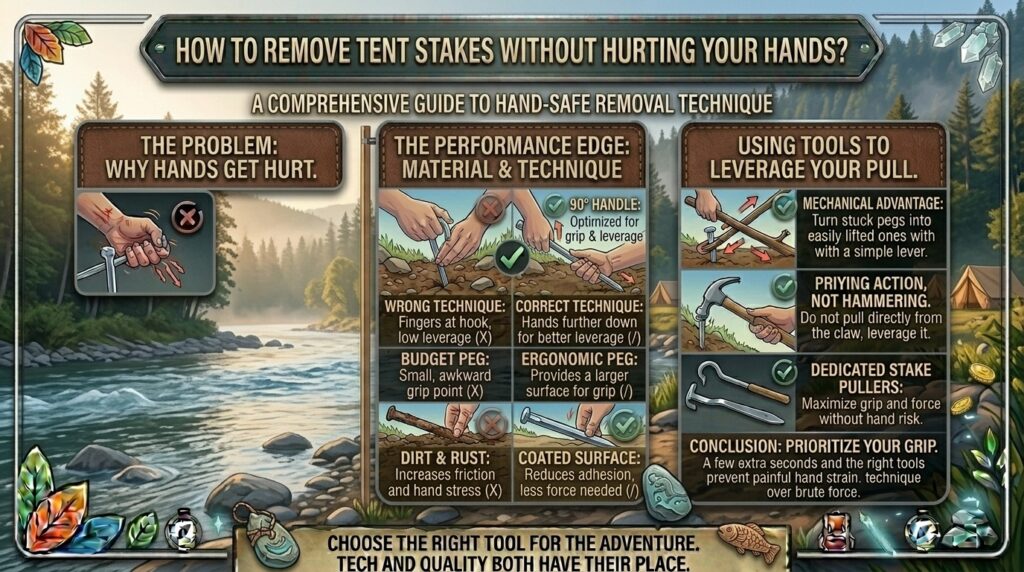
The Ultimate Guide: How to Remove Tent Stakes Without Hurting Your Hands. By using a second tent stake as a handle, rocking or twisting the peg
You’ve had an incredible weekend in the great outdoors, the morning sun is warm, and you’re packing up your gear to head home. Everything is rolling up perfectly until you reach your tent anchors. You grab a metal peg, pull with all your might, and nothing happens. You pull harder, the thin metal edges slice painfully into your palms, your grip slips, and you’re left with raw, blistered skin and a stake that hasn’t budged a single millimeter.
Trying to yank stubborn tent stakes out of dry clay, frozen earth, or gravel-choked soil is a recipe for hand injuries and intense frustration. But you don’t need to sacrifice your skin to break camp.
So, how do you remove stubborn tent stakes without hurting your hands?
The short answer is: You must stop pulling straight up with your bare hands and leverage the power of simple physics. By using a second tent stake as a handle, rocking or twisting the peg to break the soil’s vacuum seal, or utilizing specialized tools like a stake-remover mallet or a loop of paracord, you can extract even the most stubborn anchors with minimal physical effort.
In this comprehensive, long-form guide, we will break down the science of why tent stakes get stuck, five genius field techniques to pull them safely, and how to protect your hands from blisters and cuts on every single trip.
1. The Science of the “Stuck”: Why Ground Grips So Hard
To pull a stake out effortlessly, you must first understand why it’s trapped in the first place. It isn’t just tightly packed dirt; it’s a combination of two physical forces:
- Frictional Resistance: When you hammer a stake into the earth (especially a textured or angled one like a Y-beam aluminum peg), the surrounding soil particles compress violently against the flat surfaces of the metal. This exerts a continuous, multi-directional clamping force along the entire buried shaft.
- The Vacuum Suction Effect: In damp dirt, clay, or wet loam, driving a stake flush displaces air. When you try to pull it straight up, it creates a microscopic vacuum pocket at the tip of the stake. You aren’t just fighting the weight of the dirt; you are physically fighting atmospheric pressure.
2. 5 Genius Ways to Extract Stuck Stakes Safely
If a stake refuses to move, never wrap your bare fingers around the sharp metal hook and yank. Instead, pivot to one of these five painless field methods:
Method 1: The “Stake-on-Stake” Handle Trick (The Ultimate No-Tool Fix)
Most premium stakes feature a small hole near the head or a curved hook. You can use your spare gear to create instant, pain-free leverage.
                  [ Pull Upward Here ]
                     ^     ^     ^
                  =================  <- (Horizontal Stake "Handle")
                        X   X
                        X   X
                     ___X___X___ [Ground Level]
                    |   X   X   |
                    |   X   X   |  <- (Vertical Stuck Stake)
                    |___________|
- Take a second, unbent tent stake from your bag and slide it horizontally through the cord loop, hole, or underneath the hook of the stuck stake.
- Grab both ends of the horizontal stake with your hands. You have now created a wide, comfortable, ergonomic handle.
- Stand directly over the stuck peg, bend your knees, and pull straight upward using your leg muscles rather than your lower back. The stake will pop right out without touching your skin.
Method 2: The “Twist and Rock” (Breaking the Vacuum)
If you try to pull a stake out without breaking the dirt’s seal first, you will waste immense energy.
- Grip the very top of the stake (ideally using a thick glove or a towel).
- Twist the stake clockwise and counter-clockwise like a key in a lock.
- Why this works: Rotating the stake breaks the friction bond and allows air to rush down the shaft into the subterranean vacuum pocket. Once the stake rotates freely in its hole, it will slide out with minimal upward pressure.
Method 3: The Mallet Hook Extract
If you followed our guide on The Biggest Tent Stake Mistakes Beginners Make, you should already have a dedicated rubber mallet or camping hammer in your gear kit. Most outdoor mallets are specifically designed for extraction.
- Locate the curved metal hook or the peg slot built into the bottom handle of your camping mallet.
- Hook it securely into the loop or notch of the stuck stake.
- Use the entire length of the mallet handle as a lever, pulling smoothly upward while keeping your hands clear of the dirt.
Method 4: The Paracord Loop Puller
If your tent stakes are driven completely flush with the ground (as they should be!), there might not be enough metal exposed to grab onto.
- Take a 2-foot piece of standard 550 paracord and tie the ends together to form a loop.
- Slip the loop underneath the notch of the buried stake using a simple lark’s head knot or slipknot.
- Wrap the top of the paracord loop around a thick stick, a log, or your hammer handle. Pull upward on the wooden handle. The soft paracord distributes the weight perfectly, protecting your fingers from friction burns.
Method 5: The Water Saturation Flush
If you are breaking camp from a site with sun-baked, dried desert clay, the ground acts exactly like concrete.
- Pour a small cup of camp water directly around the base of the stuck stake.
- Wait 2 to 3 minutes. The water will naturally seep down the shaft via capillary action, liquefying the tightly bound clay molecules and lubricating the metal.
- Give the stake a gentle kick with your boot to break the softened seal, then pull it out smoothly.
3. Crucial Safety Mistakes to Avoid When Breaking Camp
When you are tired and rushing to pack up your car or backpack, don’t fall into these dangerous extraction traps:
- The Slingshot Slip: Never yank on a stuck stake while leaning your body weight backwards. If the stake suddenly breaks free from the mud, you will fly backward, risking spinal injuries, hitting your head on boulders, or violently pulling the sharp stake toward your own face. Always stand directly over the stake and lift vertically using your legs.
- Yanking by the Fabric Loops: Never pull a stake out by tugging on the nylon loops or webbing attached directly to your tent floor. The metal peg will easily slice or rip through the high-tension stitching of your expensive tent, permanently ruining your shelter’s waterproofing and structural alignment.
- Using Flat Construction Pliers: Pliers with sharp teeth will chip away the anodized protective coating on premium aluminum stakes, making them rough, prone to corrosion, and full of sharp metal burrs that will slice your hands on future trips.
4. Frequently Asked Questions (FAQ)
Why do some stakes come out easily while others are trapped?
This usually comes down to the soil density and texture variations across your campsite. A stake driven near a tree root or in a patch of hard clay will have vastly higher friction levels than a stake driven into loose forest loam just three feet away.
Should I leave a stuck stake behind if I can’t get it out?
No, never. Leaving metal or plastic stakes buried flush in the ground is a direct violation of Leave No Trace principles. It creates a highly dangerous hazard for wildlife, can destroy trail maintenance lawnmowers or vehicles, and ruins the site for future campers. Use the Water Saturation or Stake-on-Stake method to ensure 100% retrieval.
How do I prepare my stakes so they don’t get stuck next time?
Before you drive your stakes into the ground, ensure they are clean. Leftover caked-on mud from previous trips acts like glue when dried. A quick wipe down with a rag before storing them makes extraction significantly smoother on your next adventure.
Summary: The Pain-Free Extraction Checklist
To ensure your hands remain safe, clean, and blister-free when breaking camp, implement this simple tactical protocol next time you pack up:
- [ ] Put on Gloves: Always pack a cheap pair of leather utility gloves in your stake bag.
- [ ] Break the Seal First: Twist and rock the stake to let air into the subterranean pocket.
- [ ] Use a Tool or Handle: Never pull directly on sharp metal hooks; use a horizontal stake or paracord loop as a handle.
- [ ] Lift with Your Legs: Stand directly over the anchor point to eliminate dangerous slingshot slips.
By treating stake extraction as a game of physics rather than a test of raw physical strength, you can protect your hands, preserve your expensive gear, and end your camping trip on a perfect, stress-free note.
Keywords: how to remove tent stakes, stuck tent pegs hard ground, tent stake remover tool, camping gear safety, how to extract tent anchors, protect hands camping, camp pack up hacks.