
Complete Guide to Anchoring a Tent Without Traditional Tent Stakes: The Best Ways to Secure a Tent on Solid Rock or Concrete
Camping on solid rock or concrete can be one of the biggest challenges outdoor enthusiasts face. Unlike camping on dirt, grass, or sand, hard surfaces make it almost impossible to use standard tent stakes. Many campers quickly discover that ordinary pegs simply:
- Cannot penetrate the ground
- Bend immediately
- Slide across rock surfaces
- Provide zero holding power
Whether you are:
- Camping on rocky mountain terrain
- Pitching a tent on a concrete campsite
- Setting up at a festival parking area
- Camping on slickrock deserts
- Staying on gravel pads
- Using rooftop or platform campsites
you need alternative methods to keep your tent secure.
Strong wind can easily turn an unsecured tent into a dangerous problem. Without proper anchoring, tents may:
- Shift across the ground
- Collapse
- Lose structural stability
- Blow away completely
Fortunately, there are several effective ways to secure a tent even when stakes cannot be driven into the ground.
In this detailed guide, you will learn:
- Why tent stakes fail on rock and concrete
- The best alternatives to tent stakes
- How to anchor tents safely
- The best weights and tie-down methods
- How to use rocks effectively
- How to secure tents during high wind
- Common mistakes to avoid
- Best tent types for hard surfaces
- Emergency anchoring techniques
- Pro camping tips for difficult terrain
By the end of this article, you will understand exactly how to keep your tent stable and secure on solid rock or concrete surfaces.
Why Tent Stakes Do Not Work on Rock or Concrete
Traditional tent stakes are designed to penetrate:
- Dirt
- Grass
- Sand
- Soil
Hard surfaces create completely different problems.
Concrete Is Too Dense
Concrete is:
- Extremely hard
- Non-penetrable
- Smooth
Standard tent stakes cannot:
- Enter the surface
- Grip properly
- Hold tension
Attempting to hammer ordinary stakes into concrete usually results in:
- Bent stakes
- Damaged tools
- Broken pegs
Solid Rock Prevents Penetration
Rocky terrain creates similar challenges.
Large rock slabs or bedrock offer:
- No penetration depth
- Minimal friction
- Poor anchor opportunities
This means campers must rely on alternative anchoring systems instead of traditional stakes.
Wind Makes Hard Surface Camping More Dangerous
Hard surfaces often provide less natural resistance against movement.
Without proper anchors:
- Wind pressure moves tents easily
- Tents slide across smooth surfaces
- Guyline tension becomes unstable
Even moderate gusts can destabilize a poorly secured shelter.
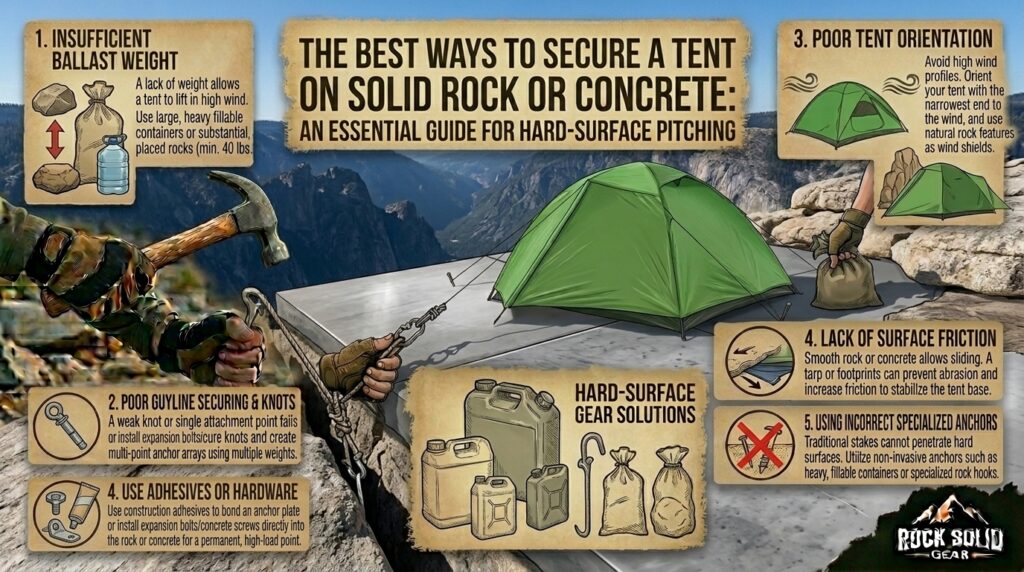
Use Heavy Rocks as Natural Anchors
One of the oldest and most effective techniques is using large rocks.
This method works especially well on:
- Mountain terrain
- Desert slickrock
- Gravel campsites
- Boulder areas
How to Use Rocks Correctly
Instead of driving stakes into the ground:
- Wrap guylines around large rocks
- Tie anchor points securely
- Position rocks away from tent edges for better tension angles
The heavier the rock, the stronger the anchor.
Choose Large Stable Rocks
Small loose rocks are ineffective.
Use rocks that are:
- Heavy
- Stable
- Difficult to move
- Flat or secure
Avoid unstable stones that may roll or shift.
Create Deadman Anchors
Deadman anchoring is one of the best techniques for difficult terrain.
Instead of vertical staking:
- Tie guylines to a heavy object
- Place the object horizontally
- Secure tension against the surface
Common deadman anchors include:
- Large rocks
- Sandbags
- Heavy gear
- Water containers
Use Sandbags for Concrete Camping
Sandbags are one of the best solutions for concrete campsites.
They provide:
- Strong weight
- Excellent portability
- Reliable tension resistance
Why Sandbags Work Well
Sandbags:
- Do not damage concrete
- Are easy to transport
- Resist sliding
- Provide adjustable weight
They are commonly used for:
- Event tents
- Festival shelters
- Pop-up canopies
- Emergency outdoor setups
Water Containers Make Excellent Tent Weights
If sandbags are unavailable, water containers can work extremely well.
Examples include:
- Water jugs
- Collapsible water bags
- Filled camping containers
Water is heavy enough to provide solid resistance while remaining easy to transport when empty.
Use Weighted Tent Bags
Commercial tent weight bags are designed specifically for hard-surface anchoring.
These bags:
- Attach to tent legs or guylines
- Hold sand, gravel, or weights
- Improve stability significantly
They are especially useful for:
- Concrete campsites
- Event setups
- Festival camping
Tie Off to Fixed Objects
Sometimes nearby structures can help stabilize your tent.
Possible anchor points include:
- Fence posts
- Large trees
- Railings
- Concrete barriers
- Park fixtures
Always ensure the object is:
- Stable
- Secure
- Safe to use
Use Paracord or Strong Rope
High-quality rope improves hard-surface tent anchoring significantly.
Paracord is popular because it is:
- Strong
- Lightweight
- Weather resistant
- Easy to carry
Good guylines distribute tension more effectively and improve tent stability.
Use Extra Guylines
Additional guylines help reduce movement on hard surfaces.
More tie-out points:
- Spread wind pressure
- Improve balance
- Increase stability
especially during storms.
Lower the Tent Profile
Tall tents catch more wind.
On rock or concrete surfaces, wind drag becomes even more dangerous because there is less ground resistance.
Best Tent Types for Hard Surfaces
Certain tent designs perform better on rock or concrete.
Low-Profile Dome Tents
Dome tents are usually:
- More aerodynamic
- Easier to stabilize
- Better in wind
Their curved shape reduces pressure during gusts.
Geodesic Tents
Geodesic tents are excellent for rocky terrain because they:
- Have strong pole structures
- Handle wind better
- Maintain stability under stress
These are commonly used for:
- Mountain expeditions
- Harsh environments
- Extreme weather camping
Avoid Tall Cabin Tents
Cabin-style tents:
- Catch more wind
- Create larger drag surfaces
- Require stronger anchoring
They are more difficult to secure on concrete or rock.
Place Non-Slip Material Under the Tent
Smooth surfaces increase sliding risk.
Non-slip materials help improve friction between the tent floor and the ground.
Useful options include:
- Rubber mats
- Grip pads
- Heavy tarps
- Anti-slip flooring
Why Tents Slide on Concrete
Concrete provides little natural grip.
Wind pressure can slowly shift:
- Tent floors
- Tent corners
- Entire shelters
Adding friction helps reduce movement significantly.
Use Your Vehicle as a Wind Barrier
Vehicles can provide:
- Wind protection
- Additional anchor points
- Shelter stabilization
Position your car strategically to reduce direct wind exposure.
Camp Near Natural Windbreaks
Natural barriers help reduce wind intensity.
Useful windbreaks include:
- Rock formations
- Hills
- Trees
- Walls
- Large boulders
Reducing direct wind exposure is one of the most effective stability improvements.
Tighten the Rainfly Properly
Loose rainflies create excessive wind drag.
Flapping fabric:
- Increases tension
- Creates instability
- Pulls anchors loose
Keep:
- Rainflies tight
- Fabric smooth
- Guylines properly tensioned
Avoid Over-Tightening
While tension matters, overtightening can:
- Stress poles
- Damage seams
- Increase structural strain
Balanced tension is ideal.
Use Heavy Camping Gear as Ballast
Your own equipment can help stabilize the tent.
Heavy items include:
- Coolers
- Water containers
- Backpacks
- Storage bins
Positioning these strategically inside the tent helps reduce movement.
Secure Tent Corners First
Corner stability is critical.
If corners shift:
- The tent loses shape
- Pole stress increases
- Wind pressure worsens
Always prioritize securing the tent corners before adjusting other areas.
Use Anchor Plates or Weighted Bases
Some commercial tent systems use:
- Metal anchor plates
- Weighted base systems
These are highly effective for:
- Concrete
- Asphalt
- Event setups
Duct Tape Is NOT a Reliable Solution
Some campers attempt to tape tents to concrete.
This rarely works well because:
- Wind pressure breaks adhesion
- Moisture weakens tape
- Concrete dust reduces grip
Mechanical anchoring methods are far more reliable.
Use Climbing Anchors Carefully
In advanced mountain camping, climbers may use:
- Rock protection points
- Climbing anchors
- Bolted tie-offs
However, these require:
- Technical knowledge
- Proper equipment
- Safety expertise
They are not recommended for casual campers.
Watch Weather Forecasts Carefully
Hard-surface camping becomes much more dangerous during storms.
Monitor:
- Wind speed
- Gust warnings
- Thunderstorm risks
- Mountain weather changes
Preparation is essential.
Reinforce Anchors Before Nightfall
Wind often increases overnight.
Before sleeping:
- Check all guylines
- Reinforce weights
- Tighten loose areas
- Inspect anchor stability
Preventive adjustments reduce nighttime problems.
Emergency Wind Protection Tips
If severe wind suddenly develops:
- Add extra weights immediately
- Lower tent height if possible
- Move gear inside
- Reinforce guylines
- Use additional rocks or ballast
If conditions become unsafe, seek sturdier shelter.
Common Mistakes Campers Make
Many hard-surface camping problems happen because of simple mistakes.
Relying Only on Tent Weight
Tent weight alone is rarely enough during strong wind.
Always use:
- Guylines
- Ballast
- Additional anchors
Ignoring Wind Direction
Facing the tent broadside into wind greatly increases instability.
Always face the narrower side toward incoming wind.
Using Small Rocks
Tiny rocks provide little resistance and may shift easily.
Use large stable anchors whenever possible.
Forgetting Extra Guylines
More anchor points improve stability dramatically.
Leaving Loose Fabric
Loose fabric increases wind drag and movement.
Best Accessories for Rock or Concrete Tent Setup
Helpful equipment includes:
- Sandbags
- Water weights
- Paracord
- Heavy-duty guylines
- Non-slip mats
- Tent weight bags
- Carabiners
- Extra rope
- Rubber floor pads
Advantages of Hard-Surface Camping
Although challenging, hard-surface camping has some benefits.
Less Mud
Concrete and rock campsites remain cleaner during rain.
Better Drainage
Rocky surfaces usually drain water more effectively than soft soil.
Reduced Ground Saturation
Hard terrain prevents tents from sinking into wet mud.
Fewer Stake Hazards
Without traditional stakes, there are fewer tripping hazards around camp.
Final Thoughts
Learning the best ways to secure a tent on solid rock or concrete is essential for campers who explore challenging environments.
Traditional tent stakes simply do not work well on:
- Concrete
- Bedrock
- Slickrock
- Gravel pads
- Hard surfaces
Fortunately, alternative anchoring techniques can provide excellent stability when used correctly.
The best methods include:
- Using large rocks
- Creating deadman anchors
- Adding sandbags or water weights
- Using strong guylines
- Positioning the tent properly
- Reducing wind exposure
- Adding non-slip materials
- Reinforcing corners and anchor points
Whether you are:
- Camping in the mountains
- Attending a festival
- Sleeping on desert slickrock
- Using a rooftop campsite
- Setting up on concrete pads
proper tent anchoring is critical for:
- Safety
- Stability
- Comfort
- Wind resistance
With the right setup techniques and equipment, you can keep your tent secure even in places where ordinary tent stakes are completely useless.