

Ultimate Guide of Premium vs. Budget Pegs: Do Expensive Tent Stakes Really Matter?
If you’ve ever browsed the aisles of an outdoor retail store or scrolled through camping gear online, you’ve likely stumbled across premium tent stakes. Brands like MSR, Snow Peak, and Nemo sell individual tent pegs for $4 to $8 a piece. Meanwhile, you can buy a generic bundle of 12 classic steel wire stakes on Amazon or at a big-box store for less than $5 total.
This massive price gap leaves every budget-conscious camper asking the same question: Do expensive tent stakes really matter, or are they just a marketing gimmick?
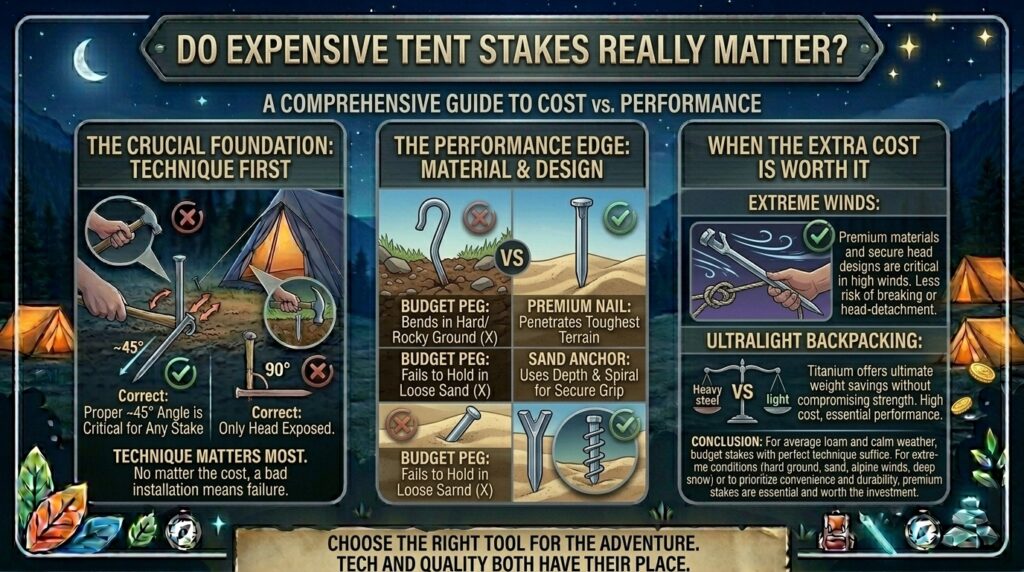
The short answer is yes, expensive tent stakes absolutely matter—but only if you camp in challenging environments. While cheap stakes work perfectly fine for backyard lawns and calm weather, premium stakes engineered from aircraft aluminum, forged steel, or titanium offer vastly superior holding power, refuse to bend in hard ground, drop your pack weight significantly, and can survive a lifetime of abuse.
In this comprehensive, long-form guide, we will break down the metallurgical differences between cheap and expensive stakes, analyze when it is worth investing in premium gear, and help you decide exactly how much you should spend on your next outdoor adventure.
1. The Core Differences: What Makes a Stake “Expensive”?
When you pay a premium for a tent stake, you aren’t just paying for a brand logo. You are paying for advanced materials science and geometric engineering.
CHEAP SKEYWER (Zero Rigidity)        PREMIUM Y-BEAM (High Rigidity)

          O  (Thin hook)                        __O__  (Pull cord)
          |                                      | |
          |  (Smooth, round                      | |   (Three distinct
          |   3mm shaft)                        /   \   structural fins)
          |                                    /_____\
    (Bends instantly)                     (Resists bending completely)
Metallurgy: Cheap Steel vs. Premium Alloys
- The Budget Option: Cheap stakes are typically made of low-grade galvanized steel wire or basic soft plastics. This steel has low yield strength, meaning the molecules permanently shift (bend) under minimal pressure.
- The Premium Option: Expensive stakes utilize 7000-series aircraft-grade aluminum, cold-forged carbon steel, or aerospace titanium. 7000-series aluminum, for example, is heat-treated to a T6 temper, giving it a spring-like resilience that flexes under stress and snaps back into a perfectly straight line rather than bending.
Geometry: Smooth Wire vs. Engineered Flanges
- The Budget Option: Cheap pegs are thin, round, and completely smooth. They have a tiny footprint underground, meaning they provide almost no frictional surface area to grab onto loose soil.
- The Premium Option: High-end stakes are engineered with specific structural shapes. The famous Y-beam design (pioneered by the MSR Groundhog) uses three intersecting fins that physically trap and compact the dirt within their channels. This creates massive holding power against wind tension without adding bulk.
2. Head-to-Head Comparison: Premium vs. Budget
To see if the price tag is justified, let’s look at how these stakes stack up across four critical performance metrics:
| Performance Metric | Cheap Wire Skewers ($0.40/each) | Premium Aluminum Y-Beams ($4.50/each) | Forged Steel Rock Pegs ($6.00/each) |
| Bending Resistance | Extremely Low | High (Flexes and returns) | Virtually Indestructible |
| Holding Power in Wind | Low (Pulls out easily) | Extremely High | High (Relies on weight/depth) |
| Weight per Stake | Heavy for their size | Ultra-Lightweight (approx. 10g) | Very Heavy (Car camping only) |
| Lifespan | 1–2 trips before bending | Years of heavy backcountry use | Lifetime guarantee |
3. When Cheap Tent Stakes Are Perfectly Fine
Let’s be completely candid: you do not always need expensive gear. Spending $50 on a full set of premium stakes is an unnecessary expense if your camping style falls into these categories:
- Fair-Weather Backyard Camping: If you are setting up a tent for the kids in a manicured grass lawn with zero wind forecast, cheap wire stakes will do the job perfectly.
- Casual Festival Camping: If you pitch a tent once a year at a music festival on flat park turf, basic stakes are fine. In fact, cheap stakes are preferred here because if someone accidentally trips over your guy line and loses a stake in the mud, you won’t care about a 40-cent loss.
- Strict Budget Restraints: If upgrading your stakes means you can’t afford a high-quality, waterproof rainfly, prioritize the tent first. You can always use field hacks (like stacking heavy rocks on cheap stakes) to boost their performance.
4. When Premium Tent Stakes are Worth Every Penny
If you step outside of the manicured campground lawn, expensive stakes quickly shift from a luxury to an absolute necessity.
A. When You Travel Ultralight (Backpacking)
When carrying everything on your back for miles, every single ounce matters. Cheap steel wire stakes are deceptively heavy. Upgrading to Titanium needle stakes or 7000-series aluminum pegs allows you to cut your stake-bag weight by more than 60% while simultaneously increasing your tent’s structural security.
B. When Facing Compacted or Rocky Earth
If you’ve read our guide on How to Put Tent Stakes in Hard Ground, you know that sun-baked desert clay, gravel, and frozen soil destroy cheap stakes instantly. Premium forged steel anchors (like Snow Peak Solid Stakes) are manufactured using the same industrial processes as structural construction spikes. You can drive them straight through gravel and tree roots with a heavy mallet without a single millimeter of deformation.
C. When Camping in Loose Media (Sand and Snow)
Standard cheap stakes are completely useless on a beach or a winter glacier. Expensive, specialized sand and snow flukes feature wide, concave profiles with engineered perforation holes. They are designed to allow sand or snow to pack through the stake, freezing or compacting it in place to create a massive subterranean anchor that can withstand coastal gales.
5. Frequently Asked Questions (FAQ)
What is the best all-around premium tent stake?
The MSR Groundhog (and its smaller sibling, the Mini Groundhog) is widely considered the gold standard by outdoor professionals. Its 7000-series aluminum Y-beam design provides unmatched holding power-to-weight ratio, making it versatile enough for almost any terrain.
Can I just buy cheap stakes and replace them when they bend?
You can, but it is a false economy. If you buy a $5 pack of cheap stakes every three trips because they keep bending, you will quickly outspend the cost of a single $30 set of premium stakes that would have lasted you a decade. More importantly, cheap stakes always bend while you are trying to pitch your tent in a storm—saving a few dollars isn’t worth the stress of a collapsing shelter in the backcountry.
Do expensive stakes come with a warranty?
Many do. Premium brands like Snow Peak or Nemo often back their forged steel or premium alloy stakes with lifetime guarantees. If you manage to structurally break or bend them under normal camping conditions, they will frequently replace them free of charge.
Summary: Should You Upgrade?
The decision to buy expensive tent stakes boils down to a simple philosophy: invest in predictability. * Stick with budget stakes if you only camp in pristine conditions, close to home, and have no weight restrictions.
- Upgrade to expensive stakes if you camp in high winds, rocky wilderness, or need to minimize your backpacking pack weight.
Upgrading your anchor kit to premium pegs ensures that when the weather turns foul and the ground gets tough, your home away from home stays permanently locked to the earth.
Keywords: do expensive tent stakes matter, premium vs cheap tent pegs, msr groundhog review, best stakes for backpacking, titanium vs steel tent stakes, are expensive tent stakes worth it, camping gear investment.