
The Complete Buyer’s Guide: Best Tent Stakes for First-Time Campers
Congratulations on planning your first camping trip! Sleeping under the stars is one of the most rewarding experiences in the world. You’ve probably already picked out a tent, a cozy sleeping bag, and a flashlight. But there is one tiny, easily overlooked piece of gear that can quietly make or break your entire weekend: your tent stakes.
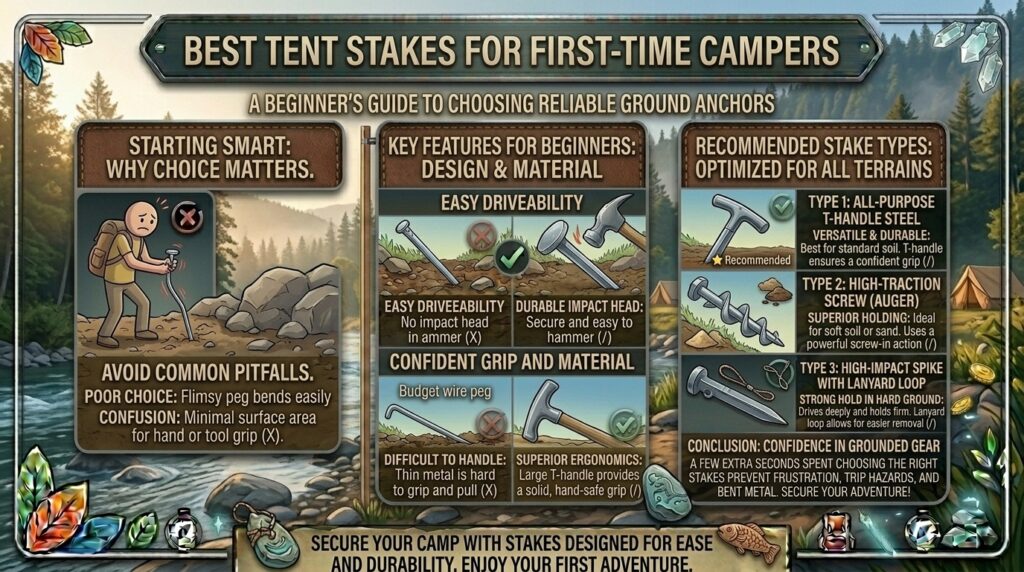
Most beginners don’t realize that the thin, silver wire stakes that come packaged inside their new tent box are notoriously weak. The moment you try to hammer them into standard campground dirt, they bend, twist, or slide right out of the ground, leaving your tent sagging and vulnerable to the wind.
If you want a stress-free pitch on your very first night, you need to upgrade to a set of stakes designed for ease of use, durability, and reliability.
So, what are the best tent stakes for first-time campers?
The short answer is: For casual car camping, the best stakes are thick, heavy-duty forged steel pegs or high-visibility ABS plastic stakes, as they are incredibly easy to hammer and won’t bend. For beginners trying backpacking or hiking, the absolute gold standard is a set of 7000-series aluminum Y-beam stakes (like the MSR Groundhog), which offer massive holding power at an ultra-light weight.
In this comprehensive guide, we will break down the top tent stakes for beginners, explain exactly what to look for when shopping, and teach you how to build a bulletproof gear kit on a budget.
1. Why You Should Ditch Your Factory Tent Stakes Immediately
Before we look at the top picks, let’s look at the enemy: the cheap wire skewer.
CHEAP WIRE SKEWER (Avoid)            PREMIUM Y-BEAM (Best for Beginners)

          O  (Thin, sharp hook)                 __O__  (Reflective pull cord)
          |                                      | |
          |  (Smooth, round                      | |   (Three structural fins
          |   3mm steel shaft)                  /   \   that bite into dirt)
          |                                    /_____\
    (Bends on the first rock)             (Resists bending completely)
Nearly every entry-level tent comes with a bundle of smooth, 3mm steel wire hooks. They fail beginners for two reasons:
- Zero Grip: Because they are completely smooth and thin, they have very little surface area. The moment a gust of wind hits your tent, they slide out of the dirt like a needle from a cushion.
- Instant Bending: If you strike a hidden pebble or a hard patch of clay with your hammer, these soft wire pegs bend instantly into a useless curve.
Upgrading to a proper set of stakes ensures that your tent stays locked to the earth, giving you total peace of mind while you sleep.
2. Top 4 Tent Stakes for Beginners (Categorized by Use)
1. The Best Overall for Car Camping: Forged Steel Rock Pegs
If you are driving up to a campsite in your car and don’t have to carry your gear on your back, weight isn’t an issue. You want raw, indestructible strength.
- Material: Forged Carbon Steel
- Shape: Solid cylindrical rod with a reinforced head and a heavy-duty side hook.
- Why it’s perfect for beginners: These stakes are essentially giant, heavy-duty nails. You can hit them with a standard household hammer or a heavy rock, and they will pierce straight through gravel, clay, and tree roots without bending.
- Top Brand Example: Snow Peak Solid Stakes or Eurmax Heavy Duty Galvanized Pegs.
2. The Best Overall for Backpacking & Hiking: Aluminum Y-Beam Stakes
If you are hiking into the wilderness and need to keep your backpack as light as possible, you cannot carry heavy steel. You need specialized aerospace metals.
- Material: 7000-Series Aircraft-Grade Aluminum
- Shape: A three-sided “Y” profile.
- Why it’s perfect for beginners: The three-sided fin design physically traps and compacts the dirt within its channels, providing immense holding power against high winds. Because it uses aircraft-grade aluminum, it can flex under intense pressure and snap back into a straight line rather than permanently bending.
- Top Brand Example: MSR Groundhog (or Mini Groundhog).
3. The Best for Festivals and Grassy Lawns: Heavy-Duty ABS Plastic Stakes
If you are heading to a summer music festival or pitching a canopy on soft park grass, expensive mountaineering stakes are overkill.
- Material: High-Impact ABS Plastic or Polycarbonate
- Shape: Wide T-flange or spiral screw design.
- Why it’s perfect for beginners: They are incredibly cheap, lightweight, and manufactured in bright neon orange or yellow, making them highly visible so drunk festival-goers won’t trip over your lines in the dark. Because they are thick, they provide massive holding power in soft grass and sand, and they won’t ruin a park lawnmower if you accidentally leave one behind.
- Top Brand Example: Coghlans ABS Tent Pegs.
4. The Best for Ultimate Hold: Threaded Screw-In Pegs
If you want a setup that requires absolutely zero guesswork or heavy hammering, screw-in pegs are a game-changer.
- Material: Heavy-Duty Coated Steel
- Shape: A long lag-screw with a plastic or metal guyline hook at the top.
- Why it’s perfect for beginners: Instead of swinging a mallet and risking your fingers, you use a cordless drill or a handheld T-handle tool to literally screw these anchors into the earth like a drywall screw. They offer the highest pull-out resistance on the market and are impossible to bend during installation.
- Top Brand Example: Orange Screw or Peggy Peg.
3. The Beginner’s Buyer’s Checklist: What to Look For
When shopping for your upgrade kit, look for these three high-utility features:
- High-Visibility Colors: Avoid dark silver or black stakes. Choose neon orange, bright yellow, or red. This prevents painful nighttime tripping hazards and makes them easy to locate when breaking camp.
- Reflective Pull Cords: Premium aluminum stakes come with a loop of utility cord woven with reflective threading tied to the head. This allows your headlamp to illuminate the stake perfectly at night, and gives you an easy handle to pull the stake out of the ground.
- A Clean Notch or Hook: Ensure the top of the stake has a deeply carved notch or a sturdy side hook. This is where your tent’s guy lines attach. If the hook is too shallow, the rope will slip off during a windy night.
4. 3 Golden Staking Rules Every Beginner Must Know
Buying the right stakes is only half the battle; you also have to install them correctly. Avoid the classic rookie mistakes by following these three rules:
- The 45-Degree Angle Rule: Never drive a tent stake straight down at a 90-degree vertical angle. Always drive it into the ground at a 45-degree angle pointing directly away from the tent. This forces the tension of the tent to pull against a solid wall of earth.
- Drive It Flush: Don’t leave several inches of the stake sticking out of the dirt. Hammer the peg down until it is completely flush with the soil level. This eliminates leverage that allows the wind to rock the stake loose, and keeps people from tripping over it.
- Listen to the “Tap”: Use light, rapid taps with a rubber mallet rather than heavy, destructive swings. If the stake suddenly stops moving and you hear a sharp metallic ping, stop hitting it. You have hit an underground boulder. Pull it out, move it three inches to the side, and try again.
5. Frequently Asked Questions (FAQ)
How many extra stakes should a beginner pack?
Always pack 4 extra stakes beyond what your tent requires. If you accidentally lose a peg in deep grass, bend one on a hidden rock, or need to double-stake a line during an unexpected windstorm, having spares will save your trip.
Can I use a regular household claw hammer for tent stakes?
You can use a steel household hammer on forged steel stakes, but never use a steel hammer on aluminum or plastic stakes. The harsh steel-on-aluminum impact will instantly shatter plastic heads or deform aluminum notches. Use a cheap rubber mallet or a block of wood.
Should I buy a dedicated stake bag?
Yes. Tent stakes are covered in dirt, mud, and sharp edges after a trip. Keeping them in a dedicated, heavy-duty canvas or ripstop nylon pouch protects the rest of your expensive tent fabric from getting punctured or stained inside your main gear duffel.
Summary: Your Perfect Beginner Setup
To wrap it up, don’t let a pile of cheap, bent factory wires ruin your very first camping trip.
- If you are car camping, buy a set of forged steel pegs.
- If you are backpacking, grab a set of aluminum Y-beams.
- Pair your new stakes with a cheap rubber mallet, drive them flush at 45 degrees, and you will sleep soundly knowing your shelter is completely secure.
Keywords: best tent stakes for beginners, top rated tent pegs, upgraded camping stakes, car camping essentials, lightweight backpacking pegs, how to choose tent stakes, msr groundhog review, rubber mallet camping.