
The Ultimate Guide to Hard-Ground Anchoring: Best Awning Pegs for Hardstanding
Pulling your RV, travel trailer, or camper van onto a pristine gravel or tarmac hardstanding pitch is a fantastic feeling. There is no mud to track into your vehicle, your levelers sit perfectly stable, and you don’t have to worry about sinking into wet grass.
But the moment you unroll your caravan or driveaway awning, you run smack into a major mechanical obstacle: how do you drive an awning peg into a ground surface that feels as solid as poured concrete?
If you try to use the flimsy plastic or thin steel hook pegs that came packaged with your outdoor gear, you will end up with a pile of bent metal, sheared plastic heads, and a loose awning that risks scratching your vehicle’s paint in a midnight storm. Hardstanding pitches demand a completely different class of anchoring hardware.
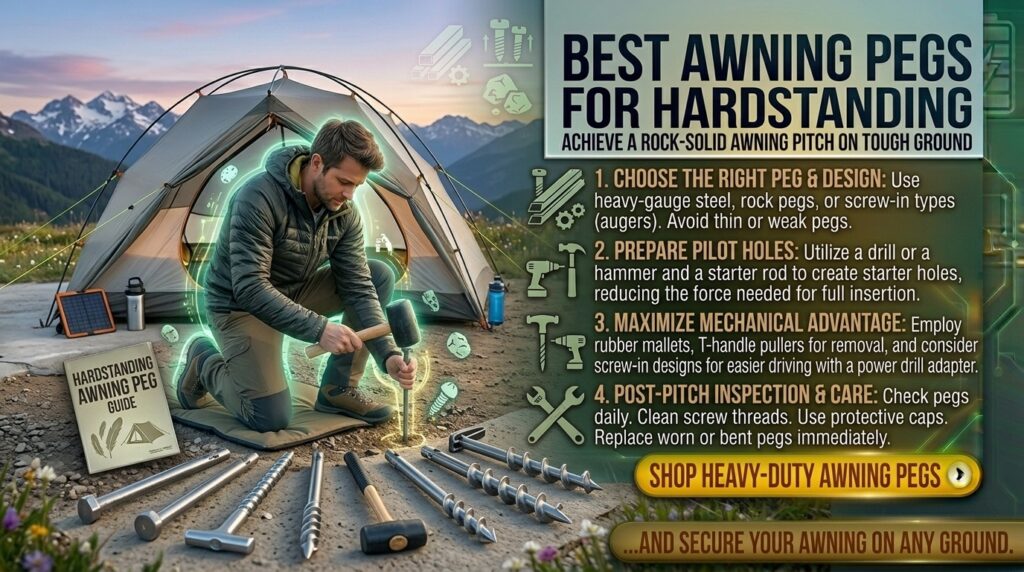
The absolute best awning pegs for hardstanding pitches are heavy-duty, forged steel rock pegs or metal screw-in drill stakes. Unlike standard camping stakes, these hard-ground specialists act like construction fasteners, easily cutting through compacted Type 1 stone, thick gravel layers, and rocky soils without bending or snapping. For maximum efficiency and minimal back strain, pairing steel screw-in pegs with a cordless drill and a 19mm socket adaptor is the ultimate setup for seasoned RVers.
To ensure your new site captures the top spot on search results, this long-form masterclass covers everything your readers need to know about choosing, driving, and extracting the ultimate hardstanding awning pegs.
1. What Exactly is Hardstanding (And Why Does It Destroy Standard Pegs)?
In the RV and camping world, a hardstanding pitch is a designated parking pad surfaced with non-soil materials. This typically consists of a top layer of loose gravel or crushed stone sitting over a highly compacted base of crushed aggregate, sub-base rock, or sometimes even old asphalt.
               [ THE HARDSTANDING CROSS-SECTION ]

  [ SURFACE LAYER ]   ──► Loose Gravel / Crushed Stone
  [ SUB-BASE LAYER ]  ──► Compacted Type 1 Aggregate (Ultra-Dense Rock)
  [ GROUND LAYER ]    ──► Bedrock / Hard-Packed Dry Clay
When you try to hammer a standard straight steel wire or V-shaped plastic peg into this profile:
- The wide profile of plastic pegs cannot push past the tightly interlocked sub-base stones, causing the plastic tip to shear off entirely.
- Standard thin steel pegs follow the path of least resistance, bending into a useless U-shape the moment they strike an underground rock.
- The lack of clean penetration means your rubber awning tension loops or structural guyline ropes can pull free during high-velocity wind gusts.
To conquer this terrain, your hardware must have a narrow cross-section, immense tensile strength, and a sharp, reinforced tip.
2. The Core Categories of Hard-Ground Awning Pegs
When shopping for hardstanding stakes, the market is broadly divided into two major functional designs: Driven Rock Pegs and Screw-In Drill Pegs.
1. Heavy-Duty Steel Rock Pegs (The Driven Method)
Rock pegs look like massive, industrial nails. They feature a thick, solid forged steel shaft, a sharp tapered point, and a heavy-duty top cap.
- The Design: Look for variations featuring a Metal T-Bar top welded directly to the shaft. These are significantly more durable than styles using cheap plastic hook-caps, which can shatter under repeated mallet impacts.
- Best Used With: A heavy 16oz to 2lb steel club hammer or camping mallet. Rubber mallets will simply bounce off rock pegs without driving them into the ground.
- Pros: Virtually indestructible; incredibly cheap to buy in bulk packs.
- Cons: Demands significant physical effort to hammer in and can be a back-breaking chore to pull back out of the ground.
2. Steel Screw-In Drill Pegs (The Modern Elite Choice)
Screw-in stakes have completely revolutionized the caravan and motorhome awning market. These pegs feature a prominent spiral thread wrapping around a hardened steel core.
- The Design: The top hex head is shaped exactly like a standard bolt head (typically 13mm or 19mm).
- Best Used With: A standard cordless impact driver or drill paired with a socket adapter.
- Pros: ZERO physical hammering required. The thread allows the peg to “squirm” past rock obstructions, achieving massive mechanical grip in loose gravel. Extraction is as simple as putting your drill in reverse.
- Cons: Higher initial cost; requires you to carry a charged power tool in your camper toolkit.
3. Best Awning Pegs for Hardstanding: Top Product Reviews
Best Overall Choice: Blue Diamond Pile Driver Pro Pegs
  [ BLUE DIAMOND PILE DRIVER SPEC PROFILE ]

  Length:      20cm to 23cm (approx. 8-9 Inches)
  Material:    Hardened Forged Steel Shaft
  Head Design: Reinforced Metal T-Bar / Threaded Base
The Blue Diamond Pile Driver Pro series is a staple on gravel caravan sites for good reason. It features an ultra-robust steel shaft with a minor thread profile at the tip. As you drive the peg down with a mallet, it naturally twists slightly, weaving around aggregate stone particles to lock tightly into the pitch sub-layer. They are exceptionally rigid, resist bending under high lateral wind loads, and last for years of active camping seasons.
Best Screw-In System: OLPRO Screw-In Hard Ground Rock Pegs
If you are tired of waking up with a sore back from hammering pegs, the OLPRO Screw-In Kit is a game-changer. This complete kit comes packed in a hard-shell storage case containing 20 high-grade threaded steel pegs featuring bright, high-visibility plastic top hooks to prevent trip hazards. Crucially, OLPRO bundles a custom drill socket adapter and a heavy-duty manual peg extractor in the kit, making it an all-in-one setup for hardstanding newcomers.
Best Heavy-Duty Anchor: Delta Ground Anchors (Steel Edition)
When dealing with massive residential awnings or seasonal pitches subjected to coastal gales, standard straight pegs might not cut it. The Delta Ground Anchor uses a radical, swept-back triangular profile. By driving the steel anchor at an angle, the wind tension actually pulls the anchor deeper into the stone sub-base rather than pulling it loose. They are expensive and bulky, but they offer unmatched holding power during severe storms.
High-Level Hardstanding Peg Comparison Matrix
| Peg Model / Style | Primary Material | Top Drive Tool | Hardstanding Score | Key Advantage |
| Blue Diamond Pile Driver | Forged Steel | Club Hammer / Mallet | 9.5 / 10 | Threaded tip maximizes gravel friction grip. |
| OLPRO Screw-In Kit | Steel + Poly Top | Cordless Drill | 9.8 / 10 | Zero physical exertion; fast setup/teardown. |
| Standard T-Bar Rock Peg | Carbon Steel | Heavy Steel Hammer | 8.5 / 10 | Very budget-friendly; highly dependable. |
| Delta Steel Anchors | Heavy Structural Steel | Heavy Sledge / Mallet | 9.0 / 10 | Unrivaled storm protection for heavy setups. |
4. Pro-Tips for Successful Hard-Ground Pegging
- Mind Your Speed with Drill Pegs: When driving a screw-in peg into loose gravel with a cordless drill, do not use maximum trigger speed. Spining the drill too fast will simply churn up the loose stone, carving out a wide, messy hole that ruins the peg’s grip. Use a low-speed, high-torque setting, applying steady downward pressure to let the threads bite seamlessly into the stone.
- The Cross-Pegging Hack: If a specific spot on your hardstanding pitch is particularly loose or gravelly, a single rock peg might slide around under wind tension. Drive two rock pegs into the same rubber awning loop at opposing 45-degree angles, forming an “X” shape beneath the stones. This locking cross-formation increases holding power dramatically.
- Don’t Forget the Extraction Tools: Getting a rock peg into compacted ground is only half the battle; getting it out at the end of the weekend can be painful. Always carry a dedicated lever-action peg puller or a crowbar. If a peg is completely jammed, give it a sharp tap on the side with your hammer to break the soil’s suction seal before trying to lift it out.
Key Factors to Consider When Buying Awning Pegs for Hardstanding
- Material Strength: Forged steel beats regular steel and aluminum on hard ground.
- Diameter & Length: Thicker (0.3+ inch) and longer stakes (10–12+ inches) perform better.
- Tip Design: Sharp, milled, or auger tips are essential.
- Corrosion Resistance: Galvanized or powder-coated for long-term outdoor use.
- Head Design: Large heads prevent hammer damage and make removal easier.
- Quantity: Most awnings need 4–8 strong anchors.
- Wind Rating: Choose stakes that match expected wind conditions in your area.
Pro Tips for Using Awning Pegs on Hardstanding
- Angle Your Stakes: Drive at a 45-degree angle away from the awning for maximum hold.
- Pre-Drill Pilot Holes: On very hard surfaces, use a masonry bit or hammer drill first.
- Use a Rubber Mallet or Sledge: Protect your stakes and hands.
- Combine Methods: Use screw anchors + sandbags on mixed surfaces.
- Check Local Campground Rules: Some parks restrict certain anchor types.
- Carry a Multi-Tool: Makes setup and takedown much easier.
- Store Properly: Clean and dry stakes after use to prevent rust.
Regional Recommendations for USA Campers
- Southwest Deserts (AZ, NV, NM, CA): Auger stakes + sandbags for sandy gravel over hardpan.
- Rocky Mountain States: Heavy forged steel nail pegs for rocky hardstanding.
- Florida & Gulf Coast: Highly corrosion-resistant galvanized or coated stakes due to humidity and salt.
- Pacific Northwest: Strong holding power needed for frequent rain and wind.
- Midwest & Northeast: Versatile auger + steel combinations for varied campground surfaces.
Alternatives When Pegs Aren’t Enough
- Heavy-duty sandbags or water weights
- Concrete blocks with ratchet straps
- Suction cup anchors (for smooth concrete)
- Permanent screw-in anchors for seasonal sites
Frequently Asked Questions (FAQ)
Can I use a regular carpenter’s hammer on camping sites?
Yes, a standard steel claw hammer or a 16oz club mallet is highly recommended for hardstanding pitches. Traditional wooden or soft rubber camping mallets will deform, split, or bounce off heavy steel rock pegs without delivering enough kinetic force to penetrate compacted gravel sub-bases.
How long should hardstanding awning pegs be?
The ideal length for a hardstanding peg is between 8 to 10 inches (20cm to 25cm). If a peg is too short (under 6 inches), it will only sit in the loose top layer of gravel and pull loose easily. If it is too long (over 12 inches), it will strike the bottom bedrock stratum, leaving several inches of dangerous metal sticking out above the surface.
Ultimate Pre-Travel Awning Checklist
Before heading out to your next hard-surface RV resort, make sure your gear bag contains:
- At least 20 to 30 heavy-duty steel rock or screw-in pegs.
- A dedicated steel-headed club hammer or a charged cordless drill.
- A spare 13mm / 19mm drive socket adapter (if using screw pegs).
- Robust mechanical peg puller to safeguard your back during teardown.
- A small tub of lubricant or WD-40 to keep the threads free of caked stone dust.
Related Guides:
- Best Tent Stakes for Backpacking
- Heavy Duty Tent Stakes for High Winds
- How to Anchor a Canopy on Concrete
Investing in a premium set of hardstanding awning pegs ensures you can pitch your shelter with total confidence, regardless of how stubborn the ground is. By ditching cheap plastic accessories, embracing the power of forged steel or threaded screw technology, and leveraging the correct installation tools, you can keep your camper setup rock-solid through any weather conditions the open road throws your way!
Keywords: best awning pegs for hardstanding, heavy duty caravan rock pegs blue diamond, screw in drill tent stakes olpro, hard ground camping gravel pitch pegs, t bar forged steel tent anchors, camping mallet club hammer hard ground, remove stubborn pegs extraction tool.